 Kat Boogaard
1 min read
Solo Summit Recap: Your No-Panic Guide to Marketing Your Solo Business
If you want a steady stream of clients, you need more than great work. It takes clarity, consistency, and a willingness to put yourself out there....

As a solopreneur, your time is your most valuable resource. Yet, when you’re constantly wearing tons of hats and juggling so many different responsibilities, your time is also one of the most difficult things to manage effectively.
 During her “Streamline to Scale: Operational Efficiency Planning” session at Lettuce’s recent Solo Summit, Emily Hollender, Founder, Fractional Marketing VP, and Advisor at Next Wave Marketing Partners, said she knows that struggle firsthand.
Emily noticed the following warning signs that indicated she needed to start being more intentional with systems and her time—and chances are you might recognize a few in your own solo business:
Nodding your head at all (or even just a few) of those red flags? You need better systems to help you make the biggest impact with your time, without wearing yourself thin. Let’s take a look at Emily’s four-step framework to make that happen.
Many solos previously worked in corporate environments, so a lot of this step involves unlearning and parting ways with those old habits and patterns. “We get to define what work looks like to us,” said Emily. To do that, she recommends asking yourself four key things:
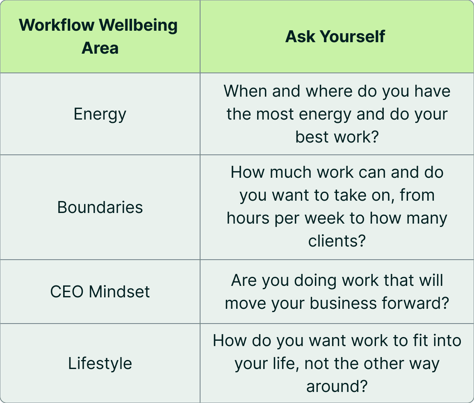
For example, Emily realized that she wanted to leave behind the corporate concept that productivity is represented by time spent behind a desk. “As a solopreneur, I want the flexibility to go surfing in the afternoon, take a walk, or take a break without feeling like I’m glued to my screen from nine to five,” she explained.
Of course, your values and priorities might be different. “Take a beat and reflect on your ideal workday,” Emily continued. “Start mapping it out and add it to your calendar to hold yourself accountable.”
You know where you want to go—but you also need to know where you’re starting. Emily shared that tracking your time is one of the best things you can do. “Tracking my time has truly been game-changing in giving me that awareness of where my time is going,” she explained.
Ultimately, it makes her more intentional with her hours by helping her:
It’s human nature to be overly optimistic about your time management skills. So, using a time tracker gives you hard data and valuable insights to be even smarter and more strategic with the hours you have.
Most solopreneurs tout their ability to multitask—but you might be surprised to learn you aren’t actually doing several things at once. “Our brains are just switching between those different contexts, making us more tired,” Emily said.
While it might feel like you’re getting more done, rapidly changing gears actually harms your productivity. “It’s truly one of the biggest challenges when it comes to time management and productivity,” explained Emily. But, unfortunately for solopreneurs, it’s also “truly part of our job. We’re naturally plugged into so many projects.”
The good news is that there are several strategies you can put into play to better manage and protect your time:
All of the above can be helpful. But, ultimately, Emily said the best thing you can do is experiment to find what works for you. “There’s truly no one perfect time management solution, system, or tool,” she shared. “So just start testing.”
Creating the system isn’t always the challenging part—it’s sticking with it. “Set that bigger picture. Set your vision and some of the goals that you want to achieve,” explained Emily.
“Every quarter or every month, check in,” she continued. “Whether you set OKRs or have another way to monitor progress toward your goals, check in with yourself.”
Emily said one of her favorite rituals is to schedule a regular “CEO day” for herself. It’s a day when she intentionally sets aside time “to do all the things that CEOs need to do.”
Whether you want to reflect on your strategy, do some big-picture planning, catch up on admin work, or just be creative, it helps you take time for the things that matter—even when they don’t fit into the normal hustle of your client work.
“I encourage you to carve out—whether it’s weekly, monthly, or quarterly—a CEO day where you can step out of the business and get a bit more of that perspective,” said Emily.
Solopreneurs often believe efficiency comes from doing more, faster. But as Emily makes clear, it actually comes from simplifying, standardizing, and staying grounded in what you really want your work to look like. With the right systems in place, you create a business that’s both sustainable and scalable.
Start with one change, stick with it long enough to feel the impact, and let that momentum carry you toward a more intentional way of working.
Learn more about how to amp up your efficiency by watching Emily’s full session or check out the complete video library to get more insights from the other experts at Solo Summit.