
 Ran Harpaz
1 min read

IN SHORT: An LLC is a legal entity; an S Corp is a tax election. Solopreneurs who combine both gain liability protection plus self-employment tax savings that can reach thousands of dollars yearly. Understanding how a sole proprietorship, an LLC, and an S Corp compare, and knowing when switching pays off, can meaningfully change what you keep.
If you're self-employed or running your own business, navigating business structures like LLCs and S Corps can feel overwhelming. You've probably wondered: which is the better option for me? Here's an insight: it's not always an either/or decision. An LLC is a legal entity, while an S Corp is a tax designation, and they can work together to provide significant benefits.
You can combine liability protection with potential tax savings by establishing an LLC and electing S Corp tax status. Plus, Lettuce can simplify the entire process. To make the best choice for your business, let's explore how LLCs and S Corps complement each other, unlocking liability protection and financial advantages.

Is Lettuce right for you?
See if Lettuce can help you keep more of what you earn with our short quiz.
Take QuizThe Basics: S Corp vs. LLC
Before we get into the nitty-gritty, let's break down what LLC vs. S Corp means, highlighting their differences and why combining them can be a smart move for solopreneurs.
What is a Limited Liability Company (LLC)?
An LLC is a legal business structure that provides financial and legal protections to its owners, known as members. It separates personal finances from business dealings, offering limited liability for the LLC's debts and actions. This means your personal assets are generally protected from business liabilities. By default, the IRS treats a single-member LLC as a "disregarded entity," so you report business income on Schedule C and pay self-employment tax just like a sole proprietor. Forming an LLC on its own doesn't change your federal taxes.
Key benefits of an LLC:
- Limited liability protections: An LLC separates your personal and business assets, shielding members from personal liability for business debts and obligations. This is especially beneficial for freelancers and independent contractors.
- Credibility: It lends credibility to your business, making it appear more legitimate to potential clients and investors.
- Flexibility: LLCs offer flexibility in management and ownership structures.
What is an S Corporation (S Corp)?
An S Corporation is an election to pass corporate income, losses, deductions, and credits to its shareholders for federal tax purposes. This election with the IRS allows S Corps to avoid the double taxation that C-corporations and solopreneurs experience, where the corporation itself is taxed, and shareholders are taxed again on dividends.
An S Corp election for your LLC gives you all of the benefits of the LLC, plus:
- Tax savings: The main benefit is saving on self-employment taxes. Only payroll taxes apply to a reasonable compensation, not the entire net income.
- Retirement contributions: You can contribute to retirement plans such as a solo 401(k), which often have higher contribution limits, and save almost 2x more to your solo 401(k) as an S Corp than an LLC.
- Business expenses: You can control business expenses and take special deductions for business use of home, miles, and more.
What Is a Sole Proprietorship?
A sole proprietorship is the default business structure for freelancers and independent contractors. If you start doing business without filing any formal entity paperwork, you're automatically a sole proprietor. No state filings, no formation fees, and no waiting period required.
Your business income flows directly to your personal tax return on Schedule C. You pay regular income tax plus the full 15.3% self-employment tax on most of your net profit, covering both the employee and employer portions of Social Security and Medicare. As your income grows, that tax burden grows quickly.
The other key risk: there is no legal separation between you and your business. If your business faces a lawsuit or cannot pay its debts, creditors can pursue your personal assets. Most solopreneurs start here. The decision to move to an LLC, and to add an S Corp election, comes down to whether the protection and tax savings justify the added structure.
Sole Proprietorship vs Disregarded LLC vs S Corp: A Side-by-Side Comparison
The three structures serve different stages of a solo business. Here is how they compare on the factors that matter most:
|
Factor
|
Sole Proprietorship
|
Disregarded LLC
|
LLC Taxed as an S Corp Election
|
|
Setup
|
None: start immediately, zero paperwork
|
File articles of organization with the state
|
LLC formation + IRS Form 2553
|
|
Liability Protection
|
None: personal assets at risk
|
Personal assets protected
|
Personal assets protected
|
|
Self-Employment Tax
|
Full 15.3% on all net profit
|
Full 15.3% on all net profit (by default)
|
Only on the salary portion; distributions are exempt
|
|
Tax Filing
|
Schedule C
|
Schedule C (by default)
|
Form 1120-S + Form 1040 Individual Tax return
|
|
Payroll Required
|
No
|
No
|
Yes (reasonable salary to owner required)
|
|
Best For
|
Under $40K income or testing a new idea
|
Liability protection and building credibility
|
$80,000+ in annual business income
|
The Power of Both: LLC + S Corp
Now, here's where it gets interesting. You can have an LLC and elect for S Corp taxation. By blending liability protection with tax advantages, this setup maximizes financial benefits and ensures operational flexibility. Here’s why it’s the ultimate choice for saving taxes while keeping your business secure:
Tax Efficiency
With an S Corp election, you can significantly reduce self-employment taxes by splitting your income between salary and distributions. Profits and losses pass directly to your personal tax return, simplifying tax obligations while avoiding double taxation.
Liability Protection
The LLC structure ensures your personal assets remain separate from your business liabilities. This protects you from financial risk in the event of lawsuits and business debts, providing peace of mind while you grow your business.
Enhanced Business Benefits
As an LLC with S Corp taxation, you can deduct a wide range of business expenses, including software, supplies, mileage, and home office costs. Additionally, you gain access to perks like health insurance and robust retirement plan options typically associated with larger corporations.
Financial Stability
Electing S Corp taxation allows you to pay yourself a steady salary, offering consistency for personal financial planning.
Why Choose Both?
The LLC + S Corp combination is more than just a setup; it’s a strategy. By pairing the liability protection of an LLC with the tax savings of an S Corp, you’ll optimize your finances and strengthen your business’s foundation.
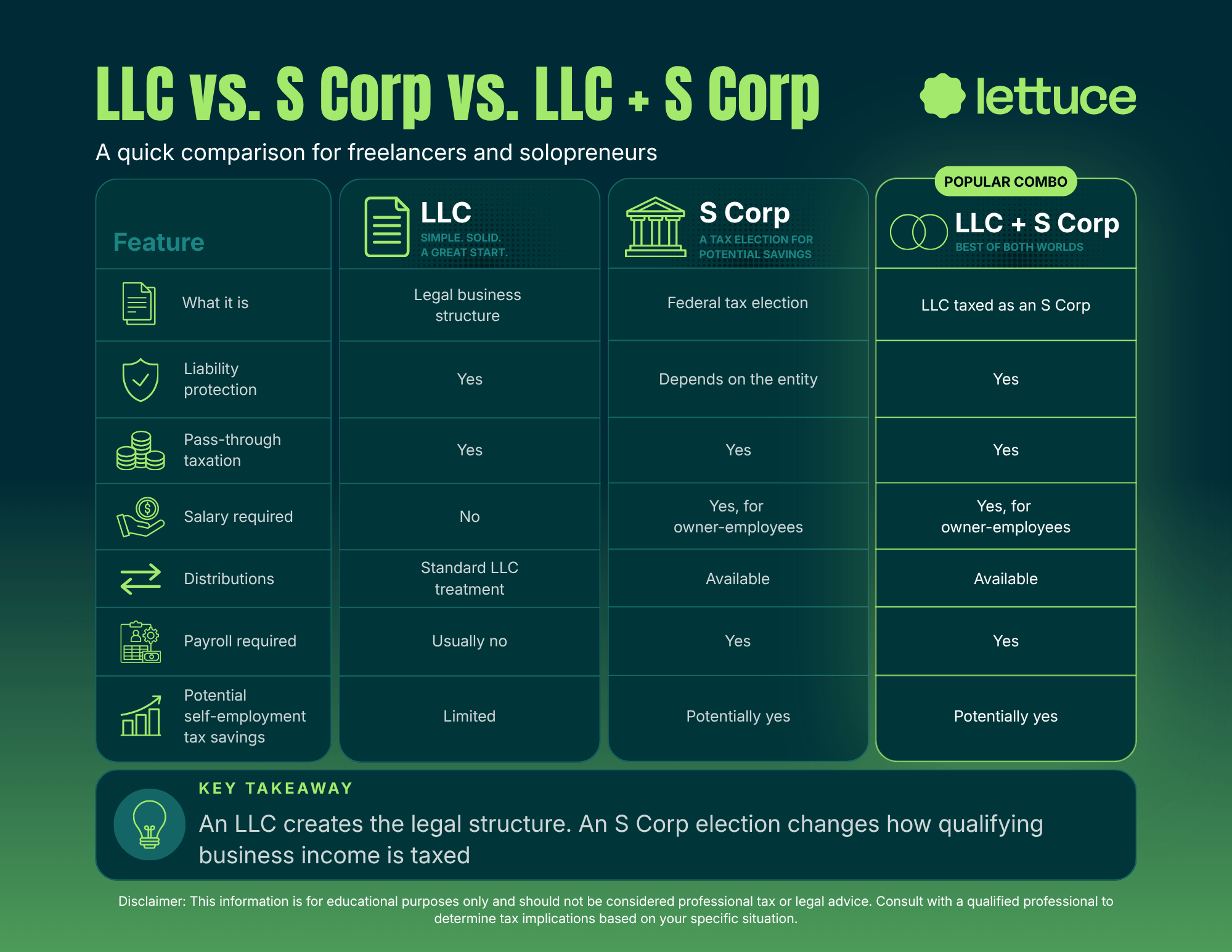
Quick comparison of an LLC vs. an S Corp vs. an LLC + S Corp
Managing This on Your Own Can Be a Headache: Let Lettuce Handle It
Setting up and maintaining an LLC with S Corp status is a smart financial move, but it comes with challenges. From filing paperwork to managing payroll, accounting, and staying compliant with IRS regulations, solopreneurs have a lot to juggle.
That’s where Lettuce steps in. With its all-in-one service, Lettuce takes the complexity off your plate. From S Corp formation to automated accounting, payroll, and tax reporting, Lettuce ensures your business stays compliant and maximizes tax savings.
Here’s how Lettuce streamlines your journey:
- LLC and S Corp setup: Handles formation paperwork and IRS filings like Form 2553 with ease.
- Seamless finances: Offers integrated business banking, bookkeeping, and accounting tools for expense tracking and reporting.
- Tax optimization: Automatically categorizes and maximizes deductions, minimizes tax burdens, and automatically pays your quarterly taxes with funds set aside.
- Automated payroll: Helps you pay yourself a salary effortlessly while staying compliant.
- Ongoing compliance: Keeps your business in good standing with regulatory requirements.
With Lettuce, you save time and money while focusing on growing your business, not on managing the details.
The Tale of Two Solopreneurs: Choosing the Right Structure
Let's look at two fictional solopreneurs, Alice and Bob, who earn $175,000 annually from their businesses, live in California, and file as singles. Alice has a disregarded LLC (taxed like a sole proprietor), while Bob has an LLC with an S Corp election. Bob pays himself a salary of $70,000 annually and takes the remaining $105,000 as a distribution.
We can see that Alice is paying $24,768 in self-employment tax, while Bob is paying $10,710 in payroll taxes.
Bob's potential tax savings are $14,058 per year, before income-tax effects, a smaller QBI deduction, California's S Corp tax, and payroll costs.
Results vary based on individual income, salary setup, state taxes, and other circumstances. These figures are for illustrative purposes only and do not constitute personalized tax advice.

Remember, every business is unique. At the same time, the LLC with S Corp election is a smart choice for many solopreneurs, especially those earning $80,000 or more in annual business.
If you’re curious whether an S Corp is right for you, use the Lettuce Tax Calculator, or add some details below, to see how much more you could save each year. It's fast, free, and comes with zero obligation.
By leveraging Lettuce's automated platform and tax-saving strategies, you can enjoy the benefits of LLC and S Corp structures without the administrative headache. Find out how much you could save today!

Get the Freshest News, Just for Solos
Sign-up for The Wedge for monthly updates that will help you better run your business-of-one.
When Should You Switch to an S Corp?
Once your annual business income consistently reaches $80,000, an S Corp election is worth serious consideration. Below that threshold, the compliance costs of running payroll and filing a business return can offset the tax savings. Here is a practical framework:
-
$80,000+ in annual business income: Strong candidate. Self-employment tax savings typically exceed the added compliance costs.
-
$40,000–$79,999 with stable income: Worth evaluating. An early election may pay off if this business is your main income, your earnings are steady, and you have a track record.
-
Below $40,000 or highly variable income: Stay a sole proprietor or disregarded LLC for now. The overhead usually outweighs the savings.
-
Higher-cost states like California: Factor in state-specific S Corp fees, which can raise your personal breakeven point.
The earlier you switch after consistently reaching the threshold, the more you accumulate in savings over time.
How to Make the Switch
If you already have an LLC, becoming an S Corp is simpler than most people expect. An S Corp is a tax designation, not a new legal entity. Your business name, operations, and clients stay the same.
-
File IRS Form 2553 to elect S Corp tax treatment. The IRS typically processes the form within 60 days.
-
Set up payroll to pay yourself a reasonable salary, as required by the IRS.
-
Maintain separate bank accounts to keep business and personal finances clearly distinct.
-
Update your bookkeeping to track salary and distributions as separate income categories.
On timing: to take effect this year, file Form 2553 within two months and 15 days of the start of your tax year (March 15 for calendar-year businesses). If you miss that deadline, the election generally starts the following year, though the IRS often grants late-election relief.
Lettuce automates the entire process, from filing Form 2553 to ongoing payroll and compliance, so you get the tax benefits without the administrative burden. Learn how it works.
5 Common Myths About LLCs and S Corps
A lot of misinformation circulates about these two structures. Here is what is actually true.
Myth 1: You have to choose between an LLC and an S Corp.
You do not. An LLC is a legal entity; an S Corp is a tax election. Most solopreneurs who use S Corp taxation do so inside an existing LLC. The two structures are designed to work together, not compete.
Myth 2: S Corps are only for large businesses.
Not true. S Corp status is particularly well-suited to solopreneurs earning $80,000 or more in annual business income. You do not need employees, a board of directors, or a complex corporate structure.
Myth 3: An S Corp means paying more taxes.
The opposite is typically true. By splitting income into salary and distributions, S Corp owners pay payroll taxes only on their salary, instead of self-employment tax on all their business profit. For solopreneurs earning $80,000 or more, the savings can amount to thousands of dollars each year.
Myth 4: Setting up an S Corp requires a lawyer.
It requires IRS Form 2553 and, in most states, an LLC formation filing. Platforms like Lettuce handle the entire process automatically, including formation, election, payroll, and compliance.
Myth 5: An S Corp election is permanent.
You can revoke your S Corp election if circumstances change, for example, if income drops below the threshold. The structure is flexible, and you are not locked in indefinitely, though after revoking you generally can't re-elect S Corp status for five years without IRS consent.
What About California?
California solopreneurs face an additional layer of cost to factor in. The state charges LLCs a minimum annual franchise tax of $800, plus an LLC fee that starts once gross receipts reach $250,000 and scales with revenue. S Corps in California also pay a 1.5% state franchise tax on net income, with the same $800 minimum.
For most California solopreneurs, the federal self-employment tax savings from an S Corp election still outweigh these state-level costs, especially once annual business income surpasses $80,000. The state fees do shift your breakeven point slightly higher compared to other states. The Lettuce Tax Calculator can help you run the California-specific numbers before deciding.

FREE CALCULATOR
What are you paying for?
Most existing S Corp owners are still paying for tools — and losing billable hours — to run the admin by hand. See your real number in 20 seconds.
Show savingsFrequently Asked Questions
What is the difference between an LLC and an S Corp?
An LLC (Limited Liability Company) is a legal business entity that separates your personal assets from your business liabilities. An S Corp is a tax designation, not a separate entity. You file Form 2553 with the IRS to have your LLC taxed as an S Corp, which can reduce the self-employment taxes you owe by splitting business income into salary and distributions.
What are the main advantages of an S Corp over a disregarded LLC?
The primary advantage is self-employment tax savings. With an S Corp election, you split your business income into a reasonable salary and owner distributions. You pay payroll taxes only on the salary portion, not on distributions. For solopreneurs earning $80,000 or more in annual business income, this structure can potentially save thousands of dollars each year compared to a disregarded LLC.
Can I have an LLC and an S Corp at the same time?
Yes, and this is the standard setup for solopreneurs who want both liability protection and tax efficiency. You form an LLC for legal protection, then file IRS Form 2553 to elect S Corp tax treatment. Your business name and operations stay the same; only the tax treatment changes. LLCs and S Corps work together, not against each other.
What does LLC mean, and how is it different from a regular company or corporation?
LLC stands for Limited Liability Company. Unlike a C corporation, an LLC can be taxed in many ways: as a disregarded LLC, as an S corp, Partnership or a C corp. Disregarded LLC, for example, avoids double taxation by default: profits pass through directly to your personal tax return rather than being taxed at both the entity level and the individual level. An LLC is also more flexible in structure and management than a traditional corporation, making it the preferred starting point for solopreneurs.
When should a sole proprietor switch to an S Corp?
The general threshold is $80,000 in annual business income. Below that, the self-employment tax savings from an S Corp election may not outweigh the added costs of running payroll and filing a business tax return. Above $80,000, the math typically favors the switch. The higher your annual business income, the greater the potential tax savings.
Is LLC versus S Corp really an either/or decision?
No. Most solopreneurs who elect S Corp status do so inside an existing LLC. The LLC provides the legal structure and liability protection; the S Corp election changes how you are taxed. Choosing between them is a false dilemma: the question is not LLC or S Corp, but whether your income level makes an S Corp election worth adding to your LLC.
Disclaimer
This content is for informational and educational purposes only and does not constitute personalized tax, legal, or financial advice. Tax savings, income thresholds, and outcomes vary based on individual circumstances, including income level, salary setup, state of residence, and business type. The examples and figures used in this article are illustrative only and are not a guarantee of results. Lettuce Financial Labs Inc. is a financial technology company, not a licensed tax advisor or law firm. Consult a qualified tax professional or attorney before making decisions about your business structure.