
 Ran Harpaz
1 min read
Retirement Planning Just Joined the Lettuce Platform
We’re thrilled to share some big news! Lettuce has acquired Carry, one of the most trusted retirement and investing platforms built specifically for...

IN SHORT: If you’re self-employed or running your own business, navigating business structures like LLCs and S Corps can feel overwhelming. You’ve probably wondered: which is the better option for me? Here’s an insight—it’s not always an either/or decision. An LLC is a legal entity, while an S Corp is a tax designation, and they can work together to provide significant benefits.
You can combine liability protection with potential tax savings by establishing an LLC and electing S Corp tax status. Plus, Lettuce can simplify the entire process. To make the best choice for your business, let’s explore how LLCs and S Corps complement each other, unlocking liability protection and financial advantages.
Before we get into the nitty-gritty, let's break down what LLC vs. S Corp means, highlighting their differences and why combining them can be a smart move for solopreneurs.
An LLC is a business structure that provides financial and legal protections to its owners, known as members. It separates personal finances from business dealings, offering limited liability for the LLC's debts and actions. This means your personal assets are generally protected from business liabilities.
Key benefits of an LLC:
An S Corporation is an election to pass corporate income, losses, deductions, and credits to its shareholders for federal tax purposes. This election with the IRS allows S Corps to avoid the double taxation that C-corporations and solopreneurs experience, where the corporation itself is taxed, and shareholders are taxed again on dividends.
An S Corp election for your LLC gives you all of the benefits of the LLC, plus:
Now, here's where it gets interesting. You can have an LLC and elect for S Corp taxation. By blending liability protection with tax advantages, this setup maximizes financial benefits and ensures operational flexibility. Here’s why it’s the ultimate choice for saving taxes while keeping your business secure:
With an S Corp election, you can significantly reduce self-employment taxes by splitting your income between salary and distributions. Profits and losses pass directly to your personal tax return, simplifying tax obligations while avoiding double taxation. You can also take advantage of higher retirement contribution limits with plans like a solo 401(k), helping you save more for the future.
The LLC structure ensures your personal assets remain separate from your business liabilities. This protects you from financial risk in the event of lawsuits, debts, or audits, providing peace of mind while you grow your business.
As an LLC with S Corp taxation, you can deduct a wide range of business expenses, including software, supplies, mileage, and home office costs. Additionally, you gain access to perks like health insurance and robust retirement plan options typically associated with larger corporations.
Electing S Corp taxation allows you to pay yourself a steady salary, offering consistency for personal financial planning. The structured tax and legal framework also reduces risks during audits or regulatory reviews.
The LLC + S Corp combination is more than just a setup; it’s a strategy. By pairing the liability protection of an LLC with the tax savings of an S Corp, you’ll optimize your finances and strengthen your business’s foundation.
Setting up and maintaining an LLC with S Corp status is a smart financial move, but it comes with challenges. From filing paperwork to managing payroll, accounting, and staying compliant with IRS regulations, solopreneurs have a lot to juggle.
That’s where Lettuce steps in. With its all-in-one service, Lettuce takes the complexity off your plate. From S Corp formation to automated accounting, payroll, and tax reporting, Lettuce ensures your business stays compliant and maximizes tax savings.
Here’s how Lettuce streamlines your journey:
With Lettuce, you save time and money while focusing on growing your business—not on managing the details.
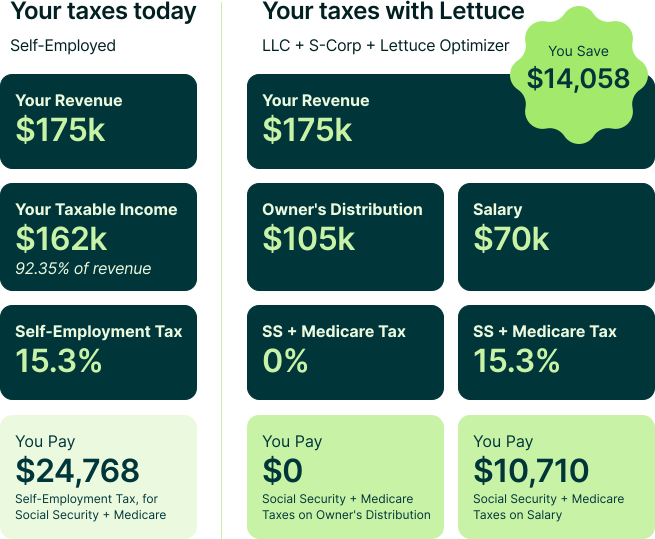
Let's look at two fictional solopreneurs, Alice and Bob, who earn $175,000 annually from their businesses, live in California and file as singles. Alice has an LLC, while Bob has an LLC with an S Corp election. Bob pays himself a salary of $70,000 annually and takes the remaining $105,000 as a distribution.
We can see that Alice is paying $24,768 in taxes, while Bob is paying $10,710.
Bob's potential tax savings are $14,058 per year.
Remember, every business is unique. At the same time, the LLC with S Corp election is a smart choice for many solopreneurs, especially those earning $70,000 or more annually.
If you’re curious whether an S Corp is right for you, use the Lettuce Tax Calculator, or add some details below, to see how much more you could save each year. It's fast, free, and comes with zero obligation.
By leveraging Lettuce's automated platform and tax-saving strategies, you can enjoy the benefits of LLC and S Corp structures without the administrative headache. Find out how much you could save today!