

 Alex Zelaya
1 min read

Health insurance premiums can become powerful deductions when handled correctly. By reimbursing premiums through payroll, reporting them on your W-2, and choosing the right coverage strategy—whether individual plans, group policies, or HRAs—you'll reduce taxable income while staying compliant.
Most solopreneurs think health insurance is just another business expense, but S Corp health insurance is your strategic advantage for serious tax savings. When set up correctly, S Corporation owners can have the business deduct health insurance premiums and then personally claim the self-employed health insurance deduction on their individual tax returns, reducing taxable income while accessing the same strategic advantages that established corporations use.
Here's what changes when you get this right: You're about to discover how to choose the right coverage, maximize every deduction, and turn your health insurance premiums into meaningful tax savings for your business-of-one. No more guessing about compliance rules or missing out on legitimate tax breaks because the process feels overwhelming.
Lettuce's automated systems can handle the complex reporting requirements and payroll steps that make S Corp health insurance work seamlessly. Get started today and prepare to make your health coverage work as hard as you do.

Is Lettuce right for you?
See if Lettuce can help you keep more of what you earn with our short quiz.
Take QuizHealth Insurance Basics for S Corp Owners
S Corp status changes how you deduct health insurance. Unlike sole proprietors or LLC owners who deduct premiums directly, S Corp owners must run premiums through payroll to qualify. Because the IRS sees you as both employee and owner, your corporation has to pay or reimburse premiums and report them as wages on your W-2.
Done right, this creates a seamless tax offset: the premium amount is added to your W-2 wages but remains entirely exempt from payroll taxes. You then claim the self-employed health insurance deduction on your personal return, wiping out the income tax on that amount.
Pro Tip: Automate premium reimbursements in your payroll system from day one. It locks in the W-2 reporting requirement and ensures you never miss a deduction. Master this step early, and what feels like extra work becomes a steady tax advantage year after year.
S Corps use to be intimidating for solopreneurs, but Lettuce has automated the entire experience. What used to be a maze of admin is now as simple as signing up.
S Corp Health Insurance in Action: What the Savings Look Like
Knowing the rules is one thing, but seeing the numbers makes the value clear. When your S Corp handles premiums correctly, routing them through payroll and reporting them on your W-2, you unlock a powerful, legal payroll tax exemption. Here's what that looks like in practice:
| Factor | Individual Plan | Family Plan |
|---|---|---|
| Annual Premium | $6,000 | $12,000 |
| S Corp Business Deduction | $6,000 | $12,000 |
| Added to W-2 Box 1 (Taxable Wages) | +$6,000 | +$12,000 |
| Personal Self-Employed Health Insurance Deduction | -$6,000 | -$12,000 |
| Subject to FICA (Social Security/Medicare) | No | No |
| Est. Tax Savings (15.3% FICA Exemption )* | ~$918/yr (~$76.50/mo) | ~$1,836/yr (~$153/mo) |
*Actual savings vary based on your tax bracket, state taxes, and individual situation. Consult a tax professional for personalized estimates.
The key is that the W-2 step isn't just a compliance requirement — it's what activates the personal deduction. Skip it, and you lose the tax advantage. These savings also scale with your premiums, so the more your coverage costs, the more the structure works in your favor.
Pro Tip: Always run the math with your actual premiums. Even a few thousand dollars in annual costs can translate into meaningful monthly savings when handled correctly.
Health Insurance Options for S Corp Owners
As an S Corp owner, you have three main ways to structure your health coverage: group health insurance plans, Health Reimbursement Arrangements (HRAs), and self-employed health insurance deductions. Each approach carries different tax advantages and requirements, so the best choice depends on your needs and how much complexity you want to manage.
| Factors | Group Health Insurance | HRA | Individual/ Self-Employed |
|---|---|---|---|
| Best For | S Corps with 2+ employees | Owners with non-owner employees | Solo S Corp owners |
| How Premiums Are Paid | S Corp pays directly | S Corp reimburses employee | Owner pays, S Corp reimburses |
| Runs Through Payroll | Yes | Yes | Yes |
| W-2 Reporting Required | Yes | Yes | Yes |
| FICA on Premiums | No (2%+ shareholders) | No | No |
| Flexibility | Low | Medium | High |
| Admin Complexity | High | High | Low |
| Works for Solopreneurs | Sometimes | Rarely | Yes |
| Tax Deductible | Yes | Yes | Yes |
Group Health Insurance Plans
Don’t let the word “group” mislead you: your S Corp can set up a plan even with only one employee (although some states require 2 participants). Group coverage can include medical, dental, and vision benefits, and when premiums are paid through payroll, they’re fully deductible. These plans may also offer better pricing than individual coverage, especially once you factor in tax savings.
Health Reimbursement Arrangements (HRAs)
HRAs allow businesses to reimburse medical expenses tax-free, but they’re less practical for solopreneurs. To qualify, you must be treated as an employee of your S Corp and be less than a 2% shareholder, and the IRS closely scrutinizes documentation. Some solos make it work if a spouse is an employee, but for most, HRAs introduce more complexity than benefit.
Self-Employed Health Insurance
For many business-of-one S Corps, individual coverage is the simplest and most effective option. You buy your own plan, have the S Corp reimburse you through payroll, and then claim the deduction on your personal tax return. This approach gives you complete flexibility in choosing coverage while still unlocking the full tax savings.
For 2026, if you include qualified long-term care insurance in your coverage, age-based deduction limits apply per person:
- Age 40 or under: $500
- Age 41–50: $930
- Age 51–60: $1,860
- Age 61–70: $4,960
- Age 71 or older: $6,200
If you're 65 or older, Medicare Part B (medical coverage) and Part D (prescription drug coverage) premiums also qualify for the self-employed health insurance deduction. Route reimbursements through payroll the same way you would any other premium.
Pro Tip: Always have your S Corp handle reimbursements in the same tax year you pay premiums. This small detail keeps you compliant and ensures you capture the full deduction.
How to Get Started with S Corp Health Insurance
Getting health insurance right as an S Corp owner isn’t complicated if you follow the right sequence. Here’s a step-by-step roadmap to set up your coverage and unlock the tax savings.
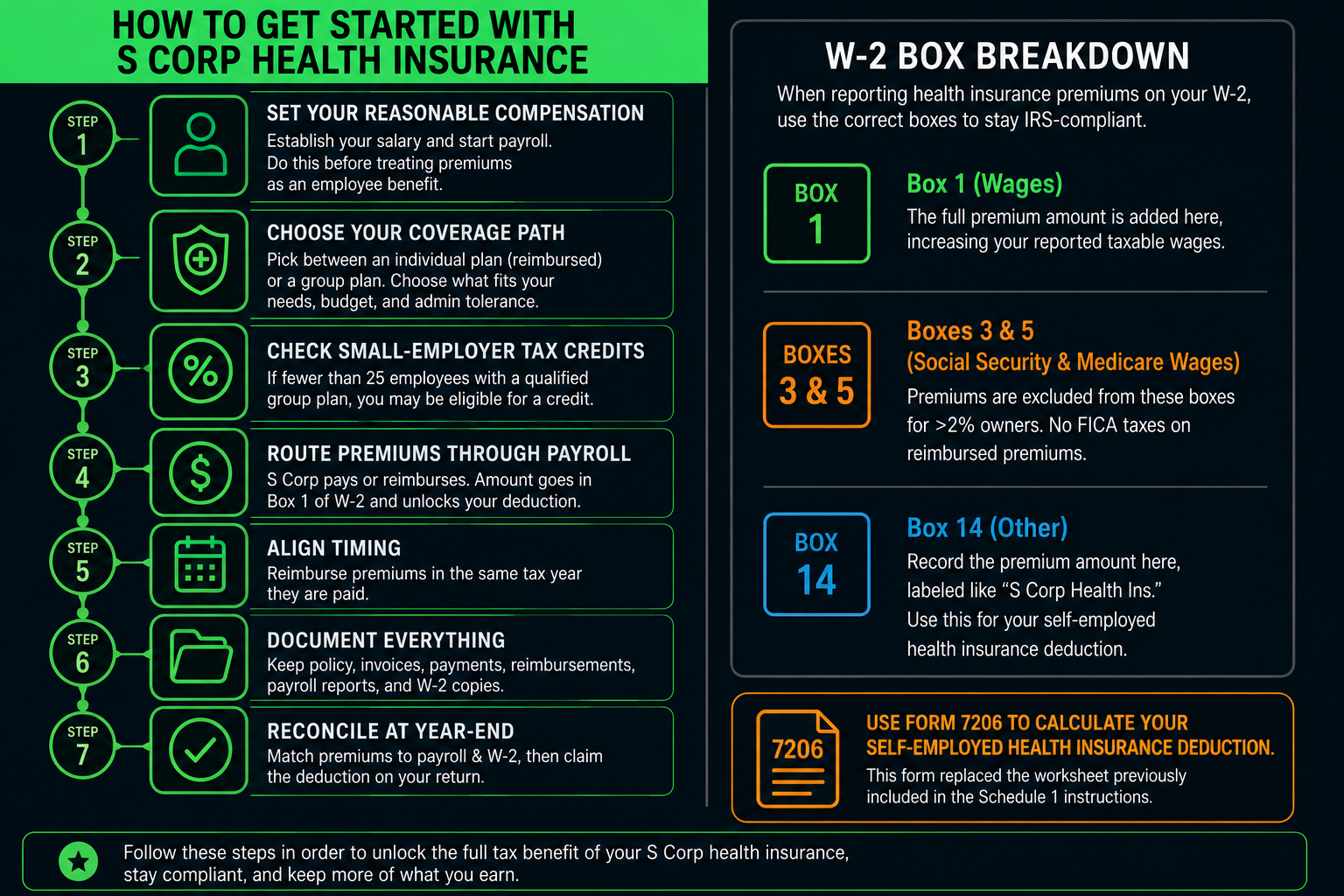
Step 1: Set your reasonable compensation.
Establish your shareholder-employee salary and start payroll. The IRS expects this to be in place before you treat premiums as an employee benefit.
Step 2: Choose your coverage path.
Decide between an individual plan reimbursed through payroll or a true group plan. Pick the option that fits your needs, budget, and admin tolerance. Lettuce Pro members can skip the complexity of finding a carrier entirely: Lettuce's PEO negotiates group-rate healthcare access for businesses-of-one through Curative's PPO network.
Step 3: Check small-employer tax credits.
If you have fewer than 25 employees and use a qualified small group plan, you may be eligible for a credit that can cover a significant portion of premiums.
Step 4: Route premiums through payroll.
Have the S Corp pay or reimburse premiums and include the amount in Box 1 of your W-2. For a more-than-2% owner, it is not subject to Social Security or Medicare wages. This is the trigger that unlocks your personal health insurance deduction.
W-2 Box Breakdown
When your S Corp reports health insurance premiums on your W-2, the amounts go in specific boxes, and getting this right is what keeps the IRS satisfied:
- Box 1 (Wages): The full premium amount is added here, increasing your reported taxable wages.
- Boxes 3 & 5 (Social Security and Medicare wages): Premiums are excluded from these boxes for shareholders owning more than 2%. You won't owe FICA taxes on the reimbursed premiums.
- Box 14 (Other): This is where you record the health insurance premium amount separately, labeled something like "S Corp Health Ins." This is what you'll reference when claiming the self-employed health insurance deduction on your personal return.
Step 5: Align timing.
Reimburse premiums in the same tax year they are paid so records match and deductions are clean.
Step 6: Document everything.
Keep the policy, invoices, proof of payment, reimbursement entries, payroll reports, and W-2 copies. Good records protect the deduction.
Step 7: Reconcile at year-end.
Confirm that the total premiums paid or reimbursed match the payroll and W-2 reporting, then claim the self-employed health insurance deduction on your return.
Use Form 7206 to calculate your self-employed health insurance deduction when filing. This form replaced the worksheet previously included in the Schedule 1 instructions.
With Lettuce, every step is handled automatically, from payroll setup to W-2 reporting, so you can capture the full tax benefit without the compliance headaches.
Frequently Asked Questions About S Corp Health Insurance
Smart solopreneurs ask the right questions about S Corp health insurance. Here are the answers that save you money.
How can S Corp owners deduct health insurance premiums on their taxes?
Have your S Corp pay or reimburse premiums through payroll and report them as wages on your W-2. Then claim the self-employed health insurance deduction on your personal return.
What are the best health insurance options for a single-member S Corp?
Individual health plans deliver the most flexibility and cost-effectiveness for solopreneurs. You buy the coverage yourself, have your S Corp reimburse you through payroll, and claim the deduction on your personal return. Group plans work too if you find a carrier that offers them to single-employee businesses, though they typically cost more and require additional management.
Can S Corp owners use a health reimbursement arrangement (HRA) for tax savings?
Most solopreneurs can't use HRAs because they require anyone who owns more than 2% of an S Corporation to be legally classified as a partner/self-employed individual for fringe benefit purposes. If you do qualify, an HRA lets your S Corp reimburse medical expenses tax-free, but the setup and compliance requirements are substantial. For most businesses-of-one, the self-employed health insurance deduction is simpler and more accessible.
What's the biggest mistake S Corp owners make with health insurance?
Paying premiums personally instead of running them through payroll is the most expensive mistake you can make. Shareholders who own more than 2% of their health insurance premiums must have their health insurance premiums reported correctly to avoid IRS scrutiny, even though it increases their reported wages. This is exactly how the system works—the payroll step unlocks the deduction.
Do I need special payroll software to handle health insurance deductions?
You need payroll that properly tracks health insurance reimbursements; this isn't optional. Lettuce's integrated system handles formation, payroll, tax filings, and compliance all in one platform, replacing the manual work and cost of multiple vendors.
Make Your S Corp Work for You—Not the IRS
Health insurance doesn’t have to be another line of stress on your to-do list. When you run premiums through your S Corp the right way, you unlock a powerful, legal payroll tax exemption. The income tax on your premium completely washes out, and those dollars bypass the 15.3% FICA tax rate entirely. That’s not a loophole, but it’s how the IRS designed the S Corps to work, and it’s one of the smartest ways solopreneurs can cut their tax bills.
The challenge isn’t knowing the rule. Instead, it’s following every step without slipping up on payroll, W-2 reporting, or recordkeeping. Missing one detail will cause you to lose the benefit. That’s why systems matter.
Lettuce’s Complete Financial System for Businesses-of-One handles the details automatically, from payroll setup to year-end reporting, so you don’t leave money on the table. Get started with Lettuce today and make your S Corp work the way it was meant to.
Lettuce offers health benefits to eligible Lettuce Pro members through its professional employer organization (PEO). Health/medical coverage is provided by Curative. This article is for informational purposes only and does not constitute medical, insurance, tax, or legal advice. Benefits, plan availability, coverage, premiums, eligibility, and potential savings vary by state and individual circumstances and are subject to change. Coverage is subject to the terms and conditions of the applicable benefit plan. Nothing in this article should be interpreted as a recommendation to purchase, enroll in, or decline any specific insurance plan. Consult a licensed insurance agent, tax professional, and/or healthcare provider before making decisions about your health coverage or benefits.
