
Skip to the main content.

8 min read

What Is a Sole Proprietorship? How to Launch, Run, and Optimize Your Solo Business

What Is a Sole Proprietorship? How to Launch, Run, and Optimize Your Solo Business

What is a sole proprietorship? It's the simplest business structure where you and your company are legally one. You're automatically a sole proprietor the moment you start earning, no paperwork required. While this setup gets you working fast, it also means paying self-employment taxes on every profit dollar. Smart solopreneurs track when S Corp savings make sense.


Here's something that might surprise you: you could already be running a sole proprietorship without even knowing it. The moment you earn your first dollar as a freelancer, consultant, or creative professional, you automatically become a sole proprietor in the eyes of the IRS.

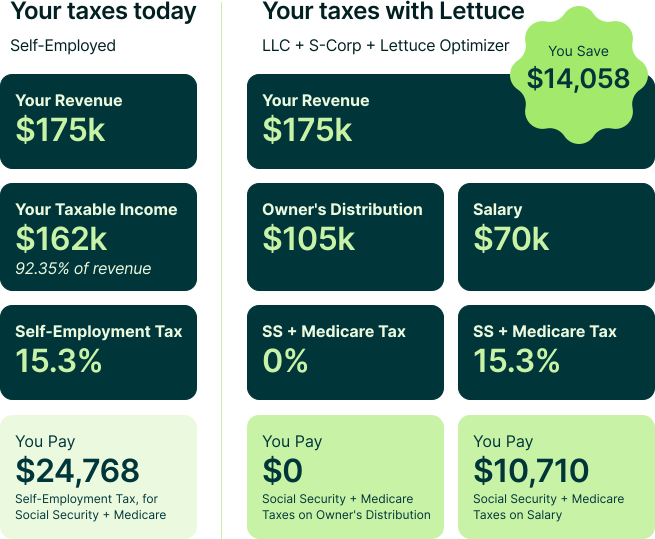
What is a sole proprietorship exactly? It's the simplest business structure where you and your business are legally the same entity, meaning no liability protection, and all profits are subject to self-employment tax. While this setup gets you earning fast, it also means you're paying self-employment taxes on every profit dollar. Savvy solopreneurs watch their profit numbers closely because once you consistently hit around $80K in annual business income, an S Corp election can save thousands in taxes annually.

That’s where automation changes the game. The right system doesn’t just simplify bookkeeping, it tracks your profit thresholds, flags when S Corp savings kick in, and handles the compliance work that keeps your taxes optimized year-round. Get started today with Lettuce to see how much more of your income you could be keeping.

lettuce-quiz

Is Lettuce right for you?

See if Lettuce can help you keep more of what you earn with our short quiz.
Take Quiz

Sole Proprietorship Basics: Simple Structure, Total Control

When you land your first freelance client and start invoicing, you’ve officially become a sole proprietor. This sole proprietorship definition is straightforward: you and your business are legally the same entity, which means maximum control but also maximum responsibility.

The Default Business Structure That Costs Nothing to Start

A sole proprietorship forms the moment you start working for yourself. No formal registration or state filings are required; you're automatically considered a sole proprietorship if you do business activities without registering as any other kind of business. Over 75% of solopreneurs start this way, and it's easy to see why: it's free, fast, and gets you earning immediately. Your business income and expenses get reported on your personal tax return on Schedule C.

You're in the Driver's Seat (But You're Also on the Hook)

As a sole proprietor, you make every decision: your rates, which clients to work with, what tools to use, and how to brand yourself. You keep all the profits and control your schedule completely. The trade-off? You're personally liable for all business debts and legal obligations. If a client sues or you can't pay business expenses, your personal assets: house, car, and savings, are at risk. There's no legal separation between you and your business.

Operating Under a Business Name Without the Complexity

You can operate under a professional business name by filing a DBA (doing business as) with your local government. While a DBA doesn't provide legal protection, it lets you use "Alex Creative Studios" instead of "Alex Johnson" on contracts and invoices. Pair this with an EIN from the IRS, which is free and keeps your Social Security number off client paperwork, while making it easier to open a business bank account.

Advantages of a Sole Proprietorship for Freelancers and Consultants

Why do most solopreneurs start as sole proprietors? Because it's the fastest path from idea to income. The advantages of a sole proprietorship for freelancers center on speed, simplicity, and flexibility.

You get to start immediately without the filing requirements that delay other business structures.

  • Start making money today — You're automatically considered a sole proprietor the moment you begin business activities, no state filing required.

  • Skip the formation fees — Most states charge nothing upfront when operating under your legal name, unlike LLCs, which can cost $50-$500+ to establish.

  • Minimal ongoing admin — No formal business meetings, separate tax returns, or payroll requirements while you focus on client work

  • Test brands with flexibility — Register a DBA name to experiment with different business identities without creating new entities.

  • Claim deductions immediately — Start writing off your home office, equipment, and business subscriptions from day one.

These advantages make sole proprietorships ideal for creative professionals testing new markets or consultants building their client base. But as your income grows past the $80K range, you'll want to understand the tax trade-offs that come with this simplicity.

Disadvantages of a Sole Proprietorship You Should Plan Around

Smart solopreneurs plan ahead for these common sole proprietorship challenges. Here's what to watch for as your business grows and your profits approach the $80K range, where these limitations become more costly:

  • Personal liability exposure: Business lawsuits can reach your personal home, car, and bank accounts.

  • Higher self-employment taxes: You pay the full 15.3% on all profits with no salary-distribution split.

  • Scaling limitations: Some clients prefer LLCs or corporations; adding employees creates payroll complexity (If you are a solopreneur using your SSN, you would need to obtain an EIN to run payroll).

  • Limited tax planning: No corporate tax strategies or employee benefit deductions available.

  • Harder capital access: Banks and investors typically prefer LLCs or corporations with separate financials.

These aren't dealbreakers for many solopreneurs, especially when starting out. But knowing them upfront lets you plan your business structure strategically and consider S Corp benefits as you grow.

How to Start a Sole Proprietorship Step by Step

You can technically begin earning today as a sole proprietor, since most states require no formation filing. The list below is the full, careful setup that protects your brand, separates your finances, and keeps you compliant.

Step 1: Choose and Register Your Business Name

  • Search your preferred name on your state’s business registry and a basic web search to avoid conflicts.

  • If you will not use your legal name, file a DBA with your city or county. Requirements vary by state.

  • Keep a copy of the DBA approval and any receipt numbers for bank and tax accounts.

  • Update your email signature, invoices, and proposals to match the legal or DBA name.

Step 2: Get Your Federal EIN

  • Apply for your Employer Identification Number online with the IRS. It is free and instant for most applicants.

  • Save the IRS confirmation notice (CP 575) as a PDF in your business records.

  • Use this EIN on W-9s, invoices, and bank forms to avoid sharing your SSN.

Step 3: Confirm Local Licensing and Home Occupation Rules

  • Check your city and county websites for a local business tax receipt or general business license.

  • If you work from home, confirm whether a home occupation permit is required.

  • If you sell taxable goods or services, note any seller’s permits or state sales tax accounts you may need.

  • Save license numbers and renewal dates in your calendar.

Step 4: Open a Dedicated Business Checking Account

  • Bring your ID, EIN letter, and DBA certificate if you filed one.

  • Open a business checking account and request a debit card.

  • Turn on transaction feeds or CSV exports for your bookkeeping tool.

  • Use this account for all income and expenses. No personal swipes.

Step 5: Set Up Simple Bookkeeping

  • Pick a single bookkeeping method and stick to it, software or spreadsheet.

  • Create a basic chart of accounts: income, cost of goods, software, equipment, advertising, travel, meals, professional fees, and home office.

  • Turn on automatic bank feeds and receipt capture.

  • Reconcile weekly. Categorize everything. Save receipts.

Step 6: Create Your Invoicing and Payments Workflow

  • Standardize invoice numbering, payment terms, and late fees.

  • Collect a signed engagement letter or services agreement before work begins.

  • Prepare a completed Form W9 for every US client if they ask you to provide one OR request a completed Form W9 from each vendor/contractor you hire so you could issue a 1099 for them at the end of the year..

  • Enable ACH or card payments so clients can pay quickly.

Step 7: Prepare for Sales Tax if Applicable

  • Verify if your service or product is taxable in your state.

  • If taxable, register for the proper account and file on the required cadence.

  • Track taxable versus non-taxable sales inside your invoicing tool.

Step 8: Cover Basic Business Risks

  • Price out general liability and professional liability (errors and omissions) insurance.

  • Save policies and certificates in a single folder with renewal reminders.

Step 9: Plan and Pay Quarterly Estimated Taxes

  • Estimate taxes using last year’s return or projected profit. A 25 to 30 percent set-aside is common.

  • Use Form 1040-ES and pay by April 15, June 15, September 15, and January 15.

  • Track payments in your bookkeeping so your CPA sees them at year-end.

Step 10: Build a Monthly and Year-End Routine

  • Month-end: reconcile accounts, tag receipts, review profit, and transfer your tax set-aside.

  • Quarter end: check whether profit is trending toward the S Corp range and adjust estimated taxes.

  • Year-end: send any required 1099s to contractors, close the books, and prepare your Schedule C.

Or Skip All These Steps

If you’d rather not handle the checklist yourself, Lettuce automates every part of the setup. From registering your name and EIN to syncing bookkeeping, estimating taxes, and tracking when S Corp savings kick in, everything runs in one place. Get started with Lettuce today to set up your business the smart way and keep more of what you earn.

Sole Proprietorship Taxes: What You Owe and How to Make It Painless

Understanding how taxes work as a sole proprietor keeps you compliant and confident at filing time. Here’s the simple breakdown.

1. What You’ll Pay

You’ll pay two main types of taxes on your business profit:

  • Income tax — Based on your total taxable income from all sources.

  • Self-employment tax (15.3%) — Covers Social Security (12.4%) and Medicare (2.9%) since you don’t have an employer paying half.

You’ll report business income and expenses on Schedule C with your personal Form 1040. Every dollar of profit is subject to income tax and the full 15.3% self-employment rate (for 2025, the Social Security tax portion (12.4%) only applies to the first $176,100 of your combined wages and net self-employment income).

2. How to Handle Quarterly Estimated Taxes

To avoid underpayment penalties, pay your estimated taxes four times per year:

  • April 15

  • June 15

  • September 15

  • January 15 (for the prior year)

Set aside 25–30% of your income for federal, state, and local taxes where applicable. Use Form 1040-ES to calculate and submit payments. Missing deadlines can trigger penalties even if you file your annual return on time.

3. Deductions That Lower What You Owe

Smart deductions directly reduce your taxable profit. Track and document every legitimate business expense, including:

  • Home office expenses

  • Equipment and software

  • Internet and phone bills

  • Health insurance premiums

  • Retirement plan contributions

Each deduction lowers your profit, and the amount is subject to both income and self-employment taxes. Staying organized throughout the year makes your tax planning far more effective.

Your Solo Playbook: Tools, Checklists, and Smart Moves

Running your business doesn’t have to feel overwhelming. The smartest solopreneurs focus on three connected systems: unified finances, automated workflows, and profit tracking. Master these, and you’ll spend less time managing admin and more time earning.

Connect Everything Through One Financial System

Stop jumping between your bank, invoicing app, and tax software. When your business bank account syncs directly with bookkeeping, every payment and purchase is categorized automatically. This turns daily expenses into instant deductions and gives you a real-time view of your cash flow.

Build Smart Workflows That Run Themselves

Automate the tasks that drain your time. Let your system match receipts, calculate quarterly estimates, and move 30% of each payment into a separate tax account. Following the IRS business startup checklist is a good foundation, but automation handles the ongoing execution, so you reclaim hours each month.

Track Your Profit Like a Strategic Owner

Monitor business income trends to see when you’re approaching the $80K range, where S Corp tax savings become meaningful. Review your monthly numbers, track income goals, and compare results against client volume to spot growth opportunities early. Keeping clear, organized financial records gives you the insight to make confident decisions about when to scale or optimize your structure.

FAQs About Sole Proprietorships, Taxes, and S Corps

Creative professionals and consultants often have similar questions about business structures and tax optimization. These answers cut through the complexity with practical guidance you can act on today.

What are the biggest tax advantages of running a sole proprietorship?

Sole proprietorships offer immediate business expense deductions against your income. You can deduct home office costs, equipment, software subscriptions, and health insurance premiums. The IRS allows substantial write-offs that reduce your taxable income, lowering both income and self-employment taxes.

When should I seriously consider switching from a sole proprietorship to an S Corp?

The sweet spot typically starts around $60,000 in annual business income, with clear benefits at $80,000+. At these levels, S Corp tax savings from salary-plus-distributions usually exceed the added administrative costs. Use a tax calculator to see your potential savings before making the switch.

How do quarterly estimated taxes work for sole proprietors?

You pay estimated taxes four times yearly using Form 1040-ES. Set aside roughly 30% of profit each quarter. Missing payments triggers penalty charges, so stay consistent with your quarterly schedule.

Can I convert my sole proprietorship to an S Corp mid-year?

Yes, you can elect S Corp status mid-year or even retroactively. An S Corp is a tax election, not a legal entity, so you need an underlying structure like an LLC first. Then file Form 2553 with the IRS, following strict timing rules for the election.

How does a reasonable salary work for S Corps in creative fields?

Your S Corp salary must reflect industry standards for your role, experience, and time invested. For designers and consultants, this often means 40-60% of total profit as salary. The remaining profit becomes distributions that avoid self-employment tax.

Take Control of Your Taxes and Time — Start With Lettuce

Running a sole proprietorship gives you full control, but it also means managing every detail yourself, from taxes and deductions to compliance and growth planning. The smartest solopreneurs know when to move beyond spreadsheets and manual tasks.

Lettuce automates everything your solo business needs: LLC formation, S Corp election, payroll, bookkeeping, and tax filing, in one connected system. You’ll save time, capture every deduction, and keep thousands more each year with guaranteed compliance. Get started today and let Lettuce handle the back office while you focus on what you do.

Related Resources

Separating Business and Personal Finances Made Easy (and Why It Matters More Than You Think)

Separating business and personal finances protects your assets, simplifies tax time, and unlocks serious savings through strategies like S Corp...

How Much Does It Cost to Start an LLC in 2025? (And How to Save More)

Starting an LLC involves far more than the initial state filing fees; ongoing compliance requirements, surprise penalties, and scattered third-party...

How to Start an S Corp: The Solopreneur's Step-by-Step Guide

Converting to an S Corp is more than just a structural change; it's a strategic move that can save solopreneurs thousands annually by reducing...