
Here is your validated schema.org/FAQPage JSON-LD markup: json

6 min read

Sole Proprietorship Taxes Explained: No More Guesswork

Sole Proprietorship Taxes Explained: No More Guesswork

Sole proprietorship taxes mean handling quarterly payments, self-employment tax, and deductions entirely on your own. Most solopreneurs learn through costly mistakes and penalties. Understanding the system transforms taxes from stressful guesswork into a predictable routine. Smart automation calculates what you owe, sets aside the right amounts, and handles quarterly payments on time, keeping you compliant year-round.


You became a sole proprietor the moment you earned your first dollar freelancing. No paperwork, no filing fees, no setup: just income that instantly counts as business income. But while getting started is simple, handling sole proprietorship taxes is where the real work begins. Quarterly payments, self-employment tax, and year-round expense tracking fall entirely on your shoulders.

Most solopreneurs learn this the hard way, missing payments and running into penalties. Once you understand how the system works, though, your taxes become predictable instead of stressful.

Lettuce turns that knowledge into a real advantage. Smart automation calculates what you owe, sets aside the right amount, and handles quarterly payments on time. Get started today to replace manual tax guesswork with a system that keeps you compliant year-round.

lettuce-quiz

Is Lettuce right for you?

See if Lettuce can help you keep more of what you earn with our short quiz.
Take Quiz

What Is a Sole Proprietorship?

A sole proprietorship is the default business structure you operate under the moment you earn freelance, consulting, or contractor income; no filings, fees, or state registration required. You’re automatically a sole proprietor unless you form an LLC or corporation. This simplicity means you and your business are legally the same entity, your income flows to your personal return on Schedule C, and you’re personally responsible for income tax, self-employment tax, and making your own estimated payments. It’s easy to start, but it also places full tax responsibility on you from day one.

How Are Sole Proprietorships Taxed?

Sole proprietors handle all tax obligations themselves; there’s no employer withholding. Here’s what that includes:

  • Self-employment tax: You owe 15.3% self-employment tax on your net profit, covering both the employer and employee portions of Social Security and Medicare.

  • Income taxes without withholding: Profit is also subject to federal and state income taxes, but nothing is withheld automatically. You’ll report income on Schedule C and pay through Form 1040.

  • Quarterly estimated taxes: If you expect to owe $1,000 or more, you must make four estimated payments each year. Missing deadlines leads to penalties and interest.

  • Manual tracking increases risk: Fluctuating income makes estimates hard, and mistakes lead to underpayment or cash flow issues.

How to File a Sole Proprietorship Tax Return

Filing as a sole proprietor is simpler than most people expect. Everything flows through your personal tax return, and you’ll follow these key steps:

  1. Complete your personal tax return (Form 1040).
    Start with Form 1040, which serves as your main filing document.

  2. Attach Schedule C to report your business income and expenses.
    Use Schedule C to list revenue, deductible expenses, and your resulting net profit or loss. This number flows directly into your Form 1040.

  3. Calculate your self-employment tax using Schedule SE.
    If your net earnings are $400 or more, file Schedule SE to calculate the 15.3% self-employment tax owed for Social Security and Medicare.

  4. Submit your payment or apply your estimated payments.
    Any quarterly estimated taxes you’ve already paid are credited here, reducing what you owe at filing time.

Optional: Level up your tax strategy with an S Corp election.
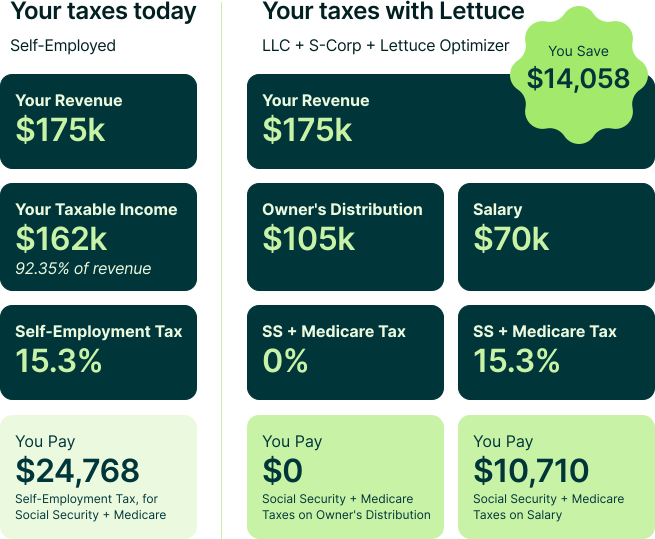
Solopreneurs earning around $80,000+ in annual business income often reduce self-employment taxes by switching from Schedule C to filing Form 1120-S and issuing themselves a K-1.

Lettuce makes this transition simple by automating LLC formation, S Corp election, payroll setup, quarterly tax payments, and year-end filings, so you can upgrade your tax strategy without taking on additional administrative work. Get started today to simplify your taxes now and unlock automatic optimization as your business grows.

Business Tax Deductions for Sole Proprietorships

Smart sole proprietor deductions turn everyday business expenses into tax savings. Every legitimate expense you track reduces your taxable income dollar-for-dollar.

  • Home office expenses using the simplified method: $5 per square foot up to 300 square feet

  • Vehicle costs through standard mileage at 70 cents per mile for 2025 business driving

  • Business supplies, from software subscriptions to office materials and advertising costs

  • Professional services, including legal fees, tax preparation, and business consulting

  • Health insurance premiums as an above-the-line deduction that reduces your adjusted gross income

  • Retirement contributions to SEP-IRAs or Solo 401(k)s that reduce current taxes

Accurate recordkeeping transforms these opportunities into real savings; every dollar tracked can mean $0.25 or more saved in taxes.

Understanding Quarterly Estimated Taxes

When you're self-employed, taxes aren’t withheld from your income; you’re responsible for saving and paying them yourself. That’s why the IRS requires estimated tax payments, which are quarterly payments based on how much tax you expect to owe for the year. These payments cover both income tax and self-employment tax and are due on:

  • April 15

  • June 15

  • September 15

  • January 15

If you expect to owe $1,000 or more for the year, you must make these estimated quarterly payments. To avoid penalties, the IRS generally expects solopreneurs to pay 90% of their current-year tax or 100% of last year’s tax.

The challenge is knowing how much to set aside when income fluctuates. Without a system, many solopreneurs guess, overpay, or end up short at tax time.

Tools that track income in real time and automatically set aside the right percentage make estimated taxes predictable instead of stressful. You always know what’s reserved and what’s due, without doing the math yourself.

As a sole proprietor, your only employment tax obligation is self-employment tax; traditional employer payroll taxes apply only if you hire actual employees or later elect S Corp status.

1099 Forms for Payments Made by Sole Proprietors

If you hire independent contractors, you’re responsible for issuing Form 1099-NEC for the work you paid them to do. The rule is simple: if you paid a contractor $600 or more for services during the year, you must file a 1099-NEC and send them a copy.

To file correctly, collect a Form W-9 from each contractor so you have their legal name, address, and tax ID. Both the IRS and your contractors must receive completed forms by January 31, and missing this deadline leads to penalties. Staying organized with contractor information and payments throughout the year makes the process straightforward.

Other Taxes Paid by Sole Proprietorships

You've got federal taxes covered, so here's what else to watch for. These other taxes sole proprietorship owners face vary by location and industry, but knowing what applies keeps you ahead of the game.

Beyond your federal obligations, you might encounter these additional requirements:

  • State income taxes range from 0% to 13%; nine states have no income tax at all

  • Local business licenses typically cost $50-$500 annually, depending on your city and business type

  • Sales tax collection applies when you sell taxable goods or services in most states

  • Professional licensing fees for consultants, regulatory permits for food services, or contractor renewals

  • Property taxes on business equipment, inventory, or commercial space you own

Your specific location and industry determine which apply to you. California sole proprietors file different forms than Texas ones, and a freelance designer faces different requirements than a food truck owner. Each state handles business taxes differently, so checking local requirements saves you from missed deadlines.

LLCs Taxed as a Sole Proprietorship: What Changes?

A single-member LLC doesn’t change how you file taxes. The IRS treats an LLC taxed as a sole proprietorship as a “disregarded entity,” meaning you’ll still file Schedule C, pay self-employment tax, and handle quarterly payments the same way you did as a sole proprietor.

What does change is legal protection. An LLC creates a separate business entity that shields your personal assets, your home, savings, and personal accounts from business-related liability. You keep the simplicity of sole proprietor taxes while gaining a layer of protection you didn’t have before.

An LLC also gives you the option to elect S Corp status later. If your business grows and the tax savings make sense, an S Corp election allows you to split income between salary and distributions.

Sole Proprietorship Taxes: Frequently Asked Questions

These FAQs break down the most common tax questions sole proprietors ask, so you know exactly how the rules apply to your business.

How do I calculate quarterly estimated taxes as a sole proprietor?

Use Form 1040-ES to calculate your payments. Pull your prior year's total tax from line 24 of Form 1040, divide by four, and pay that amount quarterly. If your income jumps significantly, you can still pay this same amount and pay the balance when you file your taxes, or you can recalculate using the current-year projected tax to avoid underpaying and triggering penalties.

What business expenses can I deduct as a sole proprietor?

You can deduct ordinary and necessary business expenses on Schedule C. Think office supplies, software subscriptions, professional development, travel, and home office costs. Keep detailed records; every receipt could save you 25-40 cents per dollar in taxes.

Do I need to file a 1099 for contractors as a sole proprietor?

Yes, you must issue Form 1099-NEC to any contractor you paid $600 or more during the tax year. The deadline is January 31st for both the contractor and the IRS. Missing this creates penalties and compliance issues.

How does a single-member LLC affect my sole proprietorship taxes?

It doesn't change your taxes at all. A single-member LLC is treated as a "disregarded entity"; you'll still file Schedule C and pay self-employment taxes exactly like a sole proprietorship. The LLC just adds liability protection for your personal assets.

What's the difference between gross income and net profit for tax purposes?

Gross income is everything you earn before expenses. Net profit is what's left after deducting business expenses: this is what you pay taxes on. If you earned $100,000 but had $25,000 in legitimate business expenses, you'd only pay taxes on $75,000 net profit.

Make Sole Proprietor Taxes Less Challenging

Sole proprietors handle everything themselves: self-employment tax, income tax, quarterly payments, deductions, and 1099s. Without employer withholding, it’s easy to fall behind, miscalculate what you owe, or miss deadlines that lead to penalties.

A clearer system makes the entire process manageable. When your quarterly taxes are calculated for you, your deductions are tracked automatically, and your filing requirements stay organized, you always know where you stand. No scrambling, no guesswork.

Lettuce brings this clarity together by setting aside the right amounts, paying quarterly taxes on time, and preparing your year-end filings. Get started today to run your business with a tax system that stays accurate and predictable year-round.

Related Resources

S Corp Tax Deadline: The Solopreneur's Guide to Staying Ahead and Saving More

Missing an S Corp tax deadline costs you more than just penalty fees; it means losing out on cash flow optimization, reinvestment opportunities, and...

S Corp Self-Employment Tax: How to Pay Less and Save More

If you're a solopreneur earning $60,000 or more, you could be leaving thousands on the table each year. An S Corp lets you split income into salary...

Managing Your S Corp Taxes with an Unpredictable Income

As a self-employed business owner with an S Corp, managing its taxes can feel like a juggling act, especially when your income is unpredictable....