
 Natalia Budyldina
1 min read

A Delaware business license is just one piece of getting your business official. Formation, state licensing, and an S Corp election are separate filings with their own agencies and deadlines. Your license also feeds into how Delaware tracks gross receipts tax. The real win? Keeping renewals, franchise tax, and filings on one calendar year-round.
Forming a Delaware LLC feels like crossing the finish line. You have your entity, your EIN, and maybe an S Corp election in motion. But the Delaware Division of Revenue requires a separate business license for most businesses operating in the state, and that step is easy to miss when formation feels like the hard part. A Delaware business license is its own requirement: a separate registration with its own process and annual renewal cycle, handled by a different agency than the one that formed your LLC.
The trap is timing. Formation happens once, produces a certificate, and feels conclusive, but the business license and the S Corp election are quieter, recurring obligations that run through different agencies and carry the actual tax consequences. For a solo consultant, the step most people celebrate is the least consequential, and the steps most people skip are the ones that shape every dollar you earn.
Lettuce keeps all three tracks current together, so Delaware setup day is the beginning of a clean operating system, not the end of your attention.

Curious if an S Corp is right for you?
Try the Lettuce Tax Calculator to see how much more you can take home each year.
See your savingsSeparate Delaware Business Licensing From Delaware LLC Formation
One of the most common mix-ups for solo owners is treating formation and licensing as the same event. They are not, and understanding what the difference is between a Delaware business license and Delaware LLC formation is what separates a clean setup from one that quietly develops gaps.
Formation Creates the Entity; the License Activates the Business
When you file with the Delaware Division of Corporations, you are creating a legal entity. That step gives your business a name, a structure, and legal standing. What it does not do is register you to conduct business and collect revenue in Delaware (the exception is if you are a holding company or a passive investment company). That is what a Delaware business license does, issued through the Division of Revenue and managed via the Delaware One Stop portal. Two agencies, two distinct jobs.
S Corp Status Adds a Third Track Entirely
If you plan to elect S Corp status, that election is a separate federal filing, Form 2553, and it operates independently of both your entity and your license. As Lettuce explains in its state-by-state S Corp guide, formation, licensing, and tax election are distinct workflows with different deadlines and different agencies. A clean setup tracks all three as separate jobs from day one.
Know Whether Your Solo Business Needs The License
The Delaware Division of Revenue requires a General Business License from any person or entity conducting business in the state, regardless of entity type, and regardless of whether you already filed LLC paperwork. For a self-employed service business, generating revenue in Delaware is enough to put you in scope. The Delaware One Stop portal is where that registration happens.
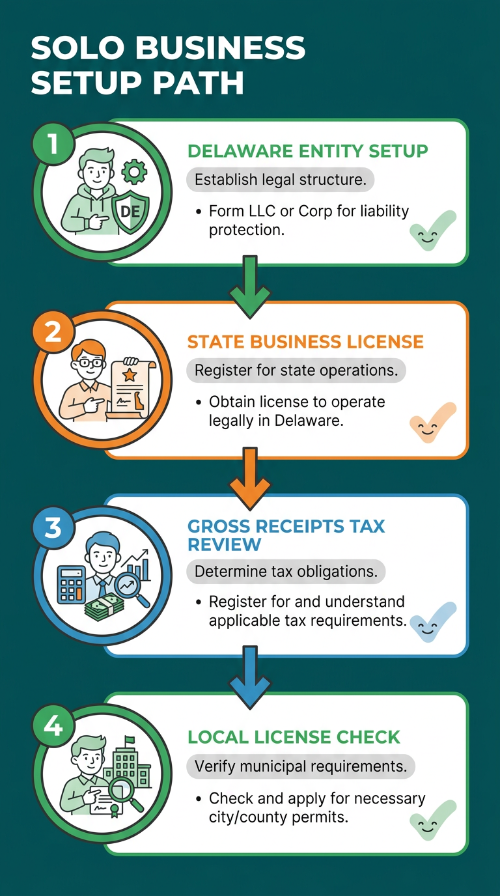
Here is how to think about the startup sequence as a business-of-one:
- Get your EIN before you apply. The business license application process will ask for a federal tax identification, so your EIN needs to come first in the sequence.
- File your S Corp election on its own timeline. Form 2553 has a separate IRS deadline and does not automatically follow from either your LLC or your business license.
- Note the renewal calendar. Delaware business licenses run on an annual term, with an option for a three-year renewal. Missing the window means your operating permission lapses, not just a compliance footnote.
- Check for recurring state fees, too. Delaware also requires an annual report and franchise tax on top of the license, so the post-formation calendar has more on it than most solo owners expect.
Connect The License To Gross Receipts Tax And Local Rules
Your Delaware business license does more than hang on a wall. It is the state's mechanism for tracking your business activity, and in Delaware, that tracking connects directly to tax obligations that catch many solo owners off guard.
Your License Is Tied to Gross Receipts Tax
Delaware does not have a state sales tax, but it does impose a gross receipts tax (GRT) on the total revenue businesses collect, with rates and exclusions that vary by business type. When you register for a business license through Delaware's One Stop portal, that registration links your account to GRT filing obligations at the same time. The Delaware Division of Revenue confirms that One Stop can simultaneously register your business with related state agencies, which means your license and your tax profile are connected from day one. For service-based solopreneurs, certain exclusions may apply depending on volume and activity, so it is worth reviewing your specific situation rather than assuming GRT does not apply to you.
Local Rules Add Another Layer
State registration is not the end of the checklist. If you operate in or around Wilmington, for example, the city imposes a 1.25% earnings tax that applies regardless of your entity type or business size. Other municipalities may have their own licensing requirements for service businesses. Check both state and local rules as part of the same setup process, not as an afterthought.
One Calendar Beats Five Separate Reminders
Most solo owners nail the formation, then let the GRT filings, license renewals, and S Corp payroll deadlines scatter across separate folders and separate mental buckets. That fragmentation is where hours disappear, and deadlines quietly lapse. One calendar that ties your Delaware annual report, GRT filings, local license renewals, and S Corp payroll obligations together is worth more than any one-time setup win.
Lettuce puts your state and federal filings on one calendar, filing federal forms for you and sending reminders before state deadlines hit.
Delaware Business License: Frequently Asked Questions (FAQs)
Delaware makes formation straightforward, but the questions that come up after the paperwork is filed tend to reveal gaps in the setup. The answers below cover the licensing and compliance details that solo owners most often miss once the LLC is officially on the books.
Do I need a Delaware business license if I already formed an LLC?
Yes. Forming an LLC through the Division of Corporations is a separate step from obtaining a business license. According to the Delaware Division of Revenue, any business operating in Delaware must obtain a General Business License regardless of entity type. Formation creates your legal shell; the license registers you to actually do business in the state.
What is the difference between a Delaware business license and Delaware LLC formation?
LLC formation is handled by the Division of Corporations and establishes your legal entity. The business license comes from the Division of Revenue and is tied to your tax registration and operating authority. Think of them as two different agencies with two different jobs. The Delaware One Stop portal is the practical starting point for the licensing side.
How does the Delaware business license connect to gross receipts tax?
Registering for a Delaware business license simultaneously links your account to gross receipts tax filing obligations. Delaware has no state sales tax, so the GRT, applied to total revenue at rates that vary by business type, is how the state monitors your activity. How your business is classified at registration determines which GRT rules apply, and certain exclusions may be available depending on your volume and business type.
Do solo consultants need local city or county licenses in Delaware?
Possibly. The state business license covers your registration at the state level, but cities and counties may require separate permits on top of that. The Delaware Division of Revenue confirms that local licensing rules can apply independently of the state license, so checking with your specific municipality is a smart step even if your consulting work is entirely service-based.
Does my S Corp election change my Delaware licensing requirements?
The S Corp election is a federal tax designation filed with the IRS and does not replace or modify your Delaware business license obligation. What it does change is your ongoing compliance stack: once you elect S Corp status, you are also managing payroll, a reasonable salary, and annual business tax filings on top of your state license renewal. Those are separate tracks that need to stay current together.
Build A Cleaner Back Office Before Your Paperwork Sprawls
Formation day wraps up in about an hour. What follows are the business license, the annual report, the GRT filings, the S Corp payroll, and the IRS-required Form 1120-S, which runs every year. The solo owners who get the most from a Delaware S Corp are the ones who treat compliance as the ongoing system it is, not the afterthought it looks like at the start.
Lettuce handles S Corp setup, automated tax payments, bookkeeping, invoicing, and annual business tax prep in one place, so the back office that starts on formation day keeps working long after the certificate arrives. Backed by the Lettuce-Back Guarantee, it's built for exactly one person: you.