 Natalia Budyldina
1 min read

Yes, you can maintain an S Corp with no income, but timing matters. While there's no minimum revenue requirement, S Corps make the most sense once you're earning $80,000+ annually, where tax savings outweigh compliance costs. Lettuce automates your entire S Corp journey, handling formation, payroll, and filings so you capture savings without extra work.
Can you legally form and maintain an S Corp with zero income? Absolutely! The IRS doesn't require any minimum income threshold to elect S Corporation status. The real opportunity lies in timing it right. While you're perfectly allowed to maintain an S Corp with no revenue, you'll still face annual filing requirements and compliance obligations that can cost more than any tax benefits you might gain.
The smarter approach? Treat S Corp election as a strategic milestone that signals your business has reached sustainable profitability, not as a premature move for a venture still finding its footing. This strategic timing becomes clear when you look at the numbers. S Corps work best for solopreneurs who've crossed the magic threshold where tax savings outweigh administrative complexity. That sweet spot typically starts around $80,000 in annual business net income, where splitting your income into salary and distributions can save thousands in self-employment taxes.
Lettuce automates the entire S Corp journey, from formation to ongoing compliance, turning complex tax strategy into a hands-off system. Ready to see your exact savings potential? Check out Lettuce's S Corp Calculator to discover if you've hit the threshold where S Corp status becomes your next smart business move.
Curious if an S Corp is right for you?
Try the Lettuce Tax Calculator to see how much more you can take home each year.
See your savings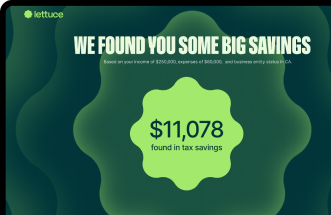
Stop Guessing: The $80K Profit Rule for S Corps
The $80,000 threshold isn't arbitrary. It represents the point where S Corp tax savings typically outweigh the added compliance costs of payroll processing, filings, and professional fees.
Here's the math: below $80K in annual business income, you're often paying $2,000-$4,000 annually in extra costs (payroll services, additional tax prep, quarterly filings) that eat into your self-employment tax savings. But once you cross that threshold, the tax benefits become substantial. You can save $8,000 or more annually by meeting S Corp requirements and making the switch.
This rule applies specifically to solopreneurs earning consistent, primary income from their business, not weekend side hustles or businesses with unpredictable revenue streams. S Corps require you to pay yourself a reasonable salary through formal payroll, even when cash flow is tight.
If your business income fluctuates wildly or represents secondary income, the operational complexity rarely justifies the tax savings. The S Corp structure works best for established businesses-of-one where you can confidently project crossing the $80K business income mark year after year.
Your S Corp Decision Checklist: Is It Time to Level Up?
Wondering when is the best time to switch to an S Corp for tax savings? Skip the guesswork. This four-point checklist cuts through the complexity and gives you a clear answer based on your actual business situation.
-
Are you a business-of-one? S Corp benefits shine brightest for solopreneurs, freelancers, and consultants who are the sole income generators in their business.
-
Is self-employment your main income source? If your business provides your primary livelihood (not just side income), you're positioned to maximize S Corp tax advantages.
-
Are you earning $80K+ in annual profit? This is the magic threshold where S Corp tax savings typically outweigh the added administrative costs and compliance requirements.
-
Are you ready for automated payroll and compliance? S Corps require paying yourself a reasonable salary and handling quarterly filings, but automation makes this effortless
Checked all four boxes? Perfect, you're ready to treat your business like the profitable business it is and potentially save thousands in taxes annually. The IRS allows S Corp elections throughout the year, and mid-year switches can still capture significant savings for the remainder of your tax year. Don't wait until January; your tax optimization journey can start as soon as you hit that $80K milestone.
What If My S Corp Has No Income This Year?
Having a slow year or temporary business pause doesn't mean you need to abandon your S Corp status. Many solopreneurs worry about keeping their S Corp during lean periods, but the answer is straightforward: you can absolutely maintain your S Corp election even with zero income.
Here's what you need to know about managing your S Corp during a no-income year:
-
Keep your S Corp status intact — There's no income requirement to maintain your election, and you won't lose your tax advantages by having a quiet year.
-
File your annual Form 1120-S — The IRS requires S corporations to file their tax return regardless of income level, so your zero-income year still needs proper documentation.
-
Stay current with state requirements — Most states require annual filings even when your allocated income is $0, though automated systems track these varying deadlines for you
-
No salary required when you have no income — Skip payroll entirely during zero-income periods, but if earnings resume mid-year, payroll obligations restart immediately
-
Maintain proper records — Keep documentation of business expenses, as these may create deductible losses that pass through to your personal return
Never miss a deadline with automation. Smart compliance systems like Lettuce handle all S Corp requirements automatically. Get started today and stay compliant whether you're earning $0 or $100K without the stress of manual tracking.
S Corp Reality Check: Payroll, Salary, and Audit Protection
Here's the deal with S Corp status: if your business generates income and you're actively working in it, you must pay yourself a reasonable salary through official payroll. The IRS takes this requirement seriously.
What happens if I elect S Corp status but don't pay myself a salary? The IRS can reclassify your distributions as wages, hit you with back payroll taxes, penalties, and interest. Corporate officers who perform services are employees, period, and that includes you as the owner.
But what if your business hits a rough patch? If your S Corp truly has no income for a year, you're not required to pay yourself a salary. Zero income means zero salary obligation. But you still need to maintain your S Corp status by completing required tax filings and keeping proper records. Think of it like renewing your driver's license; the paperwork continues even when you're not driving much. Your S Corp distributions and compliance requirements don't disappear just because revenue does.
S Corp Election Without Income: Frequently Asked Questions
These FAQs address the most frequently asked questions from solopreneurs. Each answer gives you clear, jargon-free guidance to help you make confident decisions about your business structure.
When is the best time to switch to an S Corp for tax savings?
The magic happens when your business consistently generates at least $80,000 in annual business income. At this threshold, splitting your income into salary and distributions creates meaningful self-employment tax savings that outweigh the extra paperwork.
Does my LLC need to make $80,000 before electing S Corp status?
Your LLC doesn't need to hit any income threshold to elect S Corp tax treatment; that $80,000 figure is simply the sweet spot where the tax benefits make the extra compliance tasks worthwhile. Remember, you're not changing your business structure; you're just electing different tax treatment for your existing LLC.
Can I keep my S Corp if my business has no income this year?
Absolutely, you can maintain your S Corp election even during a zero-income year. The IRS requires you to file Form 1120-S annually regardless of income level, but there's no requirement to dissolve your election just because revenue dropped.
What happens if I elect S Corp status but don't pay myself a salary?
You must pay yourself a reasonable salary if your S Corp generates income and you perform services for the business. Skip payroll, and the IRS can reclassify distributions as wages, which means catch-up payments and fees you'd rather avoid.
How does Lettuce automate S Corp compliance and payroll?
The platform handles your entire S Corp lifecycle from formation through ongoing compliance. You get automated payroll processing, tax withholdings, quarterly filings, and salary calculations based on industry benchmarks, plus audit defense and compliance guarantees if questions arise. Everything runs in the background while you focus on growing your business, with real-time visibility into your tax savings and cash flow.
Make the System Work for You: Automate Your S Corp with Lettuce
Yes, you can elect S Corp status with no income, but the real power lies in doing it when the timing makes sense. Lettuce helps solopreneurs make that switch confidently, ensuring your structure is ready once your business crosses the point where savings truly begin.
When you reach consistent profitability, Lettuce automates everything: formation, payroll, filings, and compliance, so you can capture tax savings without adding extra work. Every rule, every deadline, is handled automatically while you focus on running your business.
Get started today with Lettuce and see exactly when your S Corp election pays off, with guaranteed compliance and effortless automation built in.