
1 min read
The Science-Backed Referral System Behind Consistent Growth
Stacey Brown Randall on Designing Referrals Without Awkward Asks, Incentives, or Constant Networking Welcome back to The Wedge, the newsletter for...

Welcome back to The Wedge, the newsletter for strategic solo business owners.
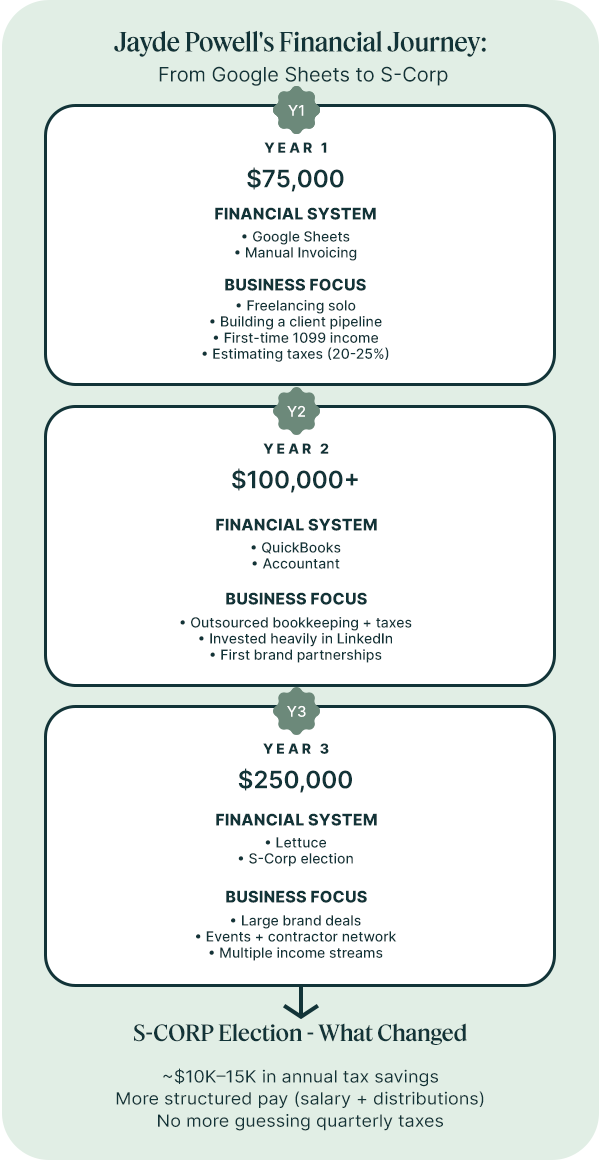
 When Jayde Powell decided to start working for herself three years ago, she started small as a freelance social media strategist. She tracked payments on a Google Sheet, and made $75,000 in her first year doing it.
She realized early on that scaling her work into a business meant outsourcing the parts she wasn't good at. In year two, she Googled "accountant for creators," hired a firm, and moved her books to QuickBooks.
Her revenue grew fast, and by year three she'd crossed $250,000 running a full-fledged creator business. She'd become a thriving "Creatorpreneur," as she calls herself. She had taken on:
Brand partnerships with companies like Canva, Adobe, and LinkedIn
Speaking engagements and conference appearances
Community events and Creatorpreneur Talk
A rotating roster of contractors supporting it all
Money was coming in from multiple directions and going out in just as many, and the more her business scaled, the harder it became to keep up with the infrastructure she'd built for a much smaller one.
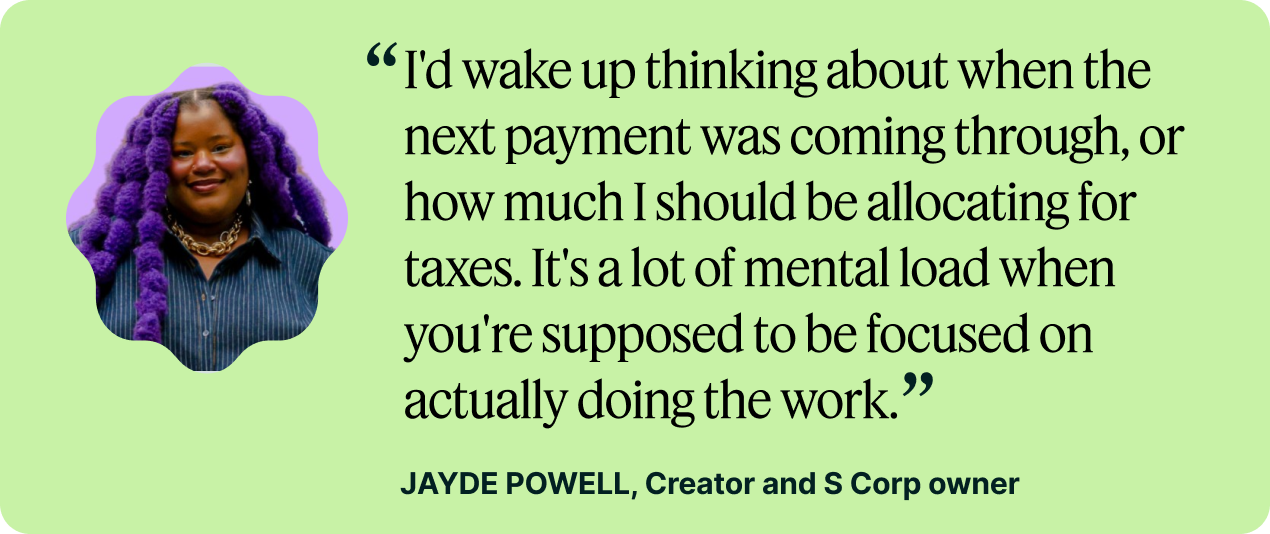
"I'd wake up every morning thinking about when the next payment was coming through, or how much I should be allocating for taxes," she says. "It's a lot of mental load when you're supposed to be focused on actually doing the work."
This issue is about that evolution: making money, keeping it, and running the financial side of a business are entirely different skills, and realizing that and implementing financial systems and strategies evolves as the business grows.
We’ll explore how financial progression unfolds through Jayde’s journey as a Creatorpreneur and look at when structuring your business finances starts saving you real money.
Is Your Business Ready For a Financial System Yet? Download Jayde’s 4-Step Checklist.
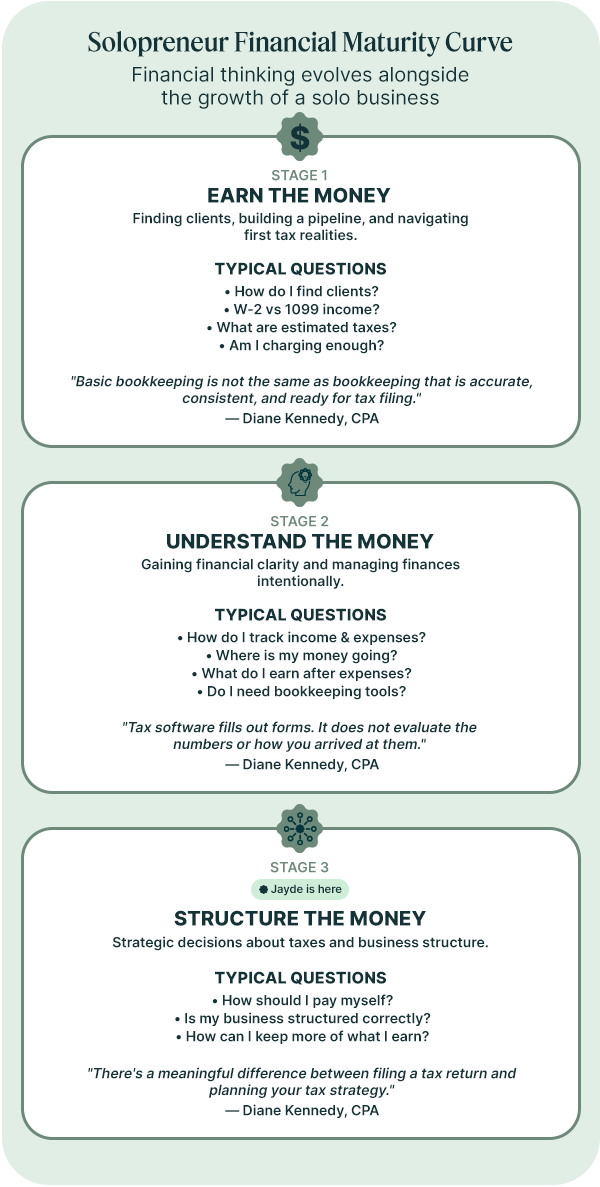
Many solo businesses move through three distinct stages of financial thinking, and the stage you're in determines what your business actually needs right now.
Stage 1: Earn the Money. Finding clients, building a pipeline, and surviving the first shock of self-employment taxes. The questions here are foundational: What's the difference between a W-2 and a 1099? What are estimated taxes, and why does the IRS want them quarterly?
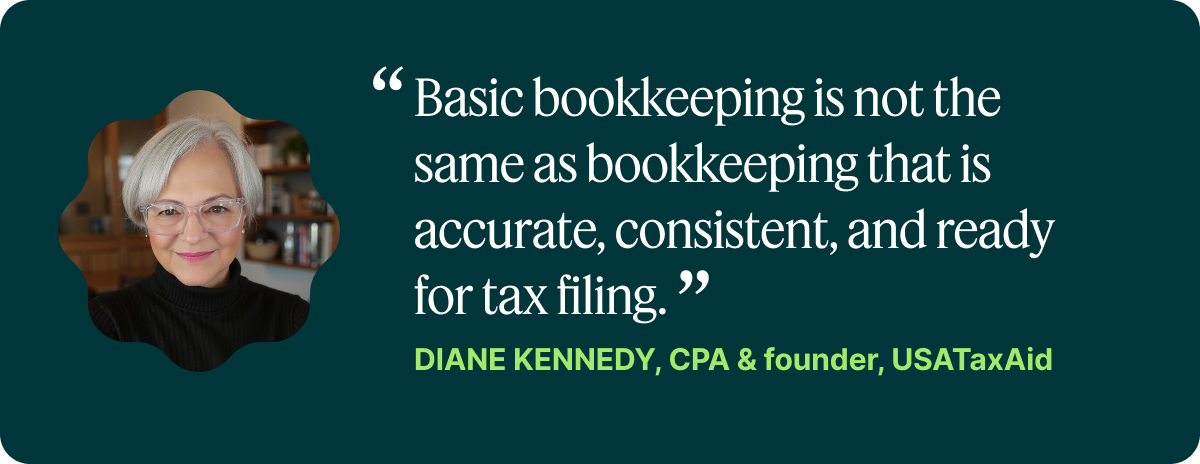
Stage 2: Understand the Money. Tracking income and expenses, moving off spreadsheets, and starting to understand what the business earns after costs. As Diane Kennedy, CPA and financial expert at Lettuce, puts it: "Basic bookkeeping is not the same as bookkeeping that is accurate, consistent, and ready for tax filing."
Stage 3: Structure the Money. How your business is set up has a direct impact on how much of what you earn you can save. The decisions here can mean tens of thousands of dollars saved every year. As Kennedy puts it: "There's a meaningful difference between filing a tax return and planning your tax strategy."
After two years of explosive growth across multiple income streams, Jayde Powell found herself in Stage 3. The setup that had carried her so far, QuickBooks, an accounting firm, and an LLC structure, was no longer the right one to take her further.
Before Lettuce, tax season meant guesswork. Every quarter, Jayde would set aside 20 to 25 percent of whatever she'd earned, wire it to the IRS, and hope the math was roughly right. She never actually knew if she was overpaying or underpaying until her accountant filed at the end of the year.
On top of that, as a sole proprietor and LLC, every dollar of profit was subject to self-employment tax, roughly 15.3%. That's a number that adds up fast at $250K.
For Jayde, the S-Corp election changed that math. When you elect S-Corp status, your business income splits into two parts: a salary you pay yourself and distributions. Self-employment tax applies only to the salary portion, not the distributions, and that difference can lead to significant savings. For solopreneurs discovering it for the first time, it tends to be one of the more meaningful tax savings available. For those already running a successful solo business, the structure is familiar territory.
For Jayde, that means tens of thousands of dollars back every year.
Here’s what Lettuce financial system and S-Corp election does for her:
Saves $10K–15K a year in self-employment taxes, with savings scaling as revenue grows
40/60 salary to distributions split, structured by Lettuce from day one
Monthly bookkeeping handled, freeing up roughly eight hours a week
Taxes are handled automatically: no guesswork or scrambling at filing time
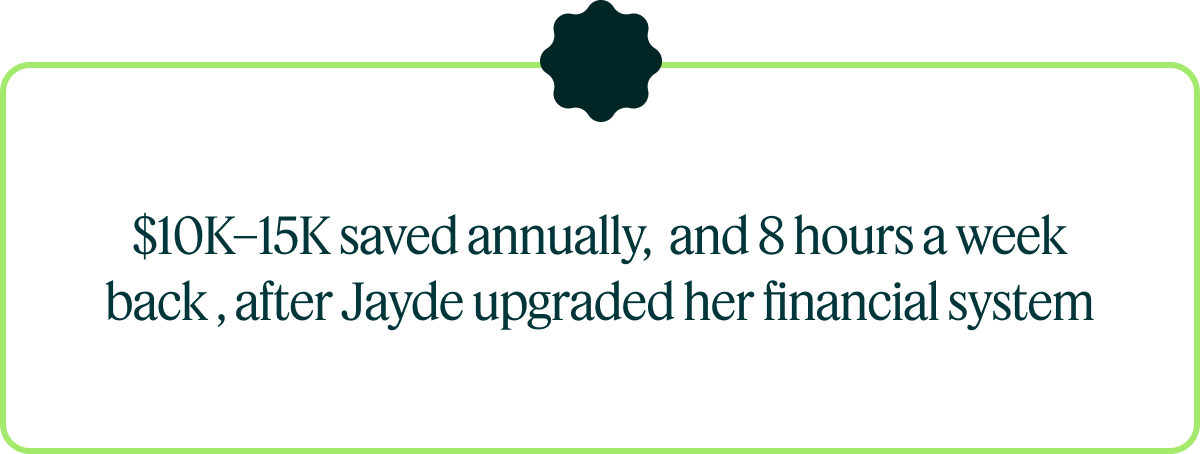
"That extra $10K a year is very beneficial," she says. "Last December my HVAC broke and I had to replace it: $8,500 out of pocket right before the holidays. When you're an independent contractor and have to come out of pocket at any moment, it's substantial."
"I couldn't have made $250,000 last year if I was spending eight hours a week on invoices and mental math," she adds. "That time went somewhere else. That somewhere else is why the number looks the way it does."
As Kennedy puts it: "Setting up financial systems isn't about giving up control. It's about upgrading infrastructure so you can efficiently scale."
Reaching this stage of growth in your business doesn't require becoming a tax expert overnight. But it does mean recognizing that your business has grown to a point where better systems, tools, and guidance can handle the financial side, freeing you up to focus on growth. Getting the financial infrastructure right, from bookkeeping to how your business is set up for taxes, compounds over time. For Jayde, an S-Corp is the lever that moves the needle most in terms of savings. If you're wondering whether you're approaching this point yourself, three questions worth sitting with:
If most of those land, you're likely at the point where the right structure starts saving you real money. Bringing in more money is what most solopreneurs optimize for. Keeping more of it, with the right systems running in the background, is the move that will compound your business.
Is Your Business Ready For a Financial System Yet? Download Jayde’s 4-Step Checklist.
