 Natalia Budyldina
1 min read

Freelancing on the side or full-time means taking charge of your taxes, and small mistakes can lead to big problems if they raise red flags with the IRS. For self-employed professionals exploring independence, knowing what triggers audits protects your income and peace of mind. By recognizing what stands out, you can build a tax-compliant business from the start. Let’s learn about common audit red flags.

Curious if an S Corp is right for you?
Try the Lettuce Tax Calculator to see how much more you can take home each year.
See your savingsIncome Reporting Inconsistencies
Income mismatches are among the most common audit triggers for self-employed taxpayers. The IRS uses advanced matching systems to compare the income reported on your return with what third parties, like clients or platforms, report on 1099s. When the numbers don’t align, the IRS takes notice.
1099s Don’t Match Reported Income
Clients must issue a 1099 for payments of $600 or more, and the IRS uses those forms to verify your income. If your return doesn’t match, it could trigger an audit.
Always review 1099 reporting requirements and cross-check forms against your records to avoid discrepancies.
Underreporting Freelance Revenue
Not all income arrives with a 1099. Direct payments, digital transfers, and platform revenue may not generate a tax form, but they’re still taxable. Underreporting this kind of income puts you at risk.
To report freelance income accurately:
- Track all earnings, whether or not you receive a 1099.
- Maintain digital records of payments, transfers, and receipts.
- Use consistent accounting methods throughout the year.
More guidance is available in the IRS’s self-employed tax center, including tips on organizing income records.
No Proof Of Cash Or Non-Documented Income
Cash income and informal gigs still count—and the IRS expects proof. Without dated logs or invoices, you’re more exposed during an audit. Even minor gaps in untracked income can cause issues.
Review which income records to keep and use a simple system to document all payments, no matter the amount.
Suspicious Or Excessive Deductions
Writing off legitimate business expenses is part of being self-employed. However, deductions that seem inflated, inconsistent, or poorly documented often draw extra attention from the IRS. Knowing what to claim—and how to justify it—helps reduce your audit risk while preserving valuable savings.
Business Use Vs. Personal Use: Car, Phone, Office
You must document shared-use assets carefully. Vehicles, phones, and home offices used for business and personal needs require accurate, proportional reporting.
According to IRS guidance on business expenses, you can deduct a portion of:
- Cell phone plans used for business
- Home office space based on actual use
- Vehicle expenses using mileage or actual cost methods
You must support each deduction with consistent records.
Meal And Travel Write-Offs With No Documentation
Meal and travel deductions must be well-documented. The IRS expects:
- Who you met with and why
- When and where the expense occurred
- Proof it was business-related
Missing details can trigger questions, especially if expenses don’t align with reported income. Review what’s required for meals, travel, and car expenses to stay compliant.
Too Many “Other” Deductions
The “Other Expenses” section on Schedule C isn’t meant for catch-all entries. Vague labels like “misc admin” or “misc travel” without details can raise flags. Use clear, specific categories whenever possible to show transparency in your reporting. Review examples of allowable deductions to avoid missteps.
Poor Recordkeeping Practices
Even accurate returns fall apart without solid documentation. Record gaps make it harder to support deductions and easier for the IRS to flag inconsistencies. For solopreneurs, building simple, reliable systems helps avoid costly mistakes.
No Receipts Or Logs
If you can’t prove it, you can’t deduct it. The IRS expects clear, organized documentation—dated receipts, mileage logs, or digital proof. Paper piles won’t cut it. Use digital tools like cloud folders or email tags to keep everything accessible and audit-ready.
Using The Wrong Categories
Misclassifying expenses doesn’t just distort your books—it can skew your Schedule C and raise audit risk.
Watch for:
- Expenses that don’t match standard IRS categories
- Duplicates across different line items
- Inconsistent use of custom labels or catch-all categories
Inconsistent Income/Expense Patterns
Spikes or dips in income and expenses can stand out, especially in high-earning fields. While seasonal shifts are normal, patterns that defy logic or industry norms may trigger a closer look. Review reports quarterly so you can catch and fix issues early.
Unusual Financial Patterns
The IRS looks for patterns that don’t align with industry norms, income level, or business type. Even accurate numbers can raise red flags if they deviate from typical filing behavior. Understanding these patterns helps you file smarter and avoid unnecessary scrutiny.
High Deduction-To-Income Ratio
When deductions nearly match your income, it raises questions. Some fields have higher overhead, but consistently low profits—or high write-offs—can trigger audits. If your business shows repeated losses, the IRS may question whether it operates for profit.
Lifestyle Doesn’t Match Reported Revenue
When your spending exceeds what you report, the IRS may take a closer look. Lifestyle audits are rare, but questions follow if income and expenses don’t align. Be ready to explain large purchases or keep your spending in step with reported revenue.
Industry Norms Matter
A personal trainer claiming $10,000 in research and development isn’t just unusual—it’s a red flag. Every business type has norms around what’s deductible and what’s typical. When your filing departs from those norms, it helps to have documentation ready.
Benchmark your expenses against others in your field to stay aligned with expectations.
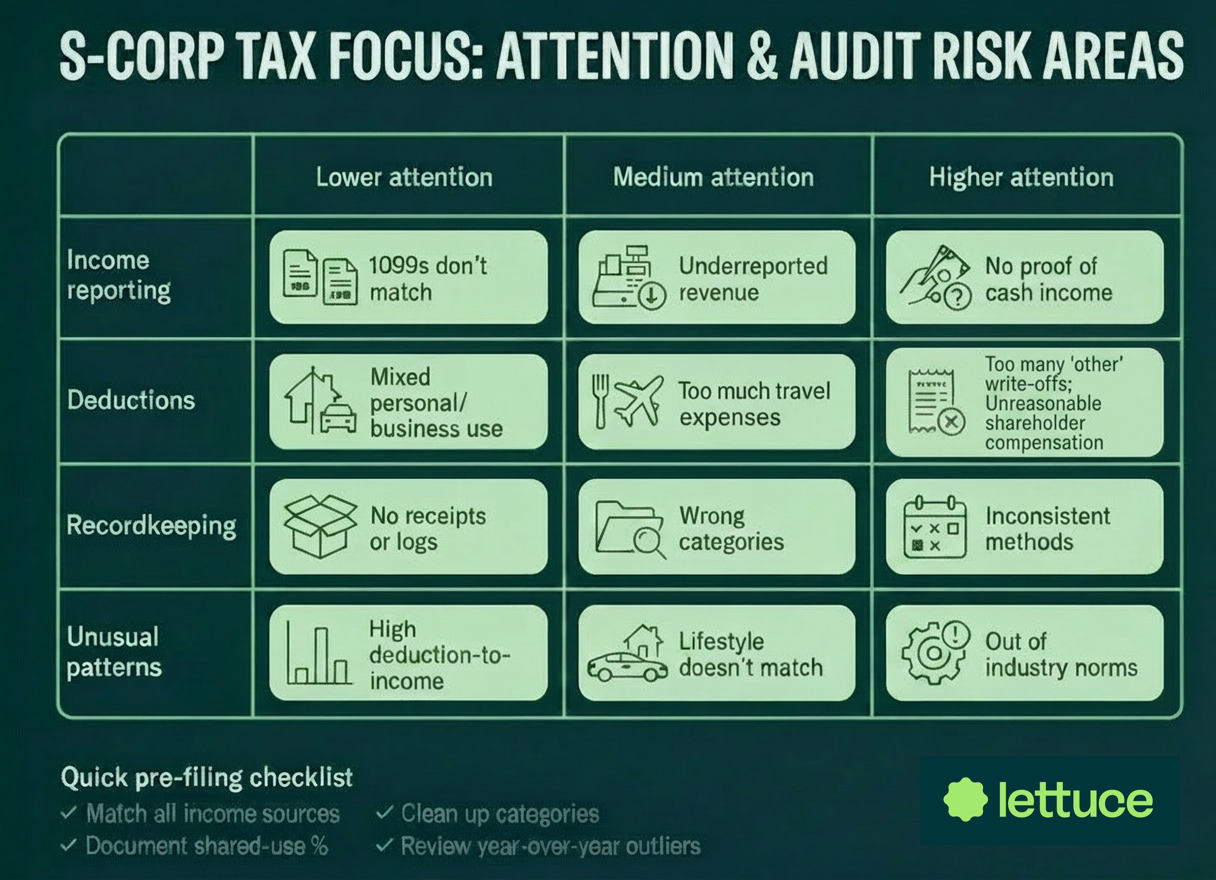
Breakdown of the S-Corp tax audit risk areas
How To Avoid Audits Before They Start
You don’t have to fear audits if your systems are sound. Proactive steps help you file with confidence and keep your business protected.
Use A Pre-Filing Audit Checklist
Before you submit your return, conduct a quick audit-readiness review to help catch obvious errors and keep your records clean.
Your checklist should include:
- Verifying all 1099s and other income sources match your records
- Confirming business use percentages for shared assets
- Checking that deductions are categorized correctly
- Reviewing patterns year-over-year for outliers
Spotting discrepancies before the IRS does makes all the difference.
Track Everything—Digitally If Possible
Paper records get lost. Digital tools make income and expense tracking easier, faster, and more reliable. Cloud storage, secure apps, and synced bank feeds simplify everything from invoicing to mileage. Whether you use software or spreadsheets, consistency matters more than complexity.
Lettuce Helps Automate Quarterly Taxes And Flag Issues Early
You don’t have to manage tax compliance alone. Lettuce’s tax tools help solopreneurs track income, organize deductions, and stay ahead of quarterly deadlines. Built-in checks flag inconsistencies early, before they become audit risks.
Take Control Of Your Tax Strategy
Audit risk isn’t about luck—it’s about preparation. By understanding what draws scrutiny and building habits that prevent errors, you stay in control of your solo business from the start.
With tools for automated admin, tax strategy and prep, and corporate-level benefits, Lettuce helps you manage compliance while focusing on growth.
Get started with Lettuce today and move forward with confidence.