
 Natalia Budyldina
1 min read

Georgia keeps its licensing local. There's no universal business license every solo operator must hold; what you need depends on your city, county, and profession. For most one-person service businesses, the real compliance work happens at the city or county level, not in Atlanta.
Before you file anything, know this: an occupational tax certificate is the local registration that many Georgia cities and counties require to legally operate a business, even a one-person consulting practice run from a home office.
The Georgia Secretary of State handles your entity formation, but entity formation and your local business license are two separate tasks with two separate government offices. Confuse them and you either over-file in the wrong place or miss a step entirely. Get clear on which office governs your actual business address, and the rest of your compliance picture, including your tax structure, falls into place. If you're already thinking ahead to S Corp election, payroll, or tax strategy, Lettuce for Consultants is built for that part of the journey.

Curious if an S Corp is right for you?
Try the Lettuce Tax Calculator to see how much more you can take home each year.
See your savingsStart With the Right Question: Statewide or Local Georgia Business License
Most Georgia solopreneurs start by searching for a statewide business license and come up empty. That is not a mistake on their part: it is a gap in how the question usually gets answered. Whether you need a statewide Georgia business license or a city and county registration depends entirely on your profession and where your business actually operates.
Georgia Has No Universal Statewide Business License
The Georgia Secretary of State handles entity registration and maintains links to profession-specific licensing boards, but there is no single blanket license that every business owner must hold. That gap is why generic advice sends solo operators in circles. You are not missing a form. The form most people picture simply does not exist for most service businesses.
Local Government Is Usually Where the License Actually Lives
For the majority of solo service businesses, the real license requirement sits at the city or county level. Local rules govern most day-to-day operating permissions, not a single state agency. Most Georgia cities and counties run their own occupational tax certificate programs, and the specific requirements depend on where your business address sits.
The First Screen Is Simple: Profession, Then Location
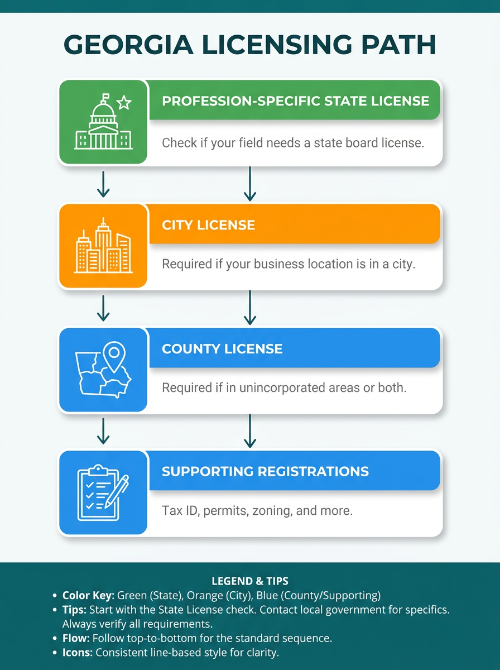
Before you check anything local, run one quick state-level check. Certain regulated professions: healthcare, law, engineering, and real estate, do require a state board license regardless of the city. If your work falls outside a regulated profession, move directly to the city or county where your business address is. That two-step screen, as Lettuce's LLC business license guide outlines, keeps you from over-researching at the state level when the answer is waiting at the county clerk's office.
Having a Georgia LLC Does Not Replace a Local Business License
Forming a Georgia LLC is a real accomplishment, but it answers one question only: who owns the business. It does not answer the city or county's question, which is: "Do you have permission to operate here?”
Those are two separate conversations with two separate government offices, and confusing them is one of the most common compliance gaps solo operators run into. Here is what you may still need after your LLC is active:
- A local occupational tax certificate or business license. Atlanta requires every business operating within city limits to obtain an Occupational Tax Certificate regardless of entity type, and Cobb County applies the same logic, explicitly noting that 1099 independent contractors must hold a license. Your LLC paperwork from the Georgia Secretary of State is actually one of the documents those offices ask you to bring with you.
- An EIN from the IRS. You need this federal employer identification number before you can open a business bank account, run payroll, or complete most local license applications. It is a parallel step, not a post-LLC afterthought.
- State tax registrations through the Georgia Tax Center. The Georgia Department of Revenue requires separate registration for each taxable activity, such as employee withholding, if you run payroll. LLC formation does not trigger those registrations automatically.
- Any professional license tied to your occupation. If your work falls under a state-regulated profession, that board registration sits alongside your local license, not instead of it.
S Corp tax treatment changes how your income is taxed, not whether your city or county expects a business registration. The annual Georgia LLC registration ($50 with the Secretary of State) keeps your entity in good standing at the state level, but it does not touch the local license obligation. These are separate obligations, answered by separate offices. Get the local license right first. Your tax structure: S Corp election, payroll, distributions, anchors to that foundation. Build it in reverse, and you're patching gaps instead of planning ahead.
Use This Georgia Business License Checklist Before You Apply Anywhere
Before you fill out a single form, confirm four facts about your business: your physical business address, whether that address falls inside city limits or only within a county, whether you meet clients on-site or work remotely, and whether your profession requires a separate state board license. Those four answers tell you exactly which office gets your application, and which ones you can skip.
Many Georgia cities and counties run their own occupational tax certificate programs with different rules, fee structures, and required documents. Atlanta, for example, requires a notarized E-Verify affidavit and a SAVE affidavit alongside the standard application through their ATLBIZ portal. What works in Atlanta does not automatically map to Savannah, Sandy Springs, or an unincorporated part of Fulton County.
Here is the checklist to run before you apply anywhere:
- Confirm your jurisdiction. Look up whether your business address sits inside a city boundary or only within a county. If it's inside city limits, start with the city clerk's office. If it's unincorporated, go straight to the county.
- Check for a profession-specific state license first. Certain fields require state board registration before any local license matters. The Georgia.gov starting a business guide is a reliable first stop for that check.
- Review local occupational tax certificate rules. City and county rules vary. Confirm fee amounts, required affidavits, and whether your business type triggers any regulatory permits on top of the standard certificate.
- Gather your entity documents and EIN before you start the application. Most jurisdictions will ask for your EIN, your LLC formation documents, and a description of your business activity. Having these ready avoids mid-application delays.
- Apply only with the office that governs your address. If your city requires a license, that is your filing. Do not also file with the county unless the county explicitly requires a separate registration for your business type.
Run through this list before you start any application. Once you know which office gets your filing, your compliance stack: payroll, tax structure, entity maintenance, builds naturally on top of that answer. Lettuce's guide on LLC business licenses covers what that next layer looks like.
Georgia Business License: Frequently Asked Questions (FAQs)
Georgia's licensing rules shift depending on where you work, what you do, and how your business is set up. The questions below address the gaps that solo consultants and independent professionals run into most often after they've sorted out their entity.
Do consultants and independent professionals in Georgia need a separate professional license?
It depends on your profession. Georgia regulates specific occupations, such as engineering, accounting, and real estate, through dedicated state boards. You can check whether your field requires a state professional certification before assuming a local occupational tax certificate covers everything. Many consulting roles have no state-level professional license requirement at all.
If you run your Georgia business from home, do you apply in the city, the county, or both?
Start by confirming whether your home address falls inside city limits. If it does, the city typically handles your occupational tax certificate. If you're in an unincorporated area, the county is your first stop. Some jurisdictions also require a home occupation permit as a separate step, so check both the city and county portals when you're not sure.
If your clients are in multiple Georgia cities, does one business license cover your whole service business?
Generally, yes. Your license or occupational tax certificate is tied to where your business is located, not where your clients are. Local registration is based on your place of business. If you operate from a single home office or address, one local registration usually covers your statewide client work.
Does my business structure change what local licenses I need?
Your entity type, whether sole proprietorship, LLC, or S Corp, does not change the local licensing requirement. Cities and counties want to know you're operating within their jurisdiction, regardless of how your business is structured. The Lettuce guide to starting an LLC notes that business license requirements depend on your state, city, county, and industry, not your formation documents.
Build the Rest of Your Compliance Stack Around the License You Actually Need
Once you've identified the right local license or occupational tax certificate for your Georgia business, the compliance work shifts from "what do I need?" to "how do I keep it running?" Register your entity with the Georgia Secretary of State, get your EIN, and set up the right state tax registrations through the Georgia Tax Center. Your license situation tells you which of those steps apply and in what order.
That sequence matters more than most solopreneurs realize. The local license is not the finish line. It is the foundation everything else anchors to: your entity, your payroll structure, your S Corp election, your tax strategy. Get it right once, and you stop rebuilding from scratch every tax season. Lettuce handles S Corp setup, payroll, bookkeeping, and tax filings in one platform; no juggling, no gaps. And the Lettuce-Back Guarantee means you're not making that move on faith alone.