
 Ashley Vuu
1 min read

Health reimbursement arrangements can get tricky if you're a more-than-2% S Corp shareholder, since you generally can't participate in one yourself. The good news? Your business can still pay or reimburse your health insurance premiums, report them on your W-2, and help you claim a self-employed health insurance deduction, as long as everything's documented correctly.
Health Reimbursement Arrangements sound like benefits reserved for large-company HR departments. Several types of Health Reimbursement Arrangements exist, and not every type is available to owner-employees of S corporations. This guide focuses on the reimbursement strategies that may apply to businesses-of-one. Depending on the type of HRA established and IRS rules that apply, an HRA may reimburse eligible medical expenses and, in some cases, health insurance premiums. The rules around who qualifies and what counts matter more than the acronym.
That's where the real opportunity lies for solo owners. Routed through your S Corp correctly, healthcare stops being a personal afterthought and becomes part of your tax strategy.
Start building that system with Lettuce, where payroll, health benefits, and tax planning connect automatically.
Curious if an S Corp is right for you?
Try the Lettuce Tax Calculator to see how much more you can take home each year.
See your savings
How Health Reimbursement Arrangements Work For S Corp Solopreneurs
An S Corp shareholder health-insurance reimbursement arrangement is different from an HRA. For a more-than-2% shareholder, the S-Corp may pay qualifying health-insurance premiums directly or reimburse the shareholder for premiums they paid personally. The corporation must then report those premiums properly on the shareholder’s W-2 for the coverage to be considered established under the S-Corp for purposes of the self-employed health-insurance deduction.
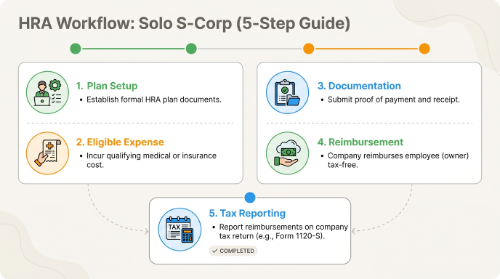
The HRA Workflow For S Corp Owners
Here is what that process usually looks like when an S Corp reimburses eligible healthcare costs under a formal arrangement:
- Adopt a written reimbursement plan that defines which expenses the business will reimburse.
- Pay for eligible health insurance premiums or medical expenses personally, based on the plan rules.
- Submit documentation, such as invoices or receipts, to support the reimbursement.
- Have the S Corp reimburse the expense through the business.
- Report the reimbursement correctly through payroll and include it on the owner’s W-2.
For S Corp solopreneurs, the tax treatment depends on this process being handled as one connected system. The reimbursement is generally included in W-2 wages, which can sound counterintuitive at first, but that reporting step is what supports the next part of the tax treatment. If eligible, the owner may then claim the self-employed health insurance deduction on their personal return. The real advantage is not just the reimbursement itself. It has a structure that supports clean records, accurate payroll, and the intended reporting outcome.
What Expenses A Solo Business Owner Can Reimburse Through A Health Reimbursement Arrangement
The line between what qualifies and what doesn't is worth knowing before you set anything up. The IRS defines reimbursable expenses under IRC §213(d), and what your health reimbursement arrangement can actually cover depends on both the expense type and your business structure. Solo owners operating as S Corps have an extra layer to manage: how reimbursements get reported through payroll, and which plan types are available to them.
|
Expense Type
|
Can S Corp Pay/
Reimburse?
|
Tax Treatment for >2% Shareholder
|
Best Fit For Business-of-One
|
|
Individual health premiums
|
Yes
|
Qualifying premiums paid or reimbursed by the S-Corp are generally included in W-2 Box 1. If the other IRS requirements are met, the shareholder may claim the self-employed health-insurance deduction.
|
Best for solo owners whose S Corp pays or reimburses premiums directly with payroll set up correctly
|
|
Dental and vision premiums
|
Yes, if qualifying insurance
|
Medical, dental, and vision insurance premiums may be included in the self-employed health-insurance deduction when the coverage is established under the S-Corp and the other requirements are met.
|
Can be part of qualifying premium reimbursement; eligibility and limits still apply.
|
|
Copays and deductibles
|
Yes
|
Qualifies under IRC §213(d); but for a more-than-2% shareholder, this reimbursement is included in W-2 wages just like a premium would be. Unlike premiums, there is no offsetting personal deduction available for it
|
Generally not tax-advantaged for a 2%+ shareholder specifically -- a common-law employee would get this tax-free, but a solo S Corp owner typically will not
|
|
Prescriptions
|
Yes
|
Must be for a diagnosed medical condition; general wellness or cosmetic items do not qualify. As with copays and deductibles, this is included in W-2 wages for a more-than-2% shareholder, with no offsetting deduction
|
Best for owners with regular prescription costs tied to a medical condition
|
|
Long-term care premiums
|
Yes, with limits
|
Premiums above the age-based IRS limit are not deductible
|
Best for owners thinking about long-term coverage
|
|
Spouse's employer plan premiums
|
Not eligible without qualification
|
Plans through a spouse's employer are not eligible for reimbursement
|
Not applicable regardless of business structure
|
|
QSEHRA plan eligibility
|
Not on the same basis as employees
|
IRS rules exclude more-than-2% shareholders from this specific HRA type on the same basis as common-law employees
|
See the Lettuce QSEHRA guide for what applies instead
|
Proper documentation and the right business structure are what turn qualifying healthcare costs into real business deductions. The S Corp health insurance guide covers how those costs flow through payroll so the deduction holds up at tax time.
When a Health Reimbursement Arrangement Is Worth It for Freelancers and Self-Employed Professionals
Not every tax strategy belongs in every business. A Health Reimbursement Arrangement (HRA) earns its place when it creates consistent savings and records you can actually maintain, but IRS rules make the answer different depending on how your business is structured. For freelancers and self-employed professionals, whether an HRA is worth it comes down to a few specific factors.
- Your entity type is the starting point. ICHRA rules exclude self-employed owners from participating as employees, and without W-2 payroll through your own S Corp, most HRA structures simply don't apply.
- Your premium size determines whether the savings justify the setup. At $300/month, the benefit is real but modest; at $18,000 a year for family coverage, running those premiums through your S Corp can mean savings depending on federal and state tax.
- Consistent payroll makes the whole system work. Irregular payroll creates administrative risk that outweighs the benefit, and IRS rules require W-2 treatment to stay compliant.
- Documentation habits matter more than most people expect. Reimbursements need receipts, a written plan document, and clean records, and if that discipline isn't already part of how you run your business, the admin burden cancels out the savings.
- Family coverage needs to shift the calculation. A QSEHRA is the closest alternative for solo owners, though S Corp 2% shareholders face specific restrictions there as well.
- Automation reduces the friction that derails most HRA attempts. When payroll, bookkeeping, and health premium tracking connect in one place, that's the difference between a strategy you use every year and one that never gets off the ground.
Health Reimbursement Arrangements: FAQ for Solo Business Owners
With HRAs, getting the structure right matters more than knowing the acronym. The questions below focus on the distinction between formal HRAs for eligible employees and the separate health-insurance reimbursement rules that generally apply to more-than-2% S-Corp shareholders.
Can a business-of-one use a health reimbursement arrangement for tax-free healthcare?
Yes, but the path depends on your business structure. The IRS defines several HRA types, and the one that fits depends on your setup. S Corp owners can reimburse health insurance premiums through payroll. When structured correctly, those reimbursements are effectively tax-advantaged at the federal level, and the premiums become tax-deductible on your personal return. A written reimbursement policy is strongly recommended and required for many formal HRA arrangements.
Do HRAs work differently for sole proprietors, single-member LLCs, and S Corps?
Yes, and the differences are real enough to change your entire approach. Sole proprietors and single-member LLC owners can deduct health premiums directly on Schedule 1. S Corp owners must run premiums through payroll and include them in W-2 Box 1. Per IRS guidance, each structure has its own reporting rules, and confirming your entity type first is the right starting point.
Can an S Corp owner use a QSEHRA?
No. A more-than-2% S-Corp shareholder is not an eligible employee for QSEHRA purposes. The shareholder generally follows the separate S-Corp health-insurance premium rules instead: the S-Corp pays or reimburses qualifying premiums, reports them properly on the shareholder’s W-2, and the shareholder may claim the self-employed health-insurance deduction if the other requirements are met.
What records should an S-Corp owner keep for health-insurance reimbursement?
Keep proof of the insurance premiums, records showing that the S-Corp paid or reimbursed those premiums, and payroll/W-2 records showing the required reporting. A formal written HRA plan document is necessary when the business actually sponsors an HRA for eligible employees, but it should not be confused with the separate S-Corp shareholder health-insurance reimbursement rules.
Make Healthcare Spending Work Harder For Your Business-Of-One
The best health reimbursement strategy for a business-of-one starts with using the right rules for the owner’s entity type. For a more-than-2% S-Corp shareholder, that generally means properly paying or reimbursing qualifying health-insurance premiums through the S-Corp and reporting them correctly—not treating the owner as a tax-free HRA participant.
That's where the right platform makes the difference. Lettuce connects payroll, bookkeeping, and health deductions so S Corp health reimbursements and tax reporting stay in one place.
See how Lettuce's financial system for solopreneurs turns health reimbursements into a built-in part of your S Corp strategy.
Lettuce offers health benefits to eligible Lettuce Pro members through its professional employer organization (PEO). Health/medical coverage is provided by Curative. This article is for informational purposes only and does not constitute medical, insurance, tax, or legal advice. Benefits, plan availability, coverage, premiums, eligibility, and potential savings vary by state and individual circumstances and are subject to change. Coverage is subject to the terms and conditions of the applicable benefit plan. Nothing in this article should be interpreted as a recommendation to purchase, enroll in, or decline any specific insurance plan. Consult a licensed insurance agent, tax professional, and/or healthcare provider before making decisions about your health coverage or benefits.