 Ashley Vuu
1 min read

An ICHRA can help businesses reimburse employees for health insurance, but S Corp owners of one often face stricter rules and less benefit from it. In most cases, deducting your health insurance premiums directly through payroll is simpler and just as tax-smart. The key is proper documentation and a setup that matches your business structure.
Most solo business owners pay for health insurance out of pocket and never capture the full tax benefit available to them. ICHRA stands for Individual Coverage Health Reimbursement Arrangement. A 2019 federal rule established it to let businesses reimburse employees for individual health insurance premiums and eligible medical costs. For a business-of-one, it's a decision about tax treatment, compliance, and whether your business structure even qualifies.
How ICHRA applies depends entirely on how your business is set up. For S Corp owners, the rules get specific quickly. Knowing which expenses count and how reimbursements connect to your S Corp health insurance setup is exactly where getting the structure right pays off.
See how Lettuce works to bring health benefits, payroll, and taxes together for businesses-of-one.
Curious if an S Corp is right for you?
Try the Lettuce Tax Calculator to see how much more you can take home each year.
See your savings
How ICHRA Works For A Solo Business Owner
An Individual Coverage Health Reimbursement Arrangement, or ICHRA, is an employer-funded plan that reimburses employees for individual health insurance premiums and eligible medical expenses. The business contributes money, and the individual uses it to pay for their own coverage. No group plan required. The 2019 federal rule establishing ICHRA created this framework specifically to let employers fund individual coverage rather than group plans.
The Four Steps Behind Every ICHRA Reimbursement
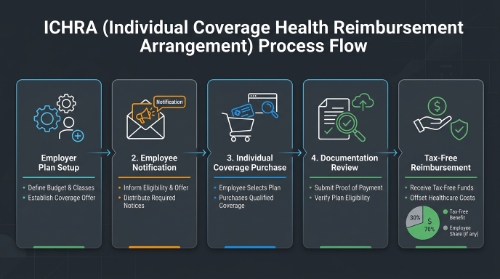
The process is straightforward. First, the business sets a monthly reimbursement limit. Second, the employee buys qualifying individual health coverage, meaning a plan purchased through the individual market or Medicare. Third, they submit documentation proving the expense. Fourth, the business reimburses up to the allowed amount. Those reimbursements are tax-free to the employee and deductible for the business when the plan is set up correctly. You can explore health coverage options for solopreneurs to see what qualifying plans look like in practice.
Formal Setup, Not Informal Draws
Paying a health insurance bill from your business account is not the same as running an ICHRA. A proper plan requires written plan documents, a defined reimbursement limit, and substantiated claims. Without those in place, the reimbursements may lose their tax-free status. For S Corp owners, coordinating this with S Corp health insurance reporting is what keeps the tax treatment clean.
When ICHRA Makes Sense Vs. A Traditional Group Health Plan
When solo business owners compare ICHRA to a traditional group health insurance plan, the gap in flexibility and cost control becomes clear fast. The right structure comes down to two things: who controls the plan and how the federal HRA regulations governing each option affect your tax treatment. A traditional group plan is built for employers with multiple employees, and for a business-of-one. This may add administrative complexity and expense for many owner-only businesses.
|
Option
|
Who Buys Coverage
|
Cost Control
|
EPlan Flexibility
|
Best Fit
|
|
ICHRA
|
Owner or employee buys an individual plan
|
Employer sets a reimbursement ceiling
|
High: any ACA-compliant individual or marketplace plan
|
Business with non-owner employees who want full plan choice with structured reimbursement
|
|
Traditional Group Plan
|
Employer selects and funds a group plan
|
Limited: premiums set by the insurer
|
Low: employees choose from the plans offered
|
Businesses with multiple W-2 employees
|
|
S Corp Premium Deduction
|
Owner buys an individual plan directly
|
Owner pays premiums directly, no reimbursement ceiling, but the deduction can't exceed the owner's wages from the S Corp
|
High: any individual plan, including off-marketplace options
|
S Corp owners who want a direct deduction without a formal HRA
|
|
PEO/Grouped Benefits
|
PEO pools members for group-rate access
|
Moderate: rates set by the pool
|
Moderate: plans offered through the PEO
|
Solos who want group-rate coverage without managing plan design
|
A traditional group plan adds cost and administrative overhead that a business-of-one rarely justifies. If you want full plan choice, the S Corp premium deduction puts that control in your hands. If you have eligible employees beyond yourself, ICHRA can do the same for them. If you want group-rate access without the setup, the grouped benefits structure available through Lettuce Pro is a strong fit. And if your business has a small team, a QSEHRA overview can help you find a simpler fit.
What Expenses Can Be Reimbursed Through An Individual Coverage Health Reimbursement Arrangement
Two things determine what expenses can be reimbursed through an Individual Coverage Health Reimbursement Arrangement: what your written plan allows and what the IRS recognizes as eligible. Conflating qualifying and non-qualifying costs creates messy tax treatment.
- Individual health insurance premiums are the primary reimbursable expense. Your plan must verify proof of qualifying coverage before any reimbursement is issued. Short-term limited-duration plans don't qualify as individual coverage for ICHRA purposes.
- Other IRS Section 213(d) medical expenses can be covered depending on your plan design. This includes dental and vision premiums, prescription costs, and out-of-pocket costs like deductibles and copays. Review the eligible expenses list and confirm your written plan explicitly covers each category before reimbursing.
- Gym memberships, cosmetic procedures, and general wellness products fall outside ICHRA's scope, regardless of how health-related they feel.
- For S Corp owners, reimbursed premiums must flow through payroll. Your S Corp reports qualifying health insurance premiums on your W-2 (generally Box 1), and you may claim the self-employed health insurance deduction on your personal return if IRS requirements are met. Miss this step and the deduction disappears. See how S Corp premiums work with payroll reporting.
- Year-end reconciliation is where reimbursements get lost. Your W-2, bookkeeping records, and personal return all need to align before filing. If they don't, you risk losing the deduction or triggering a correction. Paying health insurance through your S Corp requires this coordination to hold up at tax time.
- Every reimbursement needs documentation on file. Proof of individual coverage, receipts, and a written plan are all required. Without them, the IRS can reclassify your reimbursements as ordinary taxable income, and your written plan loses its legal standing.
Common ICHRA Questions Solo Business Owners Ask
ICHRA sounds like a straightforward benefit, but the rules get specific fast once you factor in your entity type and payroll setup. Solo business owners tend to have the same sticking points. The answers depend almost entirely on how your business is set up and how you're already handling payroll.
Can an S Corp owner use ICHRA for health insurance?
Not in the way most people expect. Your S Corp is the employer, but as a more-than-2% shareholder, the IRS treats you as self-employed for fringe benefit purposes, so an ICHRA that covers only you isn't an option. The cleaner path is routing premiums through S Corp health insurance reimbursement and reporting them on your W-2.
Do you need employees other than yourself for ICHRA to work?
Yes. ICHRA is an employer-sponsored benefit built for W-2 employees. If your S Corp has no employees beyond yourself, ICHRA adds compliance complexity without a clear payoff. IRS guidelines on HRAs confirm that these arrangements must be employer-funded and offered to eligible employees. For a solopreneur with no staff, ICHRA simply is not the right tool.
Is ICHRA better than deducting health insurance premiums through your S Corp?
For most solo owners, no. The S Corp premium reimbursement approach generally involves less administrative complexity than establishing a formal HRA, while still requiring proper documentation and payroll reporting. Your S Corp pays or reimburses your premiums and adds them to your W-2. You then deduct them above the line on your personal return, with no formal plan documents required. That deduction has its own limits: it can't exceed your wages from the S Corp for the year, and the IRS disallows it for any month you or your spouse could get subsidized coverage elsewhere.
How does ICHRA compare to QSEHRA for a solo business owner?
QSEHRA for small businesses and ICHRA work similarly on paper, but for a business-of-one, the differences matter more than the similarities. For a true business-of-one with no eligible employees, neither QSEHRA nor ICHRA is typically the right fit — these arrangements are generally designed around employer-employee relationships rather than owner-only reimbursement strategies. If you have someone on your payroll, QSEHRA has lower annual contribution limits than ICHRA but requires less administrative setup.
If I have eligible employees, does offering them an ICHRA affect their ACA marketplace subsidies?
Yes, and it's worth flagging to anyone you offer it to. If the ICHRA is considered "affordable" under ACA rules, that employee and their household lose eligibility for marketplace premium tax credits for as long as the offer stands, whether or not they actually use it. If the offer is "unaffordable," the employee can choose between the ICHRA and their marketplace tax credit, but not both.
Choose The Health Benefit Setup That Matches Your Business Structure
The right solo business owner health reimbursement strategy is about structure, not terminology. Your entity type, payroll, and S Corp compensation rules determine which approach works. Get that alignment right, and your health benefit shows up where it should.
Lettuce connects S Corp formation, payroll, and health premium tracking, so nothing gets lost. Your health benefit should work as hard as your business does. With the Lettuce-Back Guarantee, if your savings don't exceed your subscription cost, your fees are refunded. See how your S Corp, payroll, and health benefits work together.
Lettuce offers health benefits to eligible Lettuce Pro members through its professional employer organization (PEO). Health/medical coverage is provided by Curative. This article is for informational purposes only and does not constitute medical, insurance, tax, or legal advice. Benefits, plan availability, coverage, premiums, eligibility, and potential savings vary by state and individual circumstances and are subject to change. Coverage is subject to the terms and conditions of the applicable benefit plan. Nothing in this article should be interpreted as a recommendation to purchase, enroll in, or decline any specific insurance plan. Consult a licensed insurance agent, tax professional, and/or healthcare provider before making decisions about your health coverage or benefits.