 Ashley Vuu
1 min read

PEO health insurance can give a business-of-one buying power, but it only fits once you're running an S Corp and paying yourself through W-2 payroll. Still a sole proprietor? A marketplace plan is usually the simpler pick. For S Corp owners, group coverage holds up when payroll, reasonable salary, and W-2 reporting are in place.
Most solopreneurs form an S Corp to cut their self-employment tax bill. What they don't always realize: that same W-2 payroll structure is also the key to group-rate health coverage, the kind that normally requires a company with actual employees. The tax savings and the benefits access come from the same setup.
A PEO, or Professional Employer Organization, uses a co-employment model to pool members together, so solo owners can access group-rate benefits that individual-market pricing doesn't offer. On your own, you don't bring a large group's scale or bargaining leverage to the table. A PEO changes that math.
PEO health insurance pays off when the right structure is already in place. An S Corp running active W-2 payroll gives a PEO the employment hook it needs to attach group-rate coverage to something you're already doing. Lettuce Healthcare makes this setup available to eligible Lettuce Pro S Corp members, powered by Curative.
Curious if an S Corp is right for you?
Try the Lettuce Tax Calculator to see how much more you can take home each year.
See your savings
When PEO Health Insurance Makes Sense for a Business of One
PEO health insurance is not a universal upgrade for every self-employed person. It is a structural play, and whether it makes sense depends on whether your business is already built to support it. The right question to ask is not "Can I get a group plan?" but "Am I already running the kind of business that makes a group plan work?"
You Want Employer-Style Benefits, and You're Ready to Run an Employer-Style Business
A PEO uses a co-employment model to give solo owners access to payroll-based benefits. That model works because you are both the employer and the employee. If you are comfortable operating with that kind of structure, a PEO group health plan is a natural fit. If that setup feels like more than you signed up for, it probably is.
You're Already an S Corp Owner Running W-2 Payroll
This is where it clicks. You're already running the payroll. You're already filing the W-2. A PEO doesn't ask you to build a second system; it layers group benefits access onto the structure you've already committed to. More return on the infrastructure you're already using. That's exactly how Lettuce Healthcare works for eligible Lettuce Pro members.
You Just Need a Policy and Have No Payroll Setup Yet
If you are still operating as a sole proprietor and your main goal is finding a health plan, a PEO arrangement is more structured than the situation calls for. Setting up an S Corp, running W-2 payroll, and joining a PEO to access group coverage is a real operational commitment. For someone at that stage, buying directly through the individual marketplace is a simpler path to coverage, with the option to build toward a more structured setup later.
What a Solo Owner Needs First
PEO health insurance works through an employer-and-employee framework. For a solo owner, that means you need to occupy both roles simultaneously, and the IRS needs to see that arrangement reflected in your payroll records. The operational prerequisite is not paperwork for its own sake; it is the structure that makes group benefits access legitimate.
Here is what needs to be in place before a PEO health insurance arrangement actually works for a business-of-one:
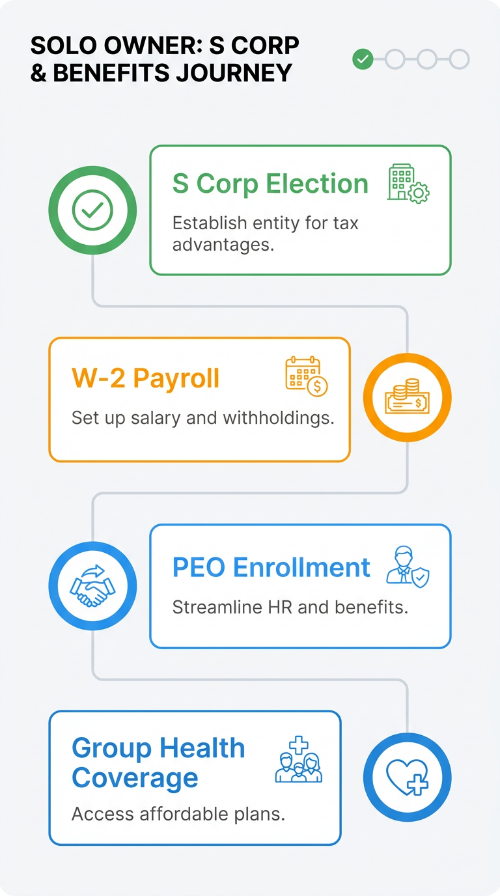
- Form an S Corp. For Lettuce Healthcare, eligible participants must operate through the required S Corp and W-2 payroll structure. A sole proprietor has not established that the structure would not meet the program's eligibility requirements.
- Run active W-2 payroll at a reasonable salary. The IRS requires S Corp owner-employees to pay themselves a reasonable salary subject to payroll taxes. That W-2 is not just a compliance formality; it is the proof of employment that PEOs and carriers verify before enrolling you in a group plan.
- Report health insurance premiums correctly on your W-2. Per IRS guidance, premiums paid by the S Corp for a shareholder-employee who owns more than 2% of the company must be included in Box 1 wages on the W-2, but excluded from Boxes 3 and 5 (Social Security and Medicare wages). Getting this right is what connects the group coverage to the tax treatment it is supposed to carry.
- Keep payroll current throughout the year. Benefits eligibility through a PEO depends on an active, ongoing payroll relationship, not a one-time setup. Consistent wage reporting keeps that relationship intact.
The insurance card at the end of this process is the visible part. The compliant payroll, wage reporting, and benefits administration running underneath it are what make the whole thing hold up. Lettuce handles S Corp payroll, W-2 reporting, bookkeeping, and tax workflows end-to-end, so when you add Lettuce Healthcare as an eligible Lettuce Pro member, the group coverage fits into a structure you are already using rather than requiring a separate system to manage.
PEO Group Health Plan vs Marketplace Plan
Not every coverage path leads to the same place, and the right one depends less on price than on what your business is already built to support. The structural differences between a PEO group plan and an individual marketplace plan shape what you pay, what you access, and how the whole arrangement fits into your S Corp setup.
| Option | Individual Marketplace Plan | Off-Marketplace Individual Plan | PEO Group Health Plan (Lettuce Healthcare) | Spouse's Employer Plan |
|---|---|---|---|---|
| Who It Fits | Solopreneurs without W-2 payroll; anyone who can enroll now, during Open Enrollment, or a qualifying life event | Solopreneurs comparing individual-market options who do not need Marketplace premium tax credits or who find a preferred plan outside the Marketplace | Eligible Lettuce Pro S Corp members running W-2 payroll | Solopreneurs with a spouse who has employer-sponsored coverage |
| How You Enroll | Healthcare.gov during Open Enrollment or a qualifying life event | Directly through insurer or broker, generally during the same Open Enrollment window or qualifying life event as marketplace plans | Through the Lettuce platform during enrollment windows; do not cancel existing coverage until your Curative member ID card is in hand | Through the spouse's employer during open enrollment |
| Payroll Required | No | No | Yes, W-2 payroll through the Lettuce PEO | No |
| Benefits Experience | ACA-compliant plans may qualify for premium tax credits based on income | More plan variety; same individual-market pricing dynamics apply | Curative PPO with national network; $0 in-network cost-sharing after completing the Baseline Visit; $0 copay telehealth; not HSA-compatible (a $0-deductible plan does not qualify as an HSA-eligible high-deductible health plan) | Full group-rate benefits without any business structure changes |
| Tradeoffs | Simpler setup and potential access to income-based premium tax credits. Premiums, deductibles, networks, and cost-sharing can differ significantly from employer group coverage, so total costs should be compared based on the individual's circumstances. | No tax credit eligibility; still individual-market rates without group buying power | Requires S Corp structure and active payroll; state availability is limited; healthcare is an optional add-on for Lettuce Pro members | Depends entirely on the spouse's job and employer; no control over plan options or continuity |
The core distinction here is structural, not just financial. Marketplace coverage is a clean, low-friction path when you need insurance and aren't yet running S Corp payroll. A PEO group health plan makes sense when you want the tax and payroll infrastructure of an S Corp to do more than reduce self-employment taxes, and group-rate benefits access is one of the most meaningful things it can do.

FREE CALCULATOR
What are you paying for?
Most existing S Corp owners are still paying for tools — and losing billable hours — to run the admin by hand. See your real number in 20 seconds.
Show savingsPEO Health Insurance for Solopreneurs: Frequently Asked Questions
Can a solopreneur use a PEO for health insurance without an S Corp?
In most cases, no. A PEO health insurance arrangement works through an employer-and-employee relationship, and a sole proprietor doesn't have one. Without an S Corp and active W-2 payroll, there's no employment hook for a PEO to attach group benefits to. If you want this kind of coverage, the S Corp structure comes first, and Lettuce Healthcare is built for exactly that next step.
Does a solo owner have to pay themselves on a W-2 to join a PEO health insurance arrangement?
Yes. Active W-2 payroll is a prerequisite, not a formality. The PEO co-employment model is built around payroll, and carriers verify that relationship before enrolling you in a group plan.
What should an S Corp owner check before switching from an individual marketplace plan to a PEO group health plan?
Start with three things: state availability, enrollment timing, and plan compatibility. Lettuce Healthcare is available in select states with more being added; enrollment opens on specific windows rather than rolling monthly, and the Curative PPO is a \$0-deductible plan, which means it is not HSA-compatible. Don't cancel your existing coverage until your Curative member ID card is in hand.
What happens if my income changes after I enroll in a PEO group health plan?
Unlike Marketplace coverage, a PEO group health plan generally is not recalculated through the income-based premium tax credit system. Continued coverage remains subject to active payroll, timely premium payment, continued program eligibility, and the applicable plan documents.
Turn S Corp Structure Into Better Benefits Access
If you're already running W-2 payroll through an S Corp, you're closer to employer-style benefits than you might think. The structure is already there. Pairing it with a PEO that negotiates group-rate coverage is the natural next step, not a separate project.
Lettuce Healthcare is built exactly for that handoff; an optional add-on for eligible Lettuce Pro members operating as S Corps, with access to a national Curative PPO network. Availability depends on your state and the current enrollment window.
For solo owners who want the full picture: S Corp formation, payroll, tax compliance, and benefits access in one place; the Lettuce-Back Guarantee means you can commit with confidence. Eligible Lettuce Pro customers may qualify for the Lettuce Guarantee, subject to the program’s published eligibility requirements, calculation methodology, exclusions, and other terms.
Your S Corp is already doing the tax work. Lettuce is how the same structure does the benefits work, too. Check your state and current enrollment window; the infrastructure is already there.
*Important information: This article is provided for general educational purposes and is not tax, legal, accounting, or insurance advice. S-Corp suitability, tax treatment, premium reporting, plan eligibility, costs, benefits, provider networks, state availability, and enrollment periods depend on individual circumstances and may change. Consult a qualified tax adviser and review the applicable plan documents before making a decision.*
Lettuce offers health benefits to eligible Lettuce Pro members through its professional employer organization (PEO). Health/medical coverage is provided by Curative. This article is for informational purposes only and does not constitute medical, insurance, tax, or legal advice. Benefits, plan availability, coverage, premiums, eligibility, and potential savings vary by state and individual circumstances and are subject to change. Coverage is subject to the terms and conditions of the applicable benefit plan. Nothing in this article should be interpreted as a recommendation to purchase, enroll in, or decline any specific insurance plan. Consult a licensed insurance agent, tax professional, and/or healthcare provider before making decisions about your health coverage or benefits.