 Christopher Hyde
1 min read

The Mega Backdoor Roth gives S Corp owners a retirement advantage most solopreneurs never tap into. By using your dual role as employee and employer, a Solo 401(k) lets you stack contributions well beyond a standard IRA, then convert them to Roth for tax-free growth. Lettuce helps you set it up right from day one.
For 2026, the elective-deferral limit for a 401(k) plan is $24,500, while the overall annual-additions limit is generally the lesser of 100% of compensation or $72,000, excluding eligible catch-up contributions. By comparison, the 2026 IRA contribution limit is $7,500. The Mega Backdoor Roth is what leverages the benefits of your S Corp structure to create a tax-free growth engine.
As an S Corp owner, you wear two hats: employee and employer. That structure lets you contribute from both sides, potentially stacking well beyond what a W-2 employee or sole proprietor can reach. The Mega Backdoor Roth is how you execute.
Start building your tax-free retirement strategy with Lettuce.
Curious if an S Corp is right for you?
Try the Lettuce Tax Calculator to see how much more you can take home each year.
See your savingsHow the Mega Backdoor Roth Works for S Corp Owners
Your S Corp structure gives you access to contribution limits that most W-2 employees will never see. How a Mega Backdoor Roth works with a Solo 401(k) depends entirely on that structure. The mechanics are more straightforward than the name suggests.
Breaking Down the Mega Backdoor Roth
A Mega Backdoor Roth is not a separate account or a special type of Roth IRA. It is a strategy involving voluntary after-tax employee contributions to a 401(k). These contributions are different from designated Roth elective deferrals and do not reduce the participant's regular elective-deferral limit.
The participant then moves the voluntary after-tax amounts to Roth through an in-plan Roth rollover or, when permitted under the plan's distribution provisions, a rollover to a Roth IRA. The voluntary after-tax contributions remain subject to the overall annual additions limit.
The after-tax contribution itself generally is not taxed again when moved to Roth. However, previously untaxed earnings associated with the contribution may be taxable when converted. Future Roth earnings are generally tax-free only when the applicable qualified-distribution requirements are satisfied.
Your S Corp Compensation Determines Contribution Capacity
An S Corp shareholder-employee may participate in the corporation's 401(k) plan based on W-2 compensation. S Corp distributions do not count as compensation for retirement-plan contribution purposes.
As an employee, the owner may make elective deferrals and, if the plan permits them, voluntary after-tax employee contributions. As the employer, the S Corp may make matching or nonelective contributions under the plan's terms.
The employee/employer structure helps determine how contributions are calculated, but S Corp status is not what makes a Mega Backdoor Roth possible. The strategy depends primarily on the plan document, permitting the necessary after-tax contribution and Roth rollover features.
How W-2 Compensation and Plan Design Affect the Available Amount
W-2 compensation is an important limitation, but it is not the only limitation. For 2026:
Employee elective deferrals generally cannot exceed $24,500.
The S Corp's employer contribution may be as much as 25% of W-2 compensation, subject to the plan document, applicable deduction rules, and the overall annual additions limit.
Total annual additions generally cannot exceed the lesser of 100% of compensation or $72,000, excluding eligible catch-up contributions.
The plan must specifically permit voluntary after-tax employee contributions.
The plan must also permit an in-plan Roth rollover or another available method of moving the after-tax contributions to a Roth.
The Two-Role Advantage: Employee and Employer Contribution Explained
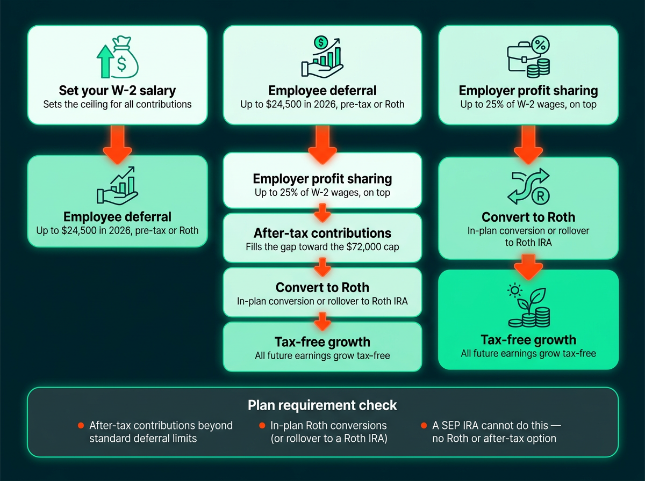
As an S Corp owner, you play two roles in your retirement plan: employee and employer. That dual role is what makes the Mega Backdoor Roth possible. By combining contributions from two separate sources, you can save more toward reaching the annual additions limits.
-
Contribute as an employee first. You can defer up to $24,500 of your W-2 salary into your Solo 401(k) in 2026, either pre-tax or as a Roth contribution.
-
Layer on employer profit sharing. Your S Corp can contribute up to 25% of your W-2 wages on top of that deferral, per IRS profit-sharing rules, with employer contributions allowed up to your tax filing deadline. On a $100,000 W-2 salary, that's up to $25,000 more going toward retirement, without touching your take-home pay.
-
Together, they push toward the annual limit. The 2026 contribution limits project a $72,000 cap, and while employee deferrals and employer profit sharing get you close, after-tax contributions can close the remaining gap.
-
After-tax contributions fill the remaining space. Once you've maxed both contribution types, any room left under that limit can be filled with after-tax dollars. Those after-tax contributions can then be converted to a Roth, which is the Mega Backdoor Roth in action.
-
The numbers add up fast. A solopreneur with $100,000 in W-2 salary could potentially contribute over $66,000 in 2026, depending on age and plan design. That's nearly 10 times what a standard IRA allows.
High-earning medical professionals running an S Corp can pair this strategy with group-rate health coverage and a Carry Solo 401(k), both available to Lettuce Pro members.
The plan you choose determines how much of that room you can actually use.
Solo 401(k) Vs SEP IRA: Which Plan Supports the Mega Backdoor Roth?
Understanding the difference between a Solo 401(k) and a SEP IRA for Mega Backdoor Roth planning starts with how each plan handles contributions. A SEP IRA only allows employer contributions with no Roth or after-tax options, while a Solo 401(k) supports both contribution types and the after-tax potential the Mega Backdoor Roth requires. The full plan comparison covers each option in detail.
|
Plan Type
|
Who Can Contribute
|
Roth Option
|
After-Tax Contribution Potential
|
Best For
|
Mega Backdoor Roth Fit
|
|
Solo 401(k)
|
Employee + Employer
|
Yes
|
Yes, with plan election
|
S Corp owners maximizing tax-free growth
|
Yes
|
|
SEP IRA
|
Employer only
|
No
|
No
|
Simplicity, lower administrative overhead
|
No
|
|
Traditional IRA
|
Individual only
|
No
|
No
|
Supplemental tax-deferred savings
|
No
|
|
Roth IRA
|
Individual only (income limits apply)
|
Yes
|
No
|
Tax-free growth for individuals within income limits
|
No
|
Bold indicates the recommended plan for Mega Backdoor Roth strategies.
The IRS confirms that one-participant 401(k) plans support both employee deferrals and employer contributions. That dual-contribution structure is exactly what the Mega Backdoor Roth requires. The Journal of Accountancy notes that Solo 401(k) plans offer flexibility that SEP IRAs cannot match for advanced retirement strategies.
Frequently Asked Questions About Mega Backdoor Roth And S Corp Retirement Planning
The Mega Backdoor Roth comes with a lot of moving parts, especially when your income flows through an S Corp. Here's a clear look at the mechanics, the plan options, and where Lettuce fits in.
Can an S Corp owner use a Mega Backdoor Roth to grow tax-free retirement savings?
Yes. The one condition is that your Solo 401(k) plan must allow after-tax contributions. When it does, you gain access to tax-free retirement savings well beyond what a standard Roth IRA allows. The rollover mechanics vary by plan, so confirming your plan's rules upfront matters.
How does a Mega Backdoor Roth work with a Solo 401(k) for S Corp owners?
You contribute after-tax dollars to your Solo 401(k) beyond your regular deferrals. You convert those contributions to a Roth, either inside the plan or rolled to a Roth IRA. Per IRS guidance, after-tax dollars can be directed separately from pre-tax amounts, provided your plan document allows in-plan conversions.
What is the difference between a Solo 401(k) and a SEP IRA for Mega Backdoor Roth planning?
A SEP IRA only accepts employer contributions. There's no Roth or after-tax option, which puts the Mega Backdoor Roth out of reach. A Solo 401(k) supports both employee deferrals and employer contributions, plus Roth and after-tax options.
How does Lettuce help automate tax-smart Solo 401(k) contributions for S Corp owners?
Lettuce integrates with Carry, a Solo 401(k) provider, to give S Corp owners direct access within the platform. Your W-2 salary determines your contribution room, and the platform tracks it automatically. The Solo 401(k) guide covers contribution limits, deadlines, and setup steps in one place. Check the contribution deadlines before year-end to avoid missing your window.
Your S Corp Retirement Strategy Starts Here
You now have the blueprint. After-tax contributions and in-plan Roth conversions work when your plan is built to support them. IRS rules on designated Roth accounts make plan design non-negotiable.
Your payroll, tax planning, and Solo 401(k) contributions stay aligned, with Lettuce running the back-office while you focus on growth. The platform handles contribution deadlines and tax filings automatically. With the Lettuce-Back Guarantee, if your tax savings don't exceed your subscription cost, you get your fees back.
Start building a retirement strategy that works as hard as your S Corp does. Review the current Carry Solo 401(k) Lettuce offering today!
The Lettuce Learning Center is operated by Lettuce Financial Labs Inc. (“Lettuce”) and contains generalized educational content about personal finance topics. The information published should not be construed as personalized investment or tax advice and should not be considered as a solicitation to buy or sell any security or engage in a particular investment, accounting, tax, or legal strategy. You should consult with qualified tax, legal, accounting, and investment professionals regarding your specific situation.
The accounts, strategies, and/or investments discussed in this material may not be suitable for all. All investments involve the risk of loss, and past performance does not guarantee future results. Investment growth or profit is never a guarantee. All statements and opinions included on the Lettuce Learning Center are intended to be current as of the date of publication but are subject to change without notice.
*Carry is owned by Lettuce.; the two are affiliated. Any investment advisory services discussed on this website are provided exclusively through its wholly-owned subsidiary, Carry Advisors LLC (“Carry Advisors”), an SEC-registered investment adviser. .*
To access Carry investment advisory services through Carry Advisors, you must be a client of Carry on an eligible membership plan. For more information about Carry Advisors’ investment advisory services, please see our Form ADV Part 2A brochure and Form CRS or through the SEC’s website at www.adviserinfo.sec.gov.