
 Natalia Budyldina
1 min read

Your business structure affects how much you pay in taxes, how much admin you carry, and how much money you keep. For profitable businesses-of-one, an LLC taxed as an S Corp can reduce self-employment tax when salary, distributions, payroll, and compliance are handled correctly.
When you work for yourself, your business structure is not just a legal label. It shapes how you pay taxes, how much admin you manage, and how much of your revenue becomes real take-home pay.
The tricky part? Most solo owners do not choose a structure strategically. They start simple as a sole proprietor or single-member LLC, then keep that setup long after the business starts making real money.
That can get expensive.
This guide breaks down the most common business structures for solo owners, including:
- Sole proprietorships
- Single-member LLCs
- LLCs taxed as S Corps
- Partnerships
- C Corps
You will see how each structure works, where the tax tradeoffs show up, and why S Corp tax treatment can help profitable businesses-of-one keep more of what they earn.
If your business-of-one is earning consistent profit, your default setup may be costing you. Lettuce helps you form, elect S Corp status, run payroll, calculate a reasonable salary, and stay compliant so your structure works harder.

Is Lettuce right for you?
See if Lettuce can help you keep more of what you earn with our short quiz.
Take QuizYour Business Structure Options, Simplified
A business structure is the legal and tax setup for your company. The IRS recognizes several business structures, including sole proprietorships, partnerships, corporations, S corporations, and LLCs.
For solo owners, the most relevant options are usually:
-
Single-member LLC
-
LLC taxed as an S Corp
Partnerships matter when there are multiple owners. C Corps matter when a company plans to raise capital, issue stock, or reinvest heavily.
| Structure | Best fit | Tax treatment | Admin level | Key tradeoff |
|---|---|---|---|---|
| Sole proprietorship | New solo owners testing an idea | Profit reported on personal return; generally subject to self-employment tax | Low | Simple, but no separate legal entity |
| Single-member LLC | Solo owners who want liability separation | Default tax treatment is similar to sole prop | Low to moderate | Legal structure, but no built-in self-employment tax savings |
| LLC taxed as S Corp | Profitable businesses-of-one | W-2 salary plus owner distributions | Moderate | More admin, but meaningful tax savings potential |
| Partnership | Businesses with 2+ owners | Pass-through taxation to partners | Moderate | Shared ownership adds complexity |
| S Corp | Companies raising capital | Separate corporate taxpayer | High |
More compliance and potential double taxation |
Taxes are not the only factor. The SBA recommends weighing ownership, liability, taxes, and paperwork before choosing a structure.
But for many profitable solo owners, tax treatment is the biggest missed opportunity.
Sole Proprietorship: Simple, Cheap, and Costly Later
A sole proprietorship is the simplest way to work for yourself.
You do not create a separate legal entity. You earn business income under your own name or a DBA, then report profit or loss on your personal tax return.
That simplicity is why many businesses start here. It is also why many stay too long.
With a sole proprietorship, net earnings from self-employment are generally subject to self-employment tax. In practice, that means you cover both the employee and employer sides of Social Security and Medicare yourself.
The upside:
-
Easy setup
-
Minimal paperwork
-
No payroll requirement
The downside:
-
No separate legal entity
-
No salary/distribution split
-
No built-in way to reduce self-employment tax
For a new side hustle, a sole proprietorship may be fine. For a solo business making high income, it can quietly drain your take-home pay.
Single-Member LLC: More Protection, Same Default Tax Problem
A single-member LLC gives your business a separate legal structure under state law. That can help separate business liabilities from personal assets, depending on your state, how the LLC is maintained, and the facts of a claim.
But an LLC is not automatically a tax savings strategy.
By default, a single-member LLC is usually treated as a disregarded entity for federal income tax purposes. That means the IRS generally taxes it much like a sole proprietorship. You still report business income on your personal return, and net earnings are generally subject to self-employment tax.
The upside:
-
Liability separation
-
A more professional setup
-
Flexible tax options
The downside:
-
Default LLC taxation usually does not reduce self-employment tax
-
State fees and filing requirements may apply
-
You still need clean books and separate business finances
This is where many solopreneurs get stuck.
They form an LLC and assume they have optimized their taxes. They have not. They have created a better legal structure, but unless they elect S Corp status or another tax classification, the tax math often stays the same.
That is why LLC vs. S Corp is the real decision point for many businesses-of-one.
LLC Taxed as an S Corp: The Solo Owner Tax Play
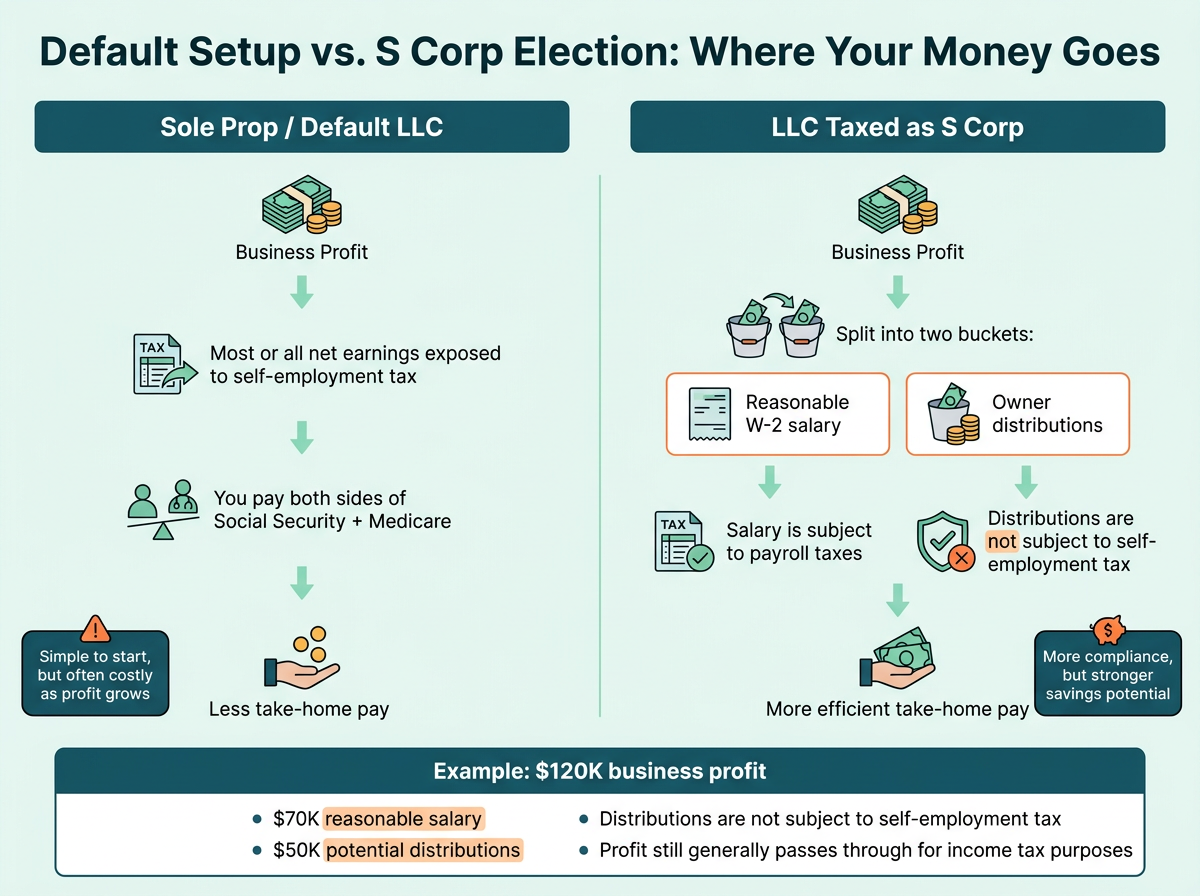
An S Corp is not a business structure in the same way as an LLC is. It is a federal tax election.
Many solo owners form an LLC, then elect to have that LLC taxed as an S Corp. The LLC remains the legal entity. The S Corp election changes how the business is taxed.
This is where the savings can show up.
Instead of treating all business profit like self-employment income, an S Corp owner who works in the business pays themselves a reasonable W-2 salary. That salary is subject to payroll taxes. Profit above that salary can generally be taken as owner distributions, which are not subject to self-employment tax.
That means:
-
Without an S Corp, many self-employed people pay self-employment tax on most or all of their business profit.
-
With an S Corp, only the reasonable salary portion is subject to payroll taxes.
-
The rest can come to you as distributions.
That split can save a solo owner thousands a year when profit is high enough.
For example, if your business earns $120,000 in profit and your reasonable salary is $70,000, the remaining $50,000 may be available as distributions. Those distributions are not subject to self-employment tax, though the profit still generally passes through for income tax purposes.
The tradeoff is compliance. S Corps requires:
-
Payroll
-
Reasonable compensation
-
Separate wage and distribution tracking
-
Annual business tax filings
The IRS is clear that S Corp shareholder-employees need reasonable compensation when they provide services to the business. If you work in the business and the company can pay you, you need a reasonable salary.
That is why S Corp savings need structure, not guesswork.
Partnership and C Corp: Usually Not the Solo Owner Path
Partnerships are generally for businesses with two or more owners. They can offer pass-through taxation and flexible ownership arrangements, but they also require:
-
Clear agreements
-
Shared decision-making
-
More complex tax reporting
-
A plan for disputes, exits, and profit-sharing
If your goal is to stay solo, focus on the sole prop, LLC, and S Corp path first.
C Corps are built for companies raising capital, issuing stock, or planning larger equity-based growth. They are separate taxpaying entities, which means the corporation may pay tax on profits, and shareholders may also pay tax on dividends.
For most freelancers, consultants, creators, and solo service providers, a C Corp is usually more structured than they need. If your goal is bigger take-home pay from a business-of-one, an LLC taxed as an S Corp is often the more practical path.
Running a consulting practice? See how Lettuce works for consultants billing $80K+, from S Corp setup to payroll and filings.
How to Pick the Structure That Pays You Best
The best business structure is not the one with the fanciest name. It is the one that fits how your business earns money.
Start with four questions:
-
How much profit are you making? If you are just starting out, a sole proprietorship or LLC may be enough. If your business consistently earns $70K+ in annual profit, the S Corp election is worth a closer look.
-
Do you need liability separation? A sole proprietorship is simple, but it does not create a separate legal entity. An LLC can help create that separation when maintained properly.
-
Do you want simplicity or savings? A default LLC is simpler than an S Corp. But simple can be expensive if your income is high enough.
-
Are you willing to run payroll? If you elect S Corp status, payroll becomes part of the deal. You need W-2 wages, withholding, tax deposits, year-end forms, and clean distribution tracking.
The right question is not, “Which structure is easiest?”
It is, “Which structure lets me keep more after taxes and admin?”
Tax-Efficient Business Structures: Frequently Asked Questions (FAQs)
Still weighing LLC vs. S Corp vs. staying simple? These answers cover the questions solo owners usually ask before changing their business structure.
What is the best business structure for a self-employed person?
It depends on income, liability risk, and admin tolerance. A sole proprietorship may work when you are just starting. An LLC can add legal separation. An LLC taxed as an S Corp may be better once your business earns consistent profit and has room for both reasonable salary and distributions.
Is an LLC or S Corp better for taxes?
An LLC is a legal structure. An S Corp is a tax election. A default single-member LLC is generally taxed much like a sole proprietorship for federal income tax purposes. An LLC taxed as an S Corp can reduce self-employment tax by splitting owner income into W-2 salary and distributions.
Why can an S Corp lower self-employment tax?
An S Corp owner who works in the business must receive reasonable W-2 compensation. That salary is subject to payroll taxes. Additional profit may be paid as distributions, which are not subject to self-employment tax.
Do S Corp distributions avoid income tax?
No. S Corp distributions are not subject to self-employment tax, but S Corp profits generally still pass through to the owner’s personal tax return and may be subject to federal and state income tax.
Can Lettuce set up my S Corp?
Yes. Lettuce forms and automates S Corps for businesses-of-one, including LLC formation, S Corp election, payroll, tax payments, bookkeeping, accounting, and business tax preparation.
Keep More of What Your Business Earns
Your business structure should help you keep more of what you earn.
A sole proprietorship is easy. A single-member LLC adds legal structure. But neither one automatically solves the self-employment tax problem.
For profitable solo owners, an LLC taxed as an S Corp can be the better move. It lets you:
-
Pay yourself a reasonable salary
-
Take additional profit as distributions
-
Reduce the amount of income exposed to self-employment tax
-
Keep payroll, filings, bookkeeping, and tax planning aligned
That is what Lettuce does. If your business-of-one is earning real money, the default structure may be costing you. Lettuce helps you find a better setup, automate the hard parts, and keep more of what you worked for.
See how much you could save with Lettuce.