
 Natalia Budyldina
1 min read

Therapist tax deductions can lower your taxable income, but the bigger savings opportunity often comes from pairing clean deduction tracking with an S Corp strategy that reduces how much of your profit is exposed to self-employment tax.
Therapists in private practice carry real business costs: office rent, telehealth software, continuing education, liability insurance, phone bills, client materials, and the everyday tools that keep sessions running smoothly. Many of those expenses may qualify as deductions when they are ordinary and necessary for your business, which means they are common in your field and helpful for your practice.
But deductions are only one part of the tax picture. They lower your taxable income, not your tax bill dollar for dollar. That is why the smartest strategy is not “buy more stuff to get more write-offs.” It is building a clean tax system that captures legitimate deductions and uses the right business structure.
Lettuce helps solopreneurs move beyond the deduction myth with automated S Corp setup, payroll, tax accounts, deduction tracking, and clean records, so you can keep more of what you earn without turning tax season into a second job.

Is Lettuce right for you?
See if Lettuce can help you keep more of what you earn with our short quiz.
Take QuizWhat Counts as a Tax Deduction for Therapists?
A therapist tax deduction is a business expense that can reduce the income your practice is taxed on. The IRS standard is simple, but strict: the expense must be ordinary and necessary for your business. Ordinary means common and accepted in your field. Necessary means helpful and appropriate for your work, even if it is not absolutely required.
For therapists, this may include expenses such as professional liability insurance, EHR software, telehealth equipment, continuing education, office rent, therapy supplies, marketing, professional licenses, and the business-use portion of phone, internet, and home-office expenses.
8 Therapist Tax Deductions Worth Tracking in Private Practice
The deductions below are some of the most relevant for private practice therapists, but every deduction depends on your facts. Keep receipts, document the business purpose, and consult a tax professional if you have a mixed-use expense, a multi-state practice, or an unusual purchase.
1. Home Office Deduction
If you use part of your home regularly and exclusively for your therapy business, you may be able to claim the home office deduction. This can apply to telehealth sessions, clinical documentation, billing, scheduling, or administrative work if the space qualifies as your principal place of business or is otherwise used in a way the IRS allows.
You generally have two ways to calculate it:
-
Simplified method: Deduct $5 per square foot, up to 300 square feet.
-
Actual expense method: Deduct the business-use percentage of eligible home expenses, such as rent, mortgage interest, utilities, insurance, repairs, and maintenance.
The key rule is exclusive use. A spare room used only for telehealth and practice admin may qualify. A guest room, kitchen table, or couch used for both personal and business purposes generally does not.

FREE CALCULATOR
Deduction
If you use part of your home regularly and exclusively for business, you can deduct it two ways. See which method puts more money back in your pocket.
Calculate
2. Office Rent and Shared Practice Space
If you rent an office, therapy room, coworking space, or part-time clinical space for your practice, those payments may be deductible business expenses. This can include monthly rent, shared suite fees, parking fees, common-area maintenance, cleaning fees, and other charges associated with the space.
Keep the lease, invoices, proof of payment, and a note showing how the space is used. If you rent an office for client sessions and also claim a home office for admin work, make sure each space has a distinct business use and meets the relevant rules.
3. Continuing Education and Clinical Training
Continuing education can be deductible when it maintains or improves skills needed in your current therapy practice. That may include CEU courses, clinical workshops, supervision, ethics training, EMDR training, trauma-informed care programs, or conferences related to your current licensure and services.
You may also be able to deduct related travel when the trip is primarily for business. The IRS has specific rules for business travel, including lodging, transportation, and meal limits.
Keep registration receipts, course agendas, completion certificates, travel receipts, and notes on how the training relates to your current practice. Be careful with education that qualifies you for a new trade or business. Training that helps you perform your current therapy work is different from education that prepares you for an entirely new profession.
4. Professional Liability and Business Insurance
Professional liability insurance, malpractice coverage, general liability insurance, cyber liability coverage, and business property insurance may be deductible when they protect your practice.
For therapists, this is one of the cleanest categories because the business connection is direct. Save policy documents, premium statements, and proof of payment. If your policy bundles several types of coverage, keep the annual statement so the expense is easy to explain later.
5. EHR, Telehealth, and Practice Software
Your digital tools are often deductible when they support your therapy practice. This can include EHR software, telehealth platforms, scheduling tools, billing software, secure messaging, encrypted email, cloud storage, accounting software, HIPAA-compliant forms tools, password managers, and cybersecurity software.
Monthly subscriptions are easy to miss because they feel small. But a $99 EHR subscription, $30 scheduling tool, and $20 secure storage plan can become meaningful over a full year. Lettuce helps identify and categorize those recurring expenses automatically.
6. Phone, Internet, and Telehealth Equipment
You may be able to deduct the business-use portion of your phone, internet, and equipment used for telehealth or practice administration. This can include a dedicated business phone line, business internet, webcam, microphone, ring light, professional backdrop, headphones, laptop stand, second monitor, router, laptop, or tablet.
If an item is used only for business, the deduction is cleaner. If it is mixed-use, deduct only the business-use percentage and keep a reasonable allocation. For larger purchases, the tax treatment may depend on whether you expense the item immediately, depreciate it, or use available safe harbor rules. The IRS has guidance on tangible property regulations, and a tax professional can help you choose the right treatment.
7. Marketing, Website, Licenses, and Professional Memberships
Costs that help you run, credential, or grow your therapy practice may be deductible. This can include website hosting, domain registration, SEO support, professional photos, directory listings, Google ads, printed materials, referral platform fees, business cards, email marketing tools, state license renewals, board fees, professional association dues, and certification renewals.
Keep proof that the expense is tied to your business. A website redesign for your therapy practice is different from a personal portfolio site. A Psychology Today listing for client acquisition is different from a general personal subscription. Some professional organizations may also separate deductible dues from lobbying, political, charitable, or nondeductible portions, so use the annual statement instead of guessing.
8. Health Insurance and Retirement Contributions
Self-employed therapists may be able to deduct eligible health insurance premiums, including medical, dental, and qualifying long-term care premiums, subject to IRS rules. For S Corp owners who own more than 2% of the company, health insurance must generally be handled through payroll and included properly on the W-2 to support the deduction.
Retirement contributions can also create meaningful tax savings while helping you build long-term wealth. Depending on your setup, you may consider a SEP IRA, Solo 401(k), traditional IRA, or another plan. S Corp owners need to be thoughtful because many retirement contribution limits are tied to W-2 wages, not total business profit.
Other Therapist Write-Offs May Still Count
Some smaller expenses can still be deductible if they are ordinary and necessary and properly documented. That may include therapy supplies, client materials, mileage, parking, local business travel, business meals, or client gifts. But these are usually not the deductions that move the needle most, and some come with strict limits. Business gifts are generally capped at $25 per recipient per year, and most business meals are deductible only at 50% when they meet IRS requirements.
The goal is not to chase every possible write-off. The goal is to capture legitimate expenses, keep clean records, and pair deductions with a bigger tax strategy when your practice is profitable enough.
How an S Corp Changes the Tax Strategy for Therapists
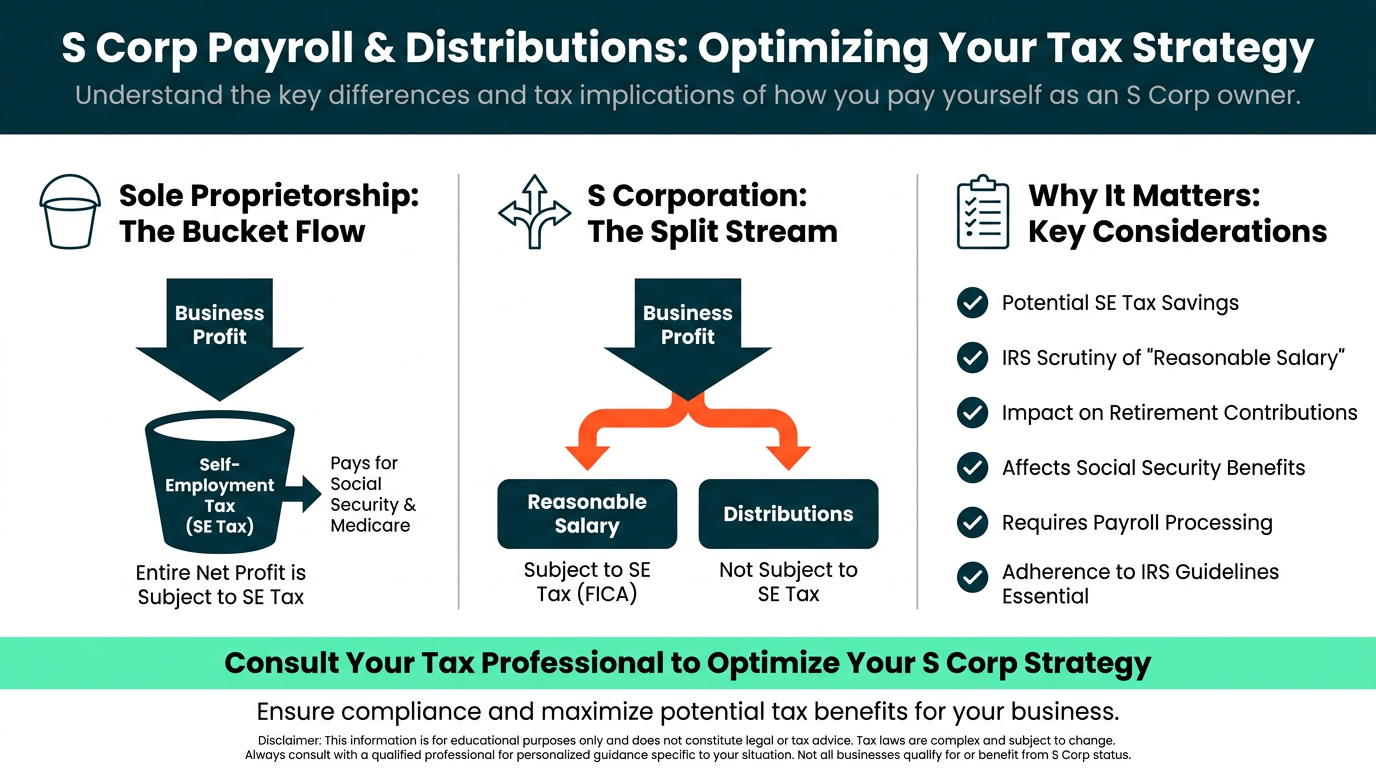
Deductions lower business profit. That matters. But for many therapists earning high net income, self-employment tax is where the bigger opportunity lies.
As a sole proprietor, your net self-employment income is generally subject to self-employment tax. As an S Corp owner, you pay yourself a reasonable salary through payroll. That salary is subject to payroll taxes. The remaining profit can generally be distributed as owner distributions, which are not subject to self-employment tax.
Here is a simplified example:
-
A therapist has $150,000 in business profit before owner pay.
-
As a sole proprietor, most of that net profit may be exposed to self-employment tax.
-
As an S Corp, the therapist might pay a reasonable salary and take the remaining profit as distributions.
-
The distributions may avoid self-employment tax, creating potential savings.
The exact savings depend on your income, reasonable salary, state taxes, retirement strategy, deductions, and filing situation. Many profitable solopreneurs can save thousands each year, and some can reach five figures. But the structure must be run correctly.
That means:
-
Paying yourself a reasonable salary
-
Running payroll consistently
-
Separating business and personal finances
-
Tracking deductions cleanly
-
Filing the right federal and state forms
-
Keeping audit-ready records
Lettuce automates the parts of S Corps that usually feel overwhelming: formation, payroll, tax accounts, filings, deduction tracking, and year-end cleanup. Instead of trying to manage spreadsheets, payroll dates, and tax deadlines on your own, you get a system built for solopreneurs.
Therapist Tax Deductions: Frequently Asked Questions (FAQs)
These FAQs cover the details private practice owners ask most often when they start tracking therapist write-offs and comparing deduction savings with S Corp savings.
What therapist tax deductions can I claim?
You may be able to claim expenses that are ordinary and necessary for your therapy practice, such as office rent, liability insurance, EHR software, telehealth equipment, continuing education, marketing, professional dues, and the business-use portion of phone, internet, mileage, and home office costs. The expense must have a clear business purpose and proper documentation.
Do tax deductions save me the full amount I spend?
No. A deduction lowers taxable income, not your tax bill dollar for dollar. If you spend $1,000 and your effective tax rate is 25%, the deduction may save about $250 in taxes, but you still spent $750.
Are therapist tax deductions better than an S Corp?
They do different jobs. Deductions reduce taxable income. An S Corp can reduce how much business profit is subject to self-employment tax when you pay yourself a reasonable salary and take eligible distributions. For many profitable private practice owners, the strongest strategy is using both.
Can therapists deduct a home office?
Yes, if the space is used regularly and exclusively for business and meets IRS requirements. A dedicated telehealth room or admin office may qualify. A mixed-use room generally does not.
Can therapists deduct continuing education?
Yes, when the education maintains or improves skills in your current therapy practice. CEUs, clinical training, conferences, and supervision may qualify. Education that prepares you for a new trade or business may not qualify.
Can therapists deduct therapy books, apps, and client materials?
Yes, when they are primarily used for your practice. Books used for clinical reference, apps used in treatment planning, and materials used in sessions may qualify. Personal development tools or personal reading should not be deducted unless there is a clear and documented business-use portion.
Can therapists deduct mileage?
Yes, business mileage may be deductible when you drive for client visits, business meetings, trainings, or travel between work locations. Your regular commute usually does not qualify. Keep a mileage log with dates, miles, destinations, and business purposes.
Can therapists deduct client gifts?
Sometimes, but the rules are limited. The IRS generally caps business gift deductions at $25 per recipient per year. Therapists should also consider professional ethics before giving gifts to clients.
When should a therapist consider an S Corp?
A therapist should consider an S Corp when the practice is consistently profitable enough that payroll tax savings may outweigh the added cost and administration. The right point depends on profit, reasonable salary, state rules, retirement goals, and filing needs. The Lettuce Tax Calculator can help estimate potential savings.
How does Lettuce help with therapist taxes?
Lettuce helps solopreneurs form and run an S Corp, automate payroll, separate tax money, track deductions, and manage filings. That gives therapists a cleaner system for both everyday write-offs and bigger S Corp tax savings.
Stop Chasing Write-Offs. Build a Better Tax Strategy.
Therapist tax deductions matter. They help you avoid overpaying taxes on money you spent to run your practice. You should track them, document them, and claim the ones you are legally allowed to claim.
But deductions are not the whole strategy. You do not build wealth by spending $1,000 to save a fraction of it. You build a stronger tax outcome by combining smart deductions with the right structure, clean books, and automated compliance.
For many self-employed therapists, that means looking seriously at an S Corp. It can reduce self-employment tax exposure, create cleaner owner pay, and work alongside deductions for a more complete savings strategy.
Ready to see what that could mean for your practice? Try the Lettuce Tax Calculator, then explore how Lettuce can help you form, run, and maintain your S Corp from one automated platform.