
 Natalia Budyldina
1 min read

Knowing when to start an LLC can make all the difference, especially once you're signing major contracts. Beyond protecting your personal assets, an LLC boosts your credibility and helps you land premium clients. With Lettuce, LLC formation, S-Corp election, and compliance happening automatically, no extra work is required.

Is Lettuce right for you?
See if Lettuce can help you keep more of what you earn with our short quiz.
Take QuizWhen to Start an LLC: The Smartest Timing for Solopreneurs
Forming an LLC at the right time, typically when signing major contracts, can protect your personal assets. An LLC not only provides liability protection but also boosts your professional credibility, making it easier to land premium clients and streamline business finances for future growth. Platforms like Lettuce automate LLC formation, S-Corp election, and ongoing compliance, allowing solopreneurs to maximize tax advantages and minimize administrative headaches.
Whether you've been freelancing for years or just started picking up clients, forming an LLC is more accessible than most people think. Here's what you need to know about when to start an LLC, its advantages and disadvantages, and how to get started.
Ready to stop leaving money on the table? Lettuce automates your LLC formation, S-Corp election, and ongoing compliance.
When Should You Form an LLC?
An LLC (Limited Liability Company) is a business structure that creates a legal wall between you and your business. If a client sues your business or you face unexpected liabilities, your home, savings, and personal investments stay protected. For tax purposes, LLCs remain pass-through entities, just like a sole proprietorship: your income flows to your personal return, taxed at your individual rate.
Most solopreneurs wait too long and miss out on liability protection. Three signs tell you it's time: you're signing contracts worth $10,000 or more with enterprise clients who require W-9s, or you're hiring contractors and taking on work with higher liability exposure. The SBA recommends choosing your business structure before registration to avoid complications later.
If you have a consistent monthly income or a signed contract requiring an EIN number, forming now means clean financial records from day one and no messy catch-up work at tax time. If you're still in the idea stage with no revenue or signed contracts, wait until you have concrete business activity to justify the state fees. Independent contractors should strongly consider LLC formation when liability exposure increases or when building long-term client relationships that require professional credibility.
How Are LLCs Taxed?
By default, single-member LLCs are "disregarded entities": you report profits on Schedule C of your Form 1040, paying regular income tax plus 15.3% self-employment tax on net earnings. There's no separate business return required.
- Single-member LLCs file a 1040 using Schedule C
- LLCs operating as S-Corps run payroll, file quarterly reports, and issue W-2s
The biggest tax decision for a growing solopreneur is when to elect S-Corp status. Once profits reach $60,000–$80,000 annually, you pay yourself a reasonable salary subject to payroll taxes and take the remaining profits as distributions, which aren't subject to self-employment tax. For many solopreneurs, this saves $8,000 to $15,000 per year. Lettuce calculates your optimal salary vs. distribution balance using IRS guidelines and handles all filings automatically.
State-level costs vary dramatically. California charges $800 annually for all LLCs, New York imposes tiered minimums based on receipts, and Texas requires franchise tax at 0.375%–0.75% but completely exempts businesses earning under $2.65 million in total revenue. Most states require annual reports with fees ranging from $25–$500. Lettuce notifies you of all state deadlines and manages compliance automatically.
Can Anyone Form an LLC?
For most solopreneurs, yes. If your business offers licensed professional services like legal or accounting work, your entity may be called a PLLC rather than a standard LLC, but the protections and process are similar. Banks and insurance companies cannot form LLCs, but beyond those exceptions, formation is broadly available to individuals, corporations, and other LLCs.
What Are the Advantages of Forming an LLC?
LLCs operate with the simplicity of a sole proprietorship while providing the liability protection of a corporation. When comparing an LLC vs. sole proprietorship, the benefits come down to five areas.
Liability protection. Your LLC acts as a legal firewall between your personal life and your business risks. Your home, car, and savings are protected from business creditors. The SBA confirms that LLC liability protection is one of the primary reasons business owners choose an LLC over a sole proprietorship. Mixing funds or ignoring formalities can pierce the veil and destroy your shield.
Professional credibility. Enterprise clients and larger contracts often require vendors to have a formal business structure. You'll move faster through vendor onboarding, command higher rates, and access banking and credit lines unavailable to sole proprietors. Lettuce's formation process handles all setup details automatically.
Pass-through tax treatment. By default, the IRS ignores the LLC structure for tax purposes, passing profits and losses directly onto your personal tax return. This avoids double corporate taxation while keeping accounting simple during your initial startup phases. Tax flexibility for growth. Start with simple pass-through taxation, then upgrade to S-Corp status when your profits justify it. This can mean $8K–$15K in annual savings on self-employment taxes. Lettuce automates the entire process from LLC formation to S-Corp election.
Financial organization. Business bank accounts create a clean paper trail for every expense and simplify taxes. The IRS requires structured recordkeeping for business deductions, and keeping business and personal finances separate demonstrates legitimate business operations. The SBA recommends opening business accounts as soon as you form your LLC.
How to Form an LLC
Forming an LLC is simpler than most solopreneurs think. These six steps turn your business into a protected, professional entity, and platforms like Lettuce handle the entire process in about 10 minutes.
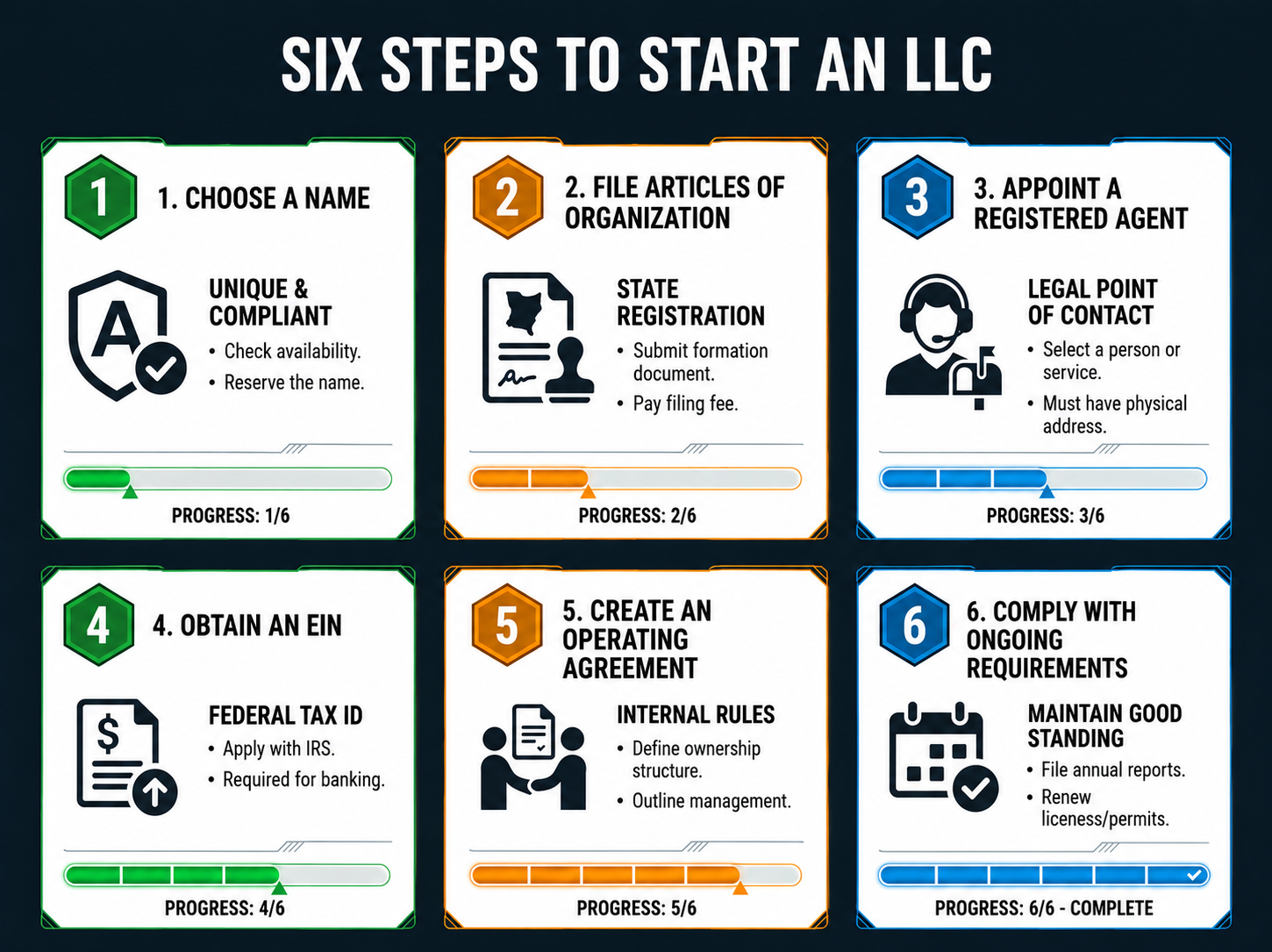
1. Choose a business name. Confirm availability in your state's business registry, check domain availability, and verify no trademark conflicts in the USPTO database. The SBA recommends coordinating these searches to maintain consistency across all your professional touchpoints. Operating as an LLC rather than a sole proprietorship immediately signals professionalism to potential clients.
2. File Articles of Organization. When you file LLC articles of organization, you create the legal entity that separates your business from your personal assets. Fees run $50–$500, depending on your state, with most states processing in one to two weeks. States like New York require newspaper publication within 120 days. Lettuce manages filings across all 50 states.
3. Select a registered agent. Every LLC needs a registered agent to receive official legal documents and state notices. You can serve as your own if you have a physical address in your formation state, or hire a service for privacy and convenience. Failing to maintain a registered agent can result in losing your LLC status. Lettuce provides registered agent support in all 50 states.
4. Apply for an EIN. Your Employer Identification Number from the IRS keeps your Social Security Number off client contracts and is required for business banking and payroll. Apply for free through the IRS online application and receive it immediately, or use Form SS-4 as a backup. When you form your LLC through Lettuce, your EIN is obtained automatically.
5. Open a separate business bank account. The SBA emphasizes opening business accounts as soon as you begin business transactions. Opening your account right after formation means every transaction is properly categorized from day one. Lettuce's free business checking integrates directly with payroll and bookkeeping, with financial separation requirements that protect your LLC's liability shield built in.
6. Create an operating agreement. Your LLC operating agreement is your business's internal rulebook. Some states, like New York, require written agreements; others, like California, mandate LLCs maintain them in their records. The SBA recommends operating agreements for all LLCs. Cornell Law School notes this provides crucial legal protection, especially for single-member LLCs. Lettuce provides state-specific templates and secure document storage.
What Are the Disadvantages of Forming an LLC?
Piercing the corporate veil. Mixing personal and business finances, ignoring corporate formalities, or being found negligent can destroy your liability shield. Consistent separation between personal and business activities, per consistent business practices, is essential to preserving your protection.
Self-employment tax still applies by default. LLC formation alone doesn't reduce your tax burden. The IRS requires LLC members to pay self-employment tax on their share of business income. An S-Corp election can reduce this, but it typically makes financial sense only once profits consistently exceed $80,000.
Additional administrative work and costs. LLCs require separate records, annual state filings, and a registered agent. If you elect S-Corp status, add quarterly employment tax filings and regular payroll. Annual overhead typically runs $200–$1,000, factoring in state fees and registered agent costs. Formation and ongoing costs are worth understanding before you commit. Modern platforms handle most of this administrative work automatically, but the underlying compliance requirements remain.
Frequently Asked Questions
Smart solopreneurs ask the right questions before making moves that affect their taxes and legal protection. These answers cut through the confusion and give you the clarity to act with confidence.
When should I form an LLC if I'm still side-hustling?
Form your LLC when your side hustle consistently brings in $1,000+ monthly, or you're signing contracts that require an EIN. Early formation protects you from day one and makes the transition to full-time entrepreneurship seamless. You'll avoid retroactive paperwork and establish clean financial separation immediately.
Is it better to start an LLC before electing S-Corp status?
Yes, starting as an LLC gives you flexibility to grow into S-Corp benefits when the timing makes sense. You can elect S-Corp status anytime after formation, but you can't go backward easily. This approach lets you evaluate your earnings trajectory before committing to payroll requirements.
How much income should I have before making my LLC an S-Corp?
Most solopreneurs see meaningful tax savings with an S-Corp election, around $80,000+ in annual profit. Below that threshold, the payroll compliance costs often outweigh the self-employment tax savings. Lettuce automates the entire process, making the S-Corp election profitable at lower income levels than traditional setups.
Which state should I form in if I work remotely?
Form in your state of residence unless you have compelling reasons otherwise. Remote work doesn't change your tax obligations to your home state. Formation timelines vary by state, but most are completed within 2-3 weeks. Lettuce handles the paperwork regardless of which state you choose.
Can I elect S-Corp mid-year or retroactively if my profits jump?
You can elect S-Corp status mid-year, and the IRS offers late election relief within 3 years and 75 days of your intended effective date. This flexibility means you don't have to predict your entire year perfectly. Lettuce handles the paperwork and ensures you meet all requirements for retroactive elections.
What if I have a month with no income—can payroll still run?
Yes, Lettuce can run payroll for as little as $1 to maintain the employer-employee relationship required for S-Corp compliance. This minimal payment preserves your S-Corp status during slow months without forcing unrealistic salary payments. The system adjusts automatically based on your account balance.
How does Lettuce handle monthly tax payments vs. quarterly estimates?
Lettuce calculates and pays your federal and state taxes monthly through payroll and it automatically calculates and submits your required Quarterly Estimated Payments to cover the pass-through profit flowing to your Schedule K-1.This approach prevents underpayment penalties and smooths your cash flow throughout the year.
Do I need an operating agreement as a single-member LLC?
While not required in every state, an operating agreement strengthens your liability protection and clarifies your business structure for banks and clients. It's especially important if you plan to elect S-Corp status later. Lettuce provides templates and handles document storage as part of your LLC formation process.
Ready to Get Started?
The smartest time to start an LLC is before your next meaningful contract or when you can see $40K+ in annual revenue. Early formation protects your assets, boosts your credibility with clients, and sets the foundation for future tax strategies like an S-Corp election. You'll avoid retroactive headaches and position yourself for success with the right business structure from day one.
Once you decide to move forward, the LLC timeline is just 2-3 weeks to completion. You get liability protection, financial organization, and access to tax advantages that can save thousands annually. Plus, you'll have peace of mind knowing your setup costs are transparent and manageable.
Stop leaving money on the table and start an LLC now with Lettuce. We'll handle your formation, S-Corp election, smart banking, automated payroll, and complete tax compliance so you can focus on what you do best.