 Natalia Budyldina
1 min read

The best way to keep records when self-employed is to use a simple, consistent system that tracks income, expenses, receipts, and tax documents throughout the year. Good records help you manage cash flow, claim deductions, and stay tax-ready, while eligible solopreneurs may unlock even greater savings through an S Corp strategy.
Recordkeeping is one of those “future you” tasks. Easy to ignore today. Painful to fix later.
But the best way to keep records when self-employed isn’t to hoard every receipt in a shoebox or spend your weekends categorizing transactions. It’s to build a simple system that separates your business money, captures the right documentation, and keeps your books clean all year.
Good records help you claim legitimate deductions, file accurately, and stay ready if questions come up later.
Lettuce helps solopreneurs go beyond receipt-chasing by automating bookkeeping, payroll, tax strategy, and S Corp support in one place.

Is Lettuce right for you?
See if Lettuce can help you keep more of what you earn with our short quiz.
Take QuizWhat Your Recordkeeping System Should Do
Think of your recordkeeping system like an office manager. Its job is to keep your business organized without slowing you down.
A good system should be:
-
Easy to use: If it takes too long, you won’t stick with it.
-
Accurate: Income and expenses should match your bank and payment records.
-
Consistent: Use the same categories and naming rules every month.
-
Current: Update records monthly, not once a year.
-
Clear: You should be able to understand your numbers without decoding a messy spreadsheet.
For most self-employed people, this starts with separate business banking. Run business income and expenses through dedicated accounts so you are not sorting through personal transactions at tax time.
Then connect those accounts to bookkeeping software or an automated platform. That gives you a cleaner trail for income, expenses, receipts, and deductions.
What Business Records Help You See
Good records are not just for the IRS. They help you run a better solo business.
Your records can show you:
-
Cash flow: Bank statements and invoices show what came in, what went out, and what you may need to set aside.
-
Income trends: Payment records help you spot strong months, slow seasons, and clients that drive the most revenue.
-
Expense patterns: Categorized expenses show where your money is going and whether certain tools, subscriptions, or services still make sense.
-
Tax exposure: Clean books make it easier to estimate taxes and avoid surprises.
-
Business health: Profit and loss reports show whether your pricing, expenses, and workload are actually working.
This is why recordkeeping should not feel like a tax-only task. It is how you keep a pulse on your business.
For a cleaner year-end process, use a tax document checklist so income records, deductions, and tax forms are not scattered across inboxes and folders.
What Records Should You Keep When Self-Employed?
You do not need to keep random paperwork forever. You need records that support your tax return and explain what happened in your business.
| Record Type | What to Save | Why It Matters |
|---|---|---|
| Income records | Invoices, 1099s, payment reports, deposits | Shows what you earned |
| Expense records | Receipts, statements, bills, vendor invoices | Supports deductions |
| Mileage records | Date, destination, business purpose, miles | Supports vehicle claims |
| Home office records | Square footage, rent, utilities, and internet | Supports home office claims |
| Asset records | Equipment receipts, purchase dates, business use | Supports depreciation |
| Tax records | Returns, estimated payments, IRS/state notices | Supports filing history |
| S Corp records | Payroll, W-2s, salary support, distributions | Supports compliance |
The IRS says your business records should clearly show income and expenses. Keep them organized enough that you can explain a transaction without relying on memory.
How to Organize Records for Self-Employment Taxes
Your recordkeeping system should make tax time easier, not harder.
At a minimum, your system should track:
-
Business income
-
Business expenses
-
Receipts and statements
-
Mileage
-
Home office details
-
Contractor payments
-
Estimated tax payments
-
Payroll records, if applicable
For expenses, save the amount, date, vendor, and business purpose. For meals, travel, gifts, and vehicle expenses, documentation matters even more because the IRS has stricter substantiation rules.
The IRS accepts electronic records, so digital files can work when they are accurate, complete, and accessible.
Here’s the part many solopreneurs miss: deductions help, but they are not magic. Spend $1,000 on a deductible business expense, and you may save only a portion of that in taxes. You still spent the money.
That is why recordkeeping should support a bigger tax strategy. For eligible solopreneurs, an S Corp may help reduce self-employment tax exposure by splitting income between a reasonable salary and distributions.
Use a Monthly Recordkeeping Routine
Waiting until tax season is how expenses get missed.
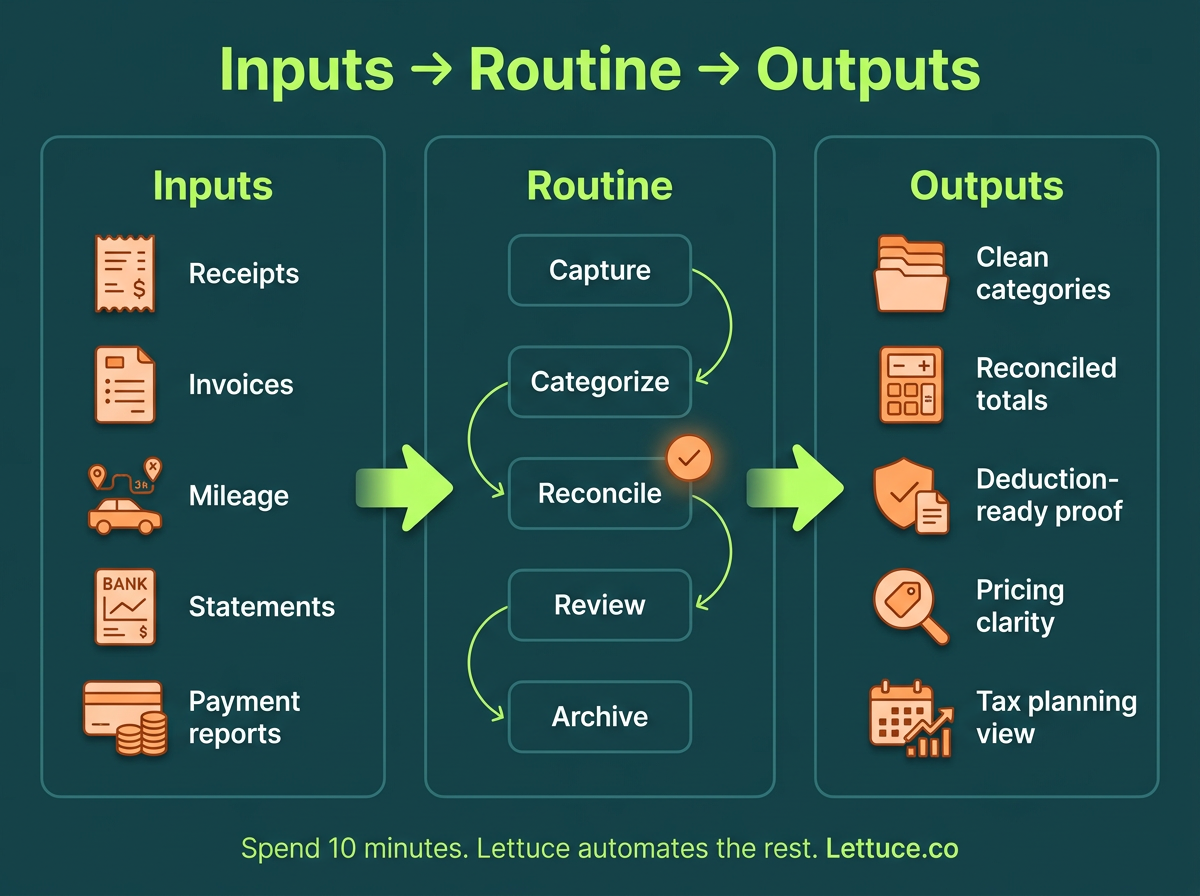
Use this monthly routine instead:
-
Capture: Save receipts, invoices, mileage logs, bank statements, and payment reports.
-
Categorize: Tag expenses by business purpose, such as software, meals, travel, education, or supplies.
-
Reconcile: Match your books against bank and credit card statements.
-
Review: Check for missing expenses, duplicates, personal charges, and uncategorized transactions.
-
Archive: Store records digitally by year, month, and category.
This process keeps your books current and makes deductions easier to support. It also gives you cleaner numbers for pricing, tax planning, and cash flow decisions.
Monthly Recordkeeping Tips for Self-Employed Professionals
Waiting until tax season is how expenses get missed.
Use this monthly routine instead:
-
Capture: Save receipts, invoices, mileage logs, bank statements, and payment reports.
-
Categorize: Tag expenses by business purpose, such as software, meals, travel, education, or supplies.
-
Reconcile: Match your books against bank and credit card statements.
-
Review: Check for missing expenses, duplicates, personal charges, and uncategorized transactions.
-
Archive: Store records digitally by year, month, and category.
This process keeps your books current and makes deductions easier to support. It also gives you cleaner numbers for pricing, tax planning, and cash flow decisions.
Digital Recordkeeping for Self-Employed Businesses
Paper records fade, get lost, and pile up. Digital records are easier to search and back up.
Use a folder structure like this:
-
2026 Income
-
2026 Expenses
-
2026 Receipts
-
2026 Mileage
-
2026 Home Office
-
2026 Contractors
-
2026 Payroll
-
2026 Tax Filings
-
2026 IRS and State Notices
Then use searchable file names:
2026-03-14_ClientLunch_ProjectName_$86.pdf
That file name gives you the date, purpose, category, and amount before you even open the file.
For digital security:
-
Use cloud storage with secure login.
-
Back up files regularly.
-
Limit access to sensitive records.
-
Shred paper records you no longer need.
-
Keep tax-year folders organized and easy to find.
These small business automations can also help reduce manual work across bookkeeping, receipts, and back-office tasks.
How Long Should You Keep Self-Employment Tax Records?
The IRS says you should keep records as long as they may be needed to prove income, deductions, or credits on a return.
In general:
-
Keep most tax records for at least three years from the date you filed the return or the return’s due date.
-
Keep records for six years if you omitted income you should have reported, and it is more than 25% of the gross income shown on your return.
-
Keep employment tax records for at least four years after the tax becomes due or is paid, whichever is later.
-
Keep property records until the period of limitations expires for the year you dispose of the property.
The IRS explains these timelines in its guide on keeping records. When in doubt, keep digital copies longer than the minimum.
Common Self-Employment Recordkeeping Mistakes to Avoid
Avoid these common mistakes:
-
Mixing accounts: Personal and business transactions should not live in the same place.
-
Waiting too long: Monthly updates are easier than year-end cleanup.
-
Missing business purpose: A receipt is stronger when it explains why the expense was business-related.
-
Forgetting mileage: Vehicle deductions need a reliable log.
-
Ignoring payroll records: If you elect S Corp status, payroll records and reasonable compensation support matter.
-
Treating deductions like profit: Deductions lower taxable income. They do not make spending free.
Good recordkeeping is not about perfection. It is about having a consistent system you trust.
Best Way to Keep Records When Self-Employed: Frequently Asked Questions (FAQs)
Smart recordkeeping makes tax season easier and helps you claim legitimate deductions with more confidence.
What is the best way to keep records when self-employed?
The best way to keep records when self-employed is to separate business finances, capture receipts digitally, categorize expenses monthly, and store documents in a searchable system.
What records should I keep for self-employment taxes?
Keep income records, expense receipts, mileage logs, bank statements, home office records, contractor payments, tax filings, and IRS or state notices. If you operate as an S Corp, keep payroll reports, W-2s, shareholder distribution records, and salary documentation.
Do I need paper receipts for business expenses?
Not always. Digital copies can work when they are clear, complete, and accessible. For meals, travel, gifts, and vehicle expenses, keep extra detail like business purpose, date, amount, and location.
How long should self-employed people keep tax records?
Most self-employed people should keep tax records for at least three years, but some records should be kept longer. Employment tax records should generally be kept for at least four years.
How do I make sure I never miss a deduction?
Use a dedicated business account, connect it to bookkeeping software, capture receipts right away, and review expenses every month. You are less likely to miss deductions when every business dollar flows through the same system.
Keep Better Records, Then Go Beyond Deductions
The best way to keep records when self-employed is simple: separate your money, capture the right documentation, reconcile monthly, and automate as much as possible.
That system helps you claim deductions without the tax-season scramble.
But deductions are only the starting point. If you’re earning enough as a solopreneur, your biggest tax opportunity may not be another receipt. It may be a smarter business structure.
Ready to simplify your back office? Get started with Lettuce and automate recordkeeping, payroll, taxes, and S Corp compliance in one place.