
 Christopher Potter
1 min read

A self-employed HSA gives you a triple tax win: deductible contributions, tax-free growth, and tax-free withdrawals for medical expenses. For S Corp owners and freelancers, the key is following the right contribution rules and keeping HSA funding separate from payroll. Automate it right, and you'll dodge errors while keeping more money working for you.
Here’s a tax strategy that works three ways at once: eligible HSA contributions may be deductible or excluded from income, earnings grow tax-free while held in the account, and withdrawals for qualified medical expenses are tax-free. While HSAs are unique in offering tax-deductible contributions, tax-free growth, and tax-free qualified withdrawals, this statement may be viewed as promotional rather than educational.
As a business-of-one, the HSA setup process is simpler than you think. Confirm you have a qualifying high-deductible health plan, open your HSA account, and start funding it monthly using the latest IRS limits. Whether you're a consultant, freelancer, or S Corp owner, the right approach turns everyday medical expenses into permanent tax savings.
Ready to automate your entire financial back-office while maximizing every tax advantage? Lettuce handles your payroll, bookkeeping, tax strategy, and healthcare so you have more time to focus on running the business.
Curious if an S Corp is right for you?
Try the Lettuce Tax Calculator to see how much more you can take home each year.
See your savings
The Requirements to Open an HSA
Before you worry about contribution timing or investment choices, you need to clear a few simple eligibility hurdles. HSAs are all-or-nothing: meet the requirements, and you unlock the triple tax advantage; miss one, and you’re out until you fix it.
To open and contribute to an HSA, you must:
- Be covered by a qualifying High Deductible Health Plan (HDHP).
- Have no other disqualifying coverage, like a general-purpose FSA or low-deductible health plan that covers you.
- Not be enrolled in Medicare. Once you enroll in any part of Medicare, you can’t make new HSA contributions. Existing HSA balances remain available after Medicare enrollment and may continue to be used for qualified medical expenses.
- Individuals approaching age 65 should coordinate Medicare enrollment carefully because retroactive Medicare coverage can affect HSA contribution eligibility.
- Not be claimed as a dependent on someone else’s tax return.
Beginning January 1, 2026, certain Bronze and catastrophic individual-market plans are treated as HSA-compatible even if they do not otherwise meet the standard HDHP deductible or out-of-pocket thresholds. Certain qualifying direct primary care arrangements also do not disqualify an otherwise eligible individual, subject to applicable service and monthly fee limits.
For HDHPs, the IRS sets minimum deductibles and maximum out-of-pocket limits each year. Your plan has to meet both tests to qualify. That’s why choosing the right health plan as a freelancer or S Corp owner matters as much as the HSA itself.
Timing matters too. HSA eligibility is determined month-by-month. If you’re covered by a qualifying HDHP on the first day of a month and meet the other conditions, you’re eligible to contribute for that month. Switch plans mid-year? Your contribution limit adjusts based on the months you were actually eligible.
An exception known as the last-month rule may allow you to make a full-year contribution if you are HSA-eligible on December 1. However, you generally must remain eligible throughout the applicable testing period or the additional contribution may become taxable and subject to an additional tax.
If you’re a more-than-2% S -Corp shareholder, your business structure changes how HSA contributions are treated. You generally cannot make pre-tax salary-reduction HSA contributions through a Section 125 cafeteria plan. You may contribute personally and claim the HSA deduction if eligible, or the S -Corp may contribute with the amount properly included in your taxable compensation.
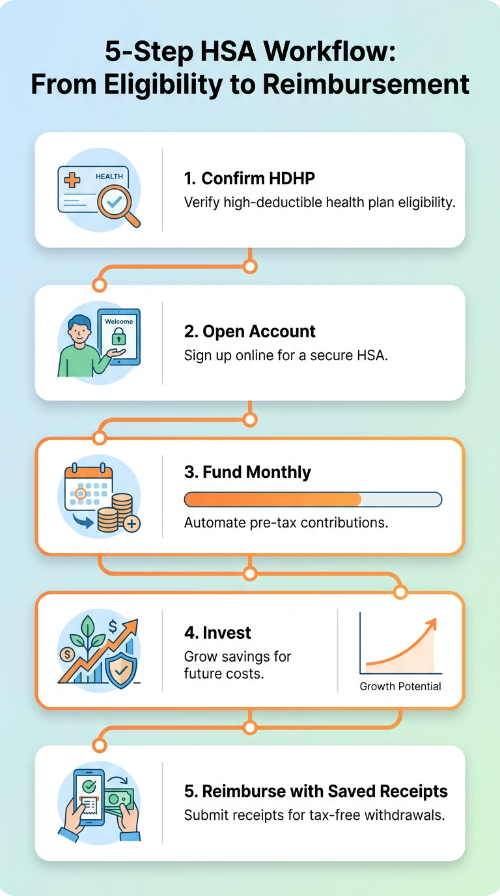
5 Steps to Open and Use an HSA as a Freelancer or Consultant
Healthcare costs don't have to hurt your bottom line. Here's exactly how to open and use an HSA as a freelancer or consultant, from plan selection to long-term wealth building.
- Confirm your coverage is HSA-compatible: For conventional HDHPs in 2026, the minimum deductible is $1,700 for self-only coverage or $3,400 for family coverage. Maximum annual out-of-pocket expenses are $8,500 for self-only coverage or $17,000 for family coverage. Beginning in 2026, certain Bronze and catastrophic individual-market plans are also treated as HSA-compatible even if they do not meet these standard thresholds. Also avoid disqualifying additional coverage, such as a general-purpose health FSA.
- Choose a low-fee HSA provider with investment options: Skip banks charging monthly maintenance fees. Providers like Fidelity, Lively, and HSA Bank offer free accounts, low-cost index funds, and easy online access.
- Set up monthly auto-contributions aligned with the 2026 IRS limits: The annual contribution limit is $4,400 for self-only coverage or $8,750 for family coverage, plus a $1,000 catch-up contribution if you are age 55 or older. To spread the standard limit evenly across 12 months, contribute approximately $366.67 monthly for self-only coverage or $729.17 monthly for family coverage. Monitor all contributions made by you or on your behalf to avoid exceeding the annual limit.
- Invest your HSA balance once you build a cash buffer: Keep 3-6 months of typical medical expenses in cash, then invest the rest in low-cost index funds. Your HSA grows tax-free, making long-term investing a powerful wealth-building strategy.
- Maximize your tax benefits today and tomorrow: HSA contributions are above-the-line deductions that reduce your AGI immediately. After age 65, your HSA becomes a retirement account where withdrawals for any purpose are penalty-free (though taxed as ordinary income for non-medical expenses).
- Non-qualified withdrawals before age 65 are generally subject to ordinary income tax plus 20% penalty.
- Save receipts and consider paying out of pocket when appropriate: You may reimburse yourself later for qualified medical expenses incurred after the HSA was established, provided the expenses were not previously reimbursed or claimed as an itemized deduction. Report the HSA distribution on Form 8889 and retain receipts and supporting records showing that the expenses qualified.
How HSAs Work for the Self-Employed (And 2026 Planning)
Keep more of what you earn with an HSA that works triple-time for your tax savings. When you're wondering how an HSA works if you're self-employed, the mechanics revolve around qualifying coverage, tax advantages, and strategic contribution timing. Here's how to make it work for you.
Your Eligibility Depends on HSA-Compatible Coverage
To contribute to an HSA, you generally must have HSA-compatible coverage and no disqualifying additional coverage. For conventional HDHPs in 2026, the minimum deductible is $1,700 for self-only coverage or $3,400 for family coverage, and maximum annual out-of-pocket expenses are $8,500 and $17,000, respectively. Beginning in 2026, certain Bronze and catastrophic individual-market plans are also treated as HSA-compatible even when they do not satisfy the conventional HDHP thresholds.
Certain qualifying direct primary care arrangements may also be permitted. Eligibility is determined month by month, so review all coverage that applies to you, including coverage provided through a spouse.
Triple Tax Advantage: In, Growth, and Out
HSAs deliver tax benefits no other account can match. Eligible personal contributions generally may be claimed as an above-the-line deduction, qualifying employer contributions may be excluded from income, earnings grow free of federal income tax while held in the account, and withdrawals for qualified medical expenses are federally tax-free.The actual tax savings depend on your marginal federal and state tax rates, your eligibility, and how the contribution is made. Unlike FSAs, unused HSA funds roll over indefinitely, and after age 65, you can withdraw for any purpose penalty-free.
2026 Contribution Strategy: Automate From Day One
Set up automatic monthly transfers of approximately $366.67 for self-only coverage or $729.17 for family coverage, based on the confirmed 2026 annual limits of $4,400 and $8,750. Eligible individuals age 55 or older may contribute an additional $1,000. Monitor contributions made by you, your business, or anyone else on your behalf because all contributions count toward the applicable annual limit. More-than-2% S Corp shareholders should also coordinate the contribution method and reporting with their payroll and tax professional.
Self-Employed HSA: Frequently Asked Questions (FAQs)
You need straight answers about HSA mechanics that don't apply to traditional employees. These FAQs address the specific scenarios you face as a business-of-one, where your structure and family situation create unique opportunities to maximize tax-free savings.
What are the HSA contribution limits for self-employed individuals in 2026?
The confirmed 2026 contribution limit is $4,400 for self-only coverage or $8,750 for family coverage. Eligible individuals age 55 or older may contribute an additional $1,000. These limits apply to the total contributions made by you and anyone contributing on your behalf.
How does an HSA work if you're self-employed and your spouse has their own coverage?
You and your spouse may each maintain separate HSAs if you are both eligible individuals. If either eligible spouse has family HDHP coverage, you generally share the annual family contribution limit and may divide it between your HSAs in any proportion you agree upon. If either spouse is age 55 or older and eligible for a catch-up contribution, that catch-up amount must be deposited into that spouse’s own HSA.
Can S Corp shareholders contribute to an HSA tax-free through payroll?
More-than-2% S Corp shareholders cannot make pre-tax salary-reduction HSA contributions through a Section 125 cafeteria plan. They may contribute personally and claim the HSA deduction if eligible. Alternatively, the S Corp may contribute to the shareholder’s HSA, but the amount generally must be included in the shareholder’s taxable compensation, after which the eligible shareholder may claim the HSA deduction on their personal return.
Can I use HSA funds for my family's medical expenses?
Your HSA covers qualified medical expenses for you, your spouse, and tax dependents, regardless of their insurance coverage. This includes expenses not covered by insurance, like dental work, vision care, and prescription medications. Keep digital receipts to reimburse yourself tax-free anytime.
What happens if I contribute too much to my HSA?
Excess HSA contributions are generally subject to a 6% excise tax for each year they remain in the account. To avoid the excise tax, withdraw the excess contribution and any related earnings by the due date of your federal income tax return, including extensions, and report the earnings as required. The IRS provides updated guidance on recent HSA rule changes affecting your planning.
Put Your HSA on Autopilot and Keep More of What You Earn
Your HSA delivers triple tax savings when you navigate the S Corp requirements correctly. Make eligible deductible or properly reported contributions, allow earnings to grow free of federal income tax while held in the account, and take federally tax-free withdrawals for qualified medical expenses. The strategy works best when your S Corp payroll and HSA contributions stay properly separated to preserve your personal deduction.
The challenge for S Corp owners is that smart integration of your HSA with S Corp operations means automating the compliance details that trip up most business owners. Monthly HSA funding, accurate W-2 reporting, and compliant health insurance premium handling all work together. When your payroll system tracks everything correctly, you maximize tax savings without the compliance headaches.
Ready to automate your entire financial back-office? Lettuce handles S Corp payroll, tax withholdings, and healthcare benefits seamlessly.
Lettuce offers health benefits to eligible Lettuce Pro members through its professional employer organization (PEO). Health/medical coverage is provided by Curative. This article is for informational purposes only and does not constitute medical, insurance, tax, or legal advice. Benefits, plan availability, coverage, premiums, eligibility, and potential savings vary by state and individual circumstances and are subject to change. Coverage is subject to the terms and conditions of the applicable benefit plan. Nothing in this article should be interpreted as a recommendation to purchase, enroll in, or decline any specific insurance plan. Consult a licensed insurance agent, tax professional, and/or healthcare provider before making decisions about your health coverage or benefits.