

 Alex Zelaya
1 min read

The 1099-NEC is the IRS form freelancers and solopreneurs receive when a client pays them $2,000 or more for services in a year. It reports nonemployee compensation, impacts your self-employment taxes, and comes with a firm January 31 deadline. Knowing how it works helps you stay compliant, avoid penalties, and make smarter tax decisions all year long.
A 1099-NEC shows up in your mailbox, and tax season suddenly feels real. The short answer: it's the IRS Form 1099-NEC that reports nonemployee compensation, payments clients make to freelancers and contractors for their work.
The form works both ways: receiving one from a client or sending one to a subcontractor. You'll walk away knowing who it applies to, how it compares to the 1099-MISC, 1099 filing deadlines, what happens if forms are filed late, and what to do when a 1099-NEC lands in your hands. Whether you're issuing forms or receiving them, understanding the rules can help you stay compliant, avoid surprises, and make more informed tax decisions throughout the year.
Lettuce gives businesses-of-one the clarity to stay on top of 1099 season without the stress, so taxes become something you can plan for instead of react to.

Curious if an S Corp is right for you?
Try the Lettuce Tax Calculator to see how much more you can take home each year.
See your savingsWhat Is a 1099-NEC — And Why Does It Exist?
The 1099-NEC is less complicated than it looks. NEC stands for Nonemployee Compensation, and the form exists for one reason: to report money paid to people who work for a business but aren't on the payroll.
What It Reports
The IRS defines this as the official way to report compensation paid to non-employees. That includes freelancers, independent contractors, consultants, and solopreneurs, each paid for services as a non-employee. When that total reaches $2,000 or more in a year, the 1099-NEC reports it to the IRS. It also tells the contractor how much income they need to report on their tax return. The threshold and entity type both matter, and the rules are more specific than most people expect.
Why the IRS Brought It Back in 2020
Before 2020, this income was buried in Box 7 of the 1099-MISC. That document covered everything from rent to royalties, each with its own deadline. The IRS reintroduced the 1099-NEC as a standalone document with one clear deadline: January 31. That change made filing cleaner and deadlines easier to track.
Who Files It — and Who Just Receives It
Here's something that trips up a lot of freelancers: you don't file the 1099-NEC. Your client does. The payer is responsible for preparing and submitting it to the IRS. You receive a payee copy, then use it to report your income when you file. The W-9 is what makes this possible. Clients collect it from you before issuing payment, so they have your tax information on record. Business structure also affects who receives one. S Corps, for example, are generally exempt from receiving 1099-NECs for services.
Who Sends a 1099-NEC — And Who Receives One?
The question most freelancers and clients both ask is when a business has to issue a 1099-NEC to a contractor, and the answer starts with a single number: $2,000. According to IRS guidance, any business or individual that pays a non-employee $2,000 or more for services in a calendar year must send that person a 1099-NEC.
That $2,000 threshold is cumulative. For example, if a client pays a contractor $200 per month for 10 months, the total reaches $2,000, and a 1099-NEC is required.
To require a 1099-NEC, the IRS generally expects four things to be true: the payment was made to a nonemployee, it was made for services, it was made in the course of a trade or business, and total payments reached at least $2,000 during the year.
| Role | Who It Includes | Key Rule |
|---|---|---|
| Payer (sends the form) | Businesses, clients, sole proprietors, partnerships | Must issue 1099-NEC when paying $2,000+ for services in a calendar year |
| Payee (receives the form) | Freelancers, independent contractors, solopreneurs, sole proprietors, single-member LLCs | Must report all income received; C Corps and S Corps are generally exempt |
| Exception: Attorneys & legal fees | Law firms and individual attorneys | Always receive a 1099-NEC regardless of business structure |
| Exception: Payment method | Credit card or third-party network payments (PayPal, Venmo Business, etc.) | Reported on Form 1099-K by the payment platform, not by the payer |
| Pre-payment requirement | Payers collecting contractor info | Collect a completed W-9 before issuing payment; required to file an accurate 1099-NEC |
Before any payment is made, payers should collect a completed W-9 from the contractor. That form captures the name, address, and Tax Identification Number that the 1099-NEC requires to be filed accurately.
1099-NEC vs. 1099-MISC: Knowing Which Form You Need
Two forms. One easy question: did the payment go toward a service, or something else? The IRS instructions for both forms draw a clear line: nonemployee compensation belongs on the 1099-NEC, while rent, royalties, prizes, and similar payments go on IRS Form 1099-MISC.
Think of the 1099-NEC as the specialist and the 1099-MISC as the generalist. One focuses specifically on contractor compensation, while the other captures several other types of reportable income.
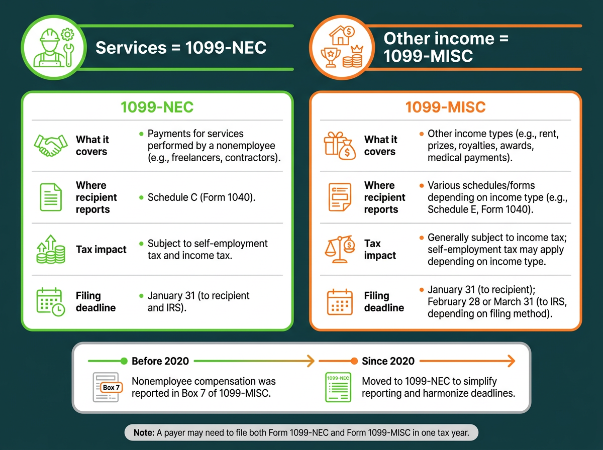
Note: The same payer may need to file both forms in a single tax year.
If you hire a subcontractor for a project and also pay rent on a co-working space, both transactions may require separate forms. Lettuce's step-by-step 1099 filing guide walks through exactly how to handle each scenario.
Breaking Down the 1099-NEC Form, Box by Box
Flip open a 1099-NEC, and you'll see it's mostly white space: a few boxes, some contact fields, and one number that drives your entire tax picture. Knowing what information goes where makes the whole form feel far less intimidating, and according to the IRS form page, most freelancers will only see one box filled with a number that requires action.
-
Box 1a (Nonemployee Compensation): This is the number that matters. It shows the total your client paid you for services during the year, and it's what you'll report as self-employment income on your tax return. Box 1 may include fees, commissions, and other compensation paid for services. If there's a number in this box, that income is generally subject to both income tax and self-employment tax.
-
Box 1b Cash Tips: A brand new box added by the IRS specifically to report cash tips received by independent workers.
-
Box 1c TTOC (Treasury Tipped Occupation Code): A new box used to input the specific code for the recipient's industry.
-
Box 1d Overtime Compensation: A brand new box dedicated to tracking qualified overtime compensation to contractors.
-
Payer and Recipient Details: The top of the form captures names, addresses, and tax ID numbers for both parties. Your information should match your W-9 exactly, since a mismatch is one of the most common reasons errors occur.
-
Box 2 (Direct Sales of $5,000 or More): This checkbox applies to certain direct sales of consumer products for resale. Most freelancers and independent contractors can safely ignore it.
-
Box 3 (Excess Golden Parachute Payments): This box is primarily relevant to corporate executive compensation and is unlikely to apply to typical freelance work.
-
Box 4 (Federal Income Tax Withheld): For most freelancers, this box is blank. If it shows a number, your client applied backup withholding due to a missing or incorrect TIN. Claim that amount as a credit on your return to offset what you owe.
-
Boxes 5, 6, and 7 (State Information): These cover state tax withheld, state ID numbers, and state income. Per the IRS instructions, for most freelancers working in a single state, these boxes are either blank or pre-filled. You rarely need to do anything with them.
-
Verify Box 1 Against Your Records: Pull your invoices and confirm the amount matches. When it does, you're ready to file. If something's off, ask your client to file a corrected form promptly, since delays can trigger 1099 late filing penalties.
-
Report All Income, Form or No Form: The IRS expects you to report every dollar earned, whether or not a 1099-NEC arrives. Your tax document checklist can help you track what you've received and flag what might be missing.
When you invoice clients through Lettuce, every paid invoice is recorded automatically, so checking your Box 1 total takes minutes, not an afternoon.
1099-NEC Deadlines and How to File
The 1099-NEC has one of the tightest deadlines in the tax calendar, and it catches a lot of people off guard. The deadline for sending and filing a 1099-NEC is January 31, covering both the copy you send to the contractor and the copy you file with the IRS. Getting both right starts with knowing exactly what's expected of you.
The January 31 Deadline: Recipient and IRS, Same Day
Per IRS Publication 1099, payers must furnish the 1099-NEC to the contractor and file it with the IRS by January 31. Both happen on the same day. If January 31 falls on a weekend or federal holiday, the deadline shifts to the next business day. There's no automatic extension for 1099-NEC, so the late filing penalties are worth knowing before January arrives. Businesses that need additional time to file with the IRS may request a 30-day extension using Form 8809, although extensions for furnishing recipient copies are much more limited.
If You're the One Sending 1099s
Collect a W-9 from every contractor before their first payment. That form captures their name, address, and tax ID, so you can file accurately. If you're submitting 10 or more information returns, the IRS requires e-filing. The IRS also offers the free Information Reporting Intake System (IRIS), which allows businesses to file information returns electronically without purchasing separate filing software. When filing, submit Copy A to the IRS, send Copy B to the contractor, and keep Copy C for your records.
If You're the One Receiving 1099s
Expect your 1099-NEC by early February. Most people assume a missing form lets them off the hook. It doesn't. You must report all income, even if a client never sends the form. Cross-check every 1099 against your own records, and flag any discrepancies with the payer right away. Bookmark Lettuce's self-employed tax deadlines guide to stay ahead of every due date, not just this one.
Whether you're issuing or receiving forms, keep copies of all 1099-NECs and related records for at least three to four years.
What Happens If You Miss the 1099-NEC Deadline?
Missing the January 31 deadline costs more the longer you wait. If you do not send a 1099-NEC on time, the IRS charges a per-form penalty that hits a flat rate if you are up to 30 days late, hits a higher flat rate if you file between 31 days late and August 1, and reaches its maximum flat rate after August 1, per recipient. The 1099 late filing penalty breakdown shows how quickly those costs add up when multiple contractors are involved.
These penalties apply to the payer responsible for issuing the form, not the contractor receiving it. However, freelancers who hire subcontractors may find themselves on the receiving side of the equation.
Here's how the tiers break down, per the IRS General Instructions for 2026:
|
How Late
|
Penalty Per Form
|
Annual Cap (General)
|
Annual Cap (Small Business)
|
|
Up to 30 days late
|
$60
|
$664,500
|
$232,500
|
|
31 days late through August 1
|
$130
|
$1,993,500
|
$664,500
|
|
After August 1, or never filed
|
$340
|
$3,987,000
|
$1,329,000
|
|
Intentional disregard
|
$680
|
No cap
|
No cap
|
All figures are 2026 amounts, subject to annual adjustment per IRS Information Return Penalties guidance. Small businesses, generally those with $5 million or less in average annual gross receipts, qualify for the lower annual caps shown above. Intentional disregard carries no annual cap and is treated as a separate, more serious violation.
In some cases, penalties can apply both for failing to file with the IRS and for failing to furnish recipient copies on time, increasing the total cost of noncompliance.
Errors are fixable: catching an error early and filing a corrected 1099-NEC can significantly reduce what you owe. Late is always better than never, and the IRS treats intentional non-filing far more harshly than an honest delay.
I Got a 1099-NEC — Now What? A Freelancer’s Action Plan
The form is in your hands. Understanding how a 1099-NEC affects your taxes as a solo business owner starts with knowing exactly what to do next.
Step 1: Verify the Amount on Your Form
Check Box 1 against your own records. Pull your invoices or bank deposits and compare them to what the payer reported, because the IRS gets a copy too. If the numbers don't match, ask the payer for a corrected form before you file.
Getting paid for sponsored content? See how Lettuce tracks income from brand deals, affiliates, and platform payouts in one place.
Step 2: Report the Income on Schedule C
Schedule C is where sole proprietors and other self-employed individuals report business income and expenses on their federal tax return. Even if a client paid you less than $2,000 or never sent a form, that income is still taxable and still needs to be reported.
Step 3: Deduct Eligible Business Expenses
Before calculating what you owe, subtract legitimate business expenses from your gross income. Common deductions may include home office expenses, software subscriptions, equipment, mileage, professional development, and health insurance premiums when eligible. Lettuce automates the income tracking and expense categorization that makes Schedule C filing straightforward.
Step 4: Calculate Your Self-Employment Tax
Unlike a W-2 employee, you pay both sides of Social Security and Medicare, known as self-employment tax. The rate is 15.3% on net earnings up to $184,500(2026), plus 2.9% above that, and you can deduct half of it on your personal return.
Step 5: Plan for Quarterly Estimated Taxes
No employer is withholding taxes for you, and staying current matters. If you expect to owe more than $1,000 in tax for the year, the IRS generally requires quarterly estimated tax payments. Retirement contributions, health insurance premiums, and vehicle deductions can all reduce what you owe before the year closes.
Many locum tenens providers are paid on 1099-NECs with no employer benefits. Once you run S Corp payroll through Lettuce Pro, you can enroll in group-rate health, dental, and vision coverage.
Special Situation: You Think You Were Misclassified
If you received a 1099-NEC but believe you should have been treated as an employee rather than an independent contractor, you may need to review IRS Form SS-8 and Form 8919 to resolve worker-classification issues.
Got it — here’s a clean FAQ intro plus the revised section with no links and a calm, helpful Lettuce tone.
Frequently Asked Questions: 1099-NEC
A 1099-NEC can raise a few follow-up questions, especially when you're juggling client work and tax admin at the same time. These quick answers help you understand what the form means, what to do with it, and how to stay one step ahead.
Do I need to report income if I never received a 1099-NEC?
Yes. You need to report all business income, even if a client never sends a 1099-NEC. The form helps you verify what was paid, but it does not decide whether that income is taxable.
Who is responsible for filing a 1099-NEC?
The payer files it, not the freelancer or solopreneur receiving payment. If a client pays a nonemployee for services and the payment meets the reporting threshold, that client is generally responsible for issuing the form.
What is the deadline for sending a 1099-NEC?
The deadline is January 31. That applies to both the copy sent to the contractor and the copy filed with the IRS, which is why it helps to collect W-9 information long before year-end.
What should I do if the amount on my 1099-NEC is wrong?
Start by comparing the number in Box 1 to your own invoices, payment records, or bank deposits. If something looks off, ask the payer to send a corrected form before you file your return.
Do corporations receive a 1099-NEC?
Usually not, but there are exceptions. Attorney payments are the big one, which is why business structure does not always take a payment out of 1099-NEC territory.
What happens if a payer files a 1099-NEC late?
The IRS can charge penalties for each late form, and those costs usually rise the longer the delay continues. That is why staying organized during the year matters so much when January rolls around.
Take Control of 1099-NEC Season and Your Tax Life
1099-NEC filing for freelancers and solopreneurs is clearer than most people expect. You now know what the form is, who sends and receives one, how it differs from the 1099-MISC, how to review it, what deadlines matter, and what steps to take after receiving it. Once you know the rules, meeting the requirements becomes much easier. Knowing the IRS guidelines puts you in a position to act, not react.
The 1099-NEC may start out feeling like just another tax form, but it's really a tool that helps you understand your income and plan ahead. Understanding the form is step one. Using that knowledge to lower your taxes and stay ahead of deadlines is where the real advantage lives. Lettuce handles the mechanics automatically, helping solopreneurs stay organized and focused on running their businesses.
For freelancers and businesses-of-one, the 1099 season doesn't have to become a yearly scramble.
Stop guessing. Start knowing. Lettuce is a predictive tax management solution built for solopreneurs and freelancers. Get visibility and control over your taxes year-round, not just in April. Get Started with Lettuce!
Curious how much you could save? Try the Lettuce Tax Calculator to see what predictive tax management could mean for your bottom line.
