 Diane Kennedy, CPA
1 min read

Businesses-of-one are reshaping the American economy, with solo operators now representing the majority of U.S. small businesses. Freelancers, contractors, consultants, and solopreneurs all fall under this fast-growing category, each running every function of their business alone. Understanding where you fit is the first step toward building smarter financial systems designed for how you actually work.
You didn’t take the traditional path. You didn’t wait for permission, a title, or a corner office. You built something real on your own terms, with your own hands. And right now, millions of other professionals are doing exactly the same thing. Welcome to the business-of-one economy: the fastest-growing, most dynamic business model in the United States today.
A business-of-one is a company with a single owner-operator who runs all functions of the business: from client delivery to financial management without full-time employees. It is the fastest-growing business model in the United States, and it is quietly reshaping the economic landscape in ways that traditional business narratives are only beginning to catch up with.
If you’re freelancing, consulting, contracting, or building a solo practice and earning real income, you are running a business-of-one, whether you call it that or not. The title on your LinkedIn profile doesn’t matter. What matters is this: the financial rules, risks, and opportunities attached to your model are fundamentally different from those of every other business type and most of the advice you’ve received simply wasn’t built for you.
In this three-part guide, we cover everything you need to know about the business-of-one model:
- What a business-of-one is and the clean, precise definition you can take to the bank
- The rise of the solo economy backed by the data that proves this is a movement, not a moment
- Who qualifies: the full spectrum of professionals, this category includes
- The unique financial challenges you face as a solo operator
- The $10,000 tax problem most solopreneurs don’t know they have and how to solve it
- How the business-of-one differs from the traditional small-business model
- The operating system your business needs to run efficiently and profitably
- Why Lettuce was built specifically for this model and what that means for your bottom line
Let’s start where every great business story should: with context.
The Rise of the Business-of-One Economy
Something significant is happening in the American economy, and if you’re running a business-of-one, you are at the center of it.
For decades, success in business was measured by headcount. The bigger the team, the more legitimate the enterprise. Investors wanted to see growth. Growth meant hiring. Hiring meant overhead. Overhead meant you were, by some unspoken cultural consensus, “serious.” That playbook is being rewritten in real time, and the numbers tell the story better than any pundit could.
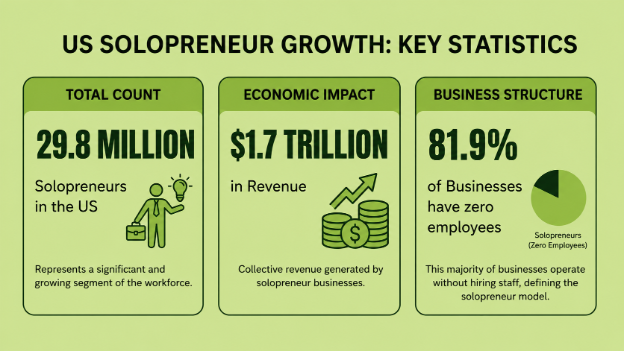
There are now 29.8 million solopreneurs in the United States, collectively generating $1.7 trillion in annual revenue, approximately 6.8% of total U.S. economic output, according to data cited across Founder Reports, the SBE Council, and multiple 2026 analyses. Let that sink in for a moment. The business-of-one isn’t a fringe category. It is an economic force comparable in scale to entire industries.
Perhaps even more striking: 81.9% of all U.S. small businesses have zero employees. Read that again. The majority of American businesses, by a wide margin, are, in fact, businesses-of-one. The solo operator isn’t the exception to the small-business story. The solo operator is the small-business story.
“29.8 million. $1.7 trillion. 81.9%. The business-of-one isn’t a side hustle — it’s an economy.”
The timing of this surge is no coincidence. According to Solo Business Hub’s 2025 trend data, 56% of solopreneurs started their businesses since 2020. The pandemic didn’t just normalize remote work. Instead, it fundamentally altered how millions of professionals thought about income, autonomy, and risk. Watching companies lay off entire workforces overnight while simultaneously discovering that high-value work could be done from anywhere accelerated a migration that had already been quietly underway.
Solo founder rates have also doubled over the past decade. According to Epirus VC’s 2026 analysis, 36% of all startups founded on Carta in 2025 were led by a solo founder, which is up from 31% in prior years. This isn’t a blip. It’s a structural shift in how entrepreneurship itself is being defined and practiced.
What’s driving the acceleration? A convergence of forces that, together, have dismantled the old barriers to going solo:
- The shift from job security to income sovereignty. Professionals who once prized the stability of a corporate salary have recalibrated their risk models. A diversified client base, many have realized, is often more stable than a single employer.
- Remote-first clients. Geography is no longer a constraint. A consultant in Austin can serve a startup in London without anyone blinking.
- The proliferation of digital tools. Platforms for payments, project management, communication, and marketing have made it possible for one person to run what once required a small team.
- AI as a force multiplier. 73% of solopreneurs now use AI tools in their day-to-day business operations. This is not a hobbyist movement. Rather, it’s a tech-forward professional class that is outpacing legacy business models in adaptability.
- The collapse of the “you need a team to be legitimate” myth. Culture has caught up with the reality that solo operators are building sophisticated, high-revenue, high-impact enterprises. The legitimacy was never in the headcount.
Contrast this with traditional business formation, which typically requires investors, co-founders, office space, and early headcount before a single dollar of revenue is earned. A business-of-one can launch and scale with a laptop, a demonstrable skill set, and the right financial systems in place. The efficiency is staggering, and the opportunity it creates is what this entire guide is designed to help you capture.
Now that we’ve established the scale and momentum of this movement, let’s get precise about who actually belongs to it.
Who Qualifies as a Business-of-One?
The term “business-of-one” is not a legal structure. It’s not something you file for or register. It is a category of working professionals, a lens through which to understand your economic identity and the unique set of financial rules that come with it. And it’s far more inclusive than most people assume.
A business-of-one includes any professional who generates income independently without full-time employees. That description covers an enormous and diverse range of working lives:
- Freelancers — designers, writers, developers, marketers, videographers, and other creatives who work project-to-project for multiple clients. If your income comes from deliverables rather than a single employer, this is you.
- Independent contractors — professionals engaged by companies on a 1099 basis for ongoing or defined-scope work. You may work with a company, but you don’t work for them in the traditional employment sense.
- Consultants — specialists who sell expertise and strategic guidance, typically at premium rates and on retainer or project structures. Consultants often serve fewer clients at higher fees, and the financial optimization stakes are correspondingly higher.
- Solopreneurs — entrepreneurs who have built a product, service, or audience-driven business around themselves without a full-time team. This includes online educators, coaches, course creators, and digital product builders.
- Self-employed licensed professionals — therapists, real estate agents, healthcare providers, attorneys, and others who operate independent practices. These are often the highest earners in the business-of-one category and frequently the most underserved by generic financial tools.
A business-of-one is not a traditional employer-employee company, a startup seeking venture capital, a formal partnership, or a passive-income side project. The distinguishing characteristic is this: you are the business. Your skill, your reputation, your decisions: they are the engine.
Solopreneur, sole proprietor, single-member LLC: if the labels start to blur together, our solopreneur tax glossary spells out exactly what each one means.
The income threshold that changes the financial equation is approximately $60,000–$100,000 in annual net profit. Below that level, the tax complexity is manageable, and the optimization opportunities are modest. Above it, generic advice starts costing you real, measurable dollars. According to data from KenYarmosh.com, about 20% of solopreneurs earn between $100,000 and $300,000 annually without hiring a single employee. For these professionals, and you may well be one of them, financial optimization is not a nice-to-have. It is essential.
Here’s a simple way to self-identify. You’re likely a business-of-one if:
- You receive 1099 income from clients or platforms
- You set your own rates and own your client relationships
- You operate without full-time employees
- You’re responsible for your own taxes, benefits, and retirement
- Your income is tied to your expertise, time, or intellectual output
- You’re earning $60,000 or more in annual net profit from your work
You’re probably NOT a business-of-one if:
- You receive a W-2 from a single employer as your primary income
- You have full-time employees on payroll
- You’re running a partnership with shared ownership and shared operations
- Your business is structured around passive income alone, with no active service or product delivery
Still not sure where you fit? You can meet real businesses of one, from an event planner and an executive coach to a real estate agent.
Lettuce works specifically with business-of-one professionals across a wide range of verticals: from content creators and consultants to therapists and licensed healthcare providers. If you’re generating real independent income, this model and the financial strategies built for it apply to you. Understanding the types of 1099 income that flow through a business-of-one is often the first step toward understanding what you actually owe and what you don’t.
The next step is acknowledging what makes running this business genuinely hard. Not impossible but distinctly, specifically challenging in ways that most financial advice simply doesn’t address.
Frequently Asked Questions About Business-of-One
What Is a Business-Of-One?
A business-of-one is a company with a single owner-operator who manages all business functions, from client delivery to financial management, without full-time employees. It is the fastest-growing business model in the United States, encompassing freelancers, independent contractors, consultants, solopreneurs, and self-employed licensed professionals. The business-of-one is defined by its structure (one person), not its legal entity or income level.
Is a Freelancer a Business-Of-One?
Yes. Freelancers are among the most common businesses-of-one. If you earn income from multiple clients, manage your own schedule, set your own rates, and receive 1099 forms rather than a W-2, you are operating as a business-of-one regardless of whether you’ve formally registered a business entity.
Does a Business-Of-One Need to Be an llc or s Corp?
No. A business-of-one is not a legal entity. It’s a way to describe a solo operator who earns income independently without full-time employees. You can be a business-of-one as a sole proprietor, single-member LLC, or, if it fits your situation, an S Corp.
Can a Business-Of-One Have Contractors or Part-Time Help?
Yes. A business-of-one can still hire freelancers, subcontractors, or part-time support. The key distinction is that the business does not rely on full-time employees as its operating model, because the owner remains the primary operator of the business.
Is a Business-Of-One the Same as a Side Hustle?
Not always. Some side hustles are casual income streams, while a business-of-one is typically an active business built around your expertise, services, or client work. If you’re earning meaningful income, managing clients, and running the financial side yourself, you’re likely operating as a business-of-one.
When Does Someone Move From Freelancer to Business-Of-One?
Usually, it happens the moment independent work becomes a real business, not just occasional extra income. If you control your pricing, manage client relationships, handle your own taxes, and operate without full-time employees, you’re already functioning as a business-of-one — whether you use that label yet or not.
Running a business-of-one means every dollar you earn is a dollar you’re responsible for protecting. Lettuce automates the incorporation, bookkeeping, payroll, and tax strategy that solo professionals need to keep more of what they make, including setting up and managing the S Corp election that often saves solopreneurs thousands each year. Try Lettuce and see what an automated, business-of-one-built financial system can do for you.
This article is Part 1 of the Business-of-One Definitive Guide Series, featuring in-depth, practical guidance from Diane Kennedy, CPA—bestselling author, strategic tax consultant, and founder of USTaxAid and KennedyTax.tax. Also ready Part 2: The $10,000 Tax Problem: Why Solopreneurs Overpay (and the S-Corp Fix) and Part 3: The Business-of-One Operating System: Tools You Need to Run Profitably
Explore all of Diane’s tax strategy advice and insights here.
Related Articles: