
 Natalia Budyldina
1 min read

The 2026 IRS mileage rate is now 72.5 cents per mile, and for freelancers and self-employed workers, that adds up to real tax savings. This guide covers which trips qualify, how to calculate your deduction, and how to keep IRS-ready records all year. Whether you're a solopreneur or S Corp owner, every business mile you log is money back in your pocket.
You drove thousands of miles for work last year. Between client meetings, supply runs, job site visits, and networking events, those miles add up fast. But did you track them? More importantly, did you deduct them?
At 72.5 cents per mile, the 2026 IRS mileage rate could turn that driving into a meaningful tax deduction. For freelancers, independent contractors, solopreneurs, and other self-employed professionals, 10,000 business miles could translate into a $7,250 deduction.
Understanding the IRS mileage rate is one of the simplest ways to reduce your tax bill, but the rules can feel confusing if you're not sure where to start. The good news is that you don't need to be a tax expert to take advantage of this deduction.
This guide walks you through everything you need to know, including the 2026 mileage rates, which trips qualify, how to calculate your deduction, how to keep compliant records, and practical ways to maximize your savings. Every mile matters, and you're in the right place to make sure none of them go to waste.
See how Lettuce automates your mileage deductions from day one.

Is Lettuce right for you?
See if Lettuce can help you keep more of what you earn with our short quiz.
Take QuizThe 2026 IRS Standard Mileage Rate — What Changed And What It Means For You
The IRS set the 2026 business rate at 72.5 cents per mile, up 2.5 cents from 2025, reflecting higher vehicle operating costs. The IRS recalculates these rates each year based on the actual costs of driving, fueling, maintaining, and insuring a vehicle. For self-employed workers, that 2.5-cent bump means every business mile you log is worth more at tax time.
The standard mileage rate applies regardless of whether you drive a gasoline, diesel, hybrid, or fully electric vehicle for business.
| Category | 2025 Rate | 2026 Rate | Change |
|---|---|---|---|
| Business | 70¢/mile | 72.5¢/mile | ↑ +2.5¢ |
| Medical | 21¢/mile | 20.5¢/mile | ↓ -0.5¢ |
| Charitable | 14¢/mile | 14¢/mile | → No change |
| Moving (active military only) | 21¢/mile | 20.5¢/mile | ↓ -0.5¢ |
Source: IRS official standard mileage rate history. The moving category has been restricted to active-duty military since 2017.
Of the four categories above, the business rate is the one that matters most for your bottom line. Since the 2017 tax law overhaul known as the Tax Cuts and Jobs Act, W-2 employees can no longer deduct unreimbursed mileage on their personal returns. Self-employed workers still can.
At 72.5 cents per mile, 10,000 business miles translates to a $7,250 deduction from your taxable income. That is a real, tangible reduction in what you owe.
What Counts As A Business Mile? (And What Definitely Doesn't)
Every mile you drive for work is a potential deduction, but only if it meets the IRS rules for what counts as a business mile. The line between deductible and non-deductible comes down to purpose.
Some trips are clear wins. Others, like your daily commute, are off the table. Here's a quick breakdown of what trips count as business miles under the IRS mileage rate rules.
Deductible business miles
-
Client meetings, site visits, and business errands for your work all count as deductible business miles.
-
Conferences, trade shows, and professional development events qualify when directly tied to your business.
-
Travel between two work locations on the same day qualifies, even if one is your home office.
-
Driving to a temporary work location qualifies as business mileage when the location is not your regular place of business.
-
Parking fees and tolls on business trips are deductible on Schedule C, in addition to your mileage.
Not deductible
- Commuting from home to a regular office is never deductible, regardless of distance.
If your home qualifies as your principal place of business, trips to client sites become deductible business travel rather than commuting. For many freelancers and solopreneurs, this is one of the most valuable and overlooked ways to increase deductible mileage.
Once you know which miles count, the next step is figuring out what they're worth.
Standard Mileage Rate vs. Actual Expense Method: A Side-by-Side Breakdown
When it comes to deducting vehicle costs, the IRS gives you two options, and picking the right one can make a real difference in your tax bill. The standard mileage rate vs. actual expense method comparison comes down to simplicity versus precision, and the best choice depends on your vehicle, your driving habits, and how much recordkeeping you want to take on.
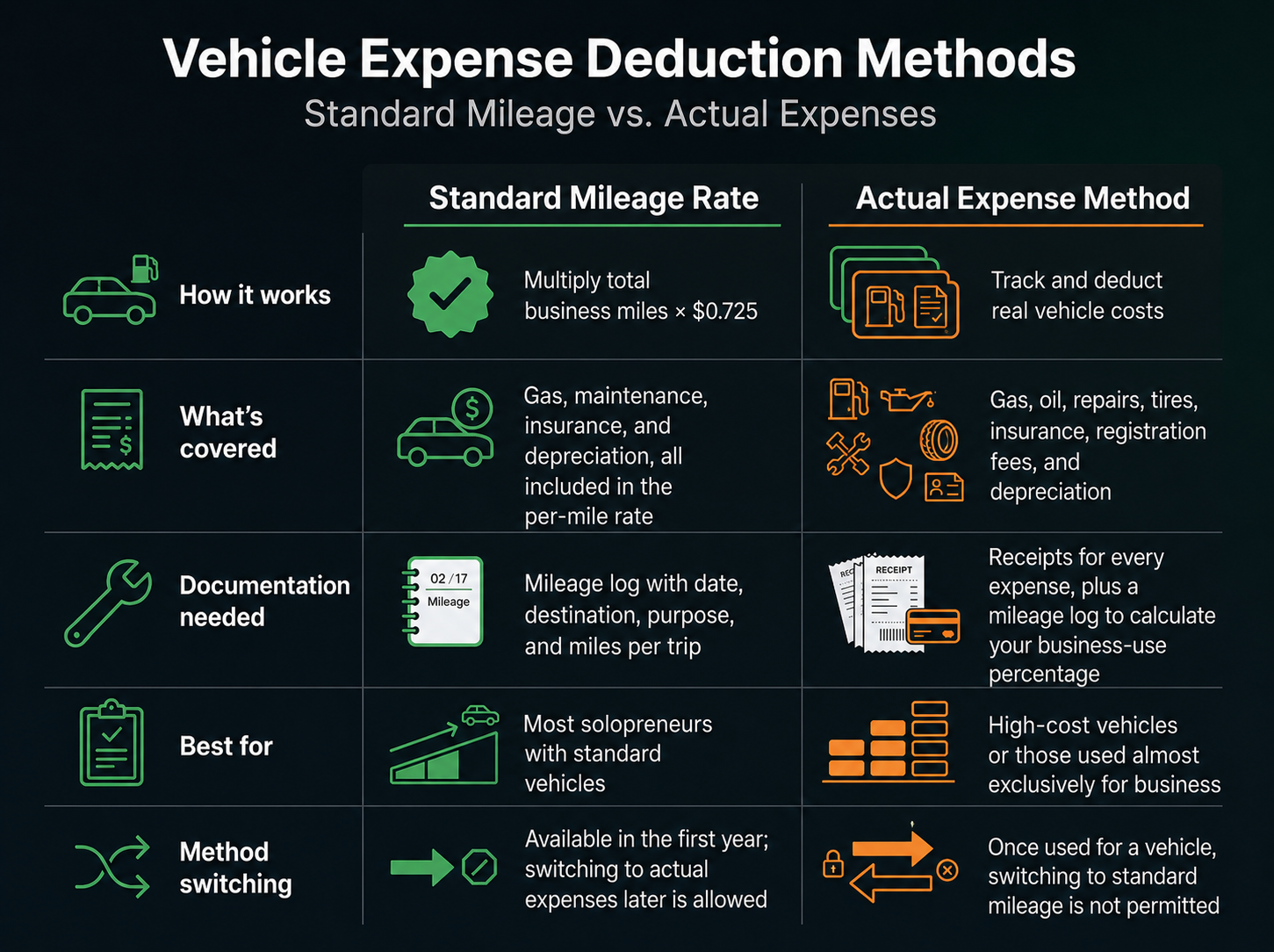 Parking fees and tolls are deductible separately under both methods.
With the actual expense method, you'll need to calculate your business-use percentage by dividing your business miles by your total miles driven for the year. You then apply that percentage to your eligible vehicle expenses.
One rule that affects both methods: if you use actual expenses in the first year a vehicle is first used for business, you generally cannot switch to the standard mileage rate for that vehicle later, per IRS Publication 463 and IRS Topic 510. Starting with the standard rate keeps your options open. Starting with the standard rate keeps your options open. If you lease your vehicle and choose the standard mileage rate, the IRS generally requires you to continue using that method for the entire lease period, including renewals.
The standard mileage method is also subject to certain IRS restrictions. For example, it generally cannot be used for vehicles that have claimed certain accelerated depreciation methods or businesses that operate large vehicle fleets.
For most freelancers and solopreneurs, the standard mileage rate is the simpler choice because it requires less recordkeeping and still delivers a meaningful deduction. The actual expense method may be worth exploring if you drive a newer, more expensive vehicle or have unusually high operating costs. If you're unsure which method is best, run the numbers both ways during your first year of business use. The comparison can help you maximize your deduction while preserving flexibility for future years.
For S Corp owners exploring more advanced vehicle strategies, vehicle write-off options covers ownership structures, and reimbursement approaches are worth reviewing before choosing a method.
How To Calculate Your Mileage Deduction In 2026 (Step-By-Step)
Here is how to calculate a vehicle deduction using the IRS mileage rate for business miles, step by step. The formula is simple, the reporting is predictable, and the savings add up fast.
Step 1: Apply the Formula
The 2026 rate announcement confirms 72.5 cents per mile for work-related miles.
Formula: Business miles × $0.725 \= your deduction
Example: Maya is a freelance graphic designer who drove 8,400 business miles in 2026.
8,400 miles × $0.725 \= $6,090
That $6,090 comes straight off your taxable income. If Maya falls into a 24% tax bracket, that deduction could reduce her tax bill by roughly $1,461. Drive 10,000 miles, and that number climbs to a $7,250 deduction. For a deeper look at how deductions affect what you owe, see the Lettuce guide to self-employed tax brackets.
Step 2: Report It on Your Tax Return
Per IRS Publication 463, mileage deductions are reported as car and truck expenses on Schedule C (Form 1040), Line 9. In Part IV, record the vehicle's in-service date, total miles, business miles, and whether you have written records. A tax document checklist makes keeping those records organized year-round straightforward. Parking fees and tolls go on Line 27a. They stack on top of your mileage deduction rather than being included in it.
Step 3: Prorate for Mixed-Use or Partial-Year Vehicles
If you use one car for both personal and business trips, only the business portion is deductible.
Example: 15,000 total miles, 9,000 miles driven for work \= 60% business use
Deduction: 9,000 × $0.725 \= $6,525
For a vehicle placed in service mid-year, count only miles logged after that date. S Corp owners have additional options.
How To Track Your Business Mileage (And Stay IRS-Ready All Year)
Solid mileage records are what turn your business driving into a deduction the IRS can't question. To claim the IRS mileage rate for business driving, your records need to cover four things.
Per IRS Publication 463, your records must be contemporaneous. That means logging each trip as it happens, not piecing it together weeks later. These four data points are all the IRS needs to honor your deduction.
-
Log date, destination, business purpose, and total miles for every trip.
-
You can track either the total miles driven for each trip or your starting and ending odometer readings.
-
Log trips immediately after each drive, before details fade; even a quick note in your phone works.
-
Use a mileage app, spreadsheet, dedicated mileage notebook, or a platform like Lettuce to make consistent logging part of your routine.
-
Keep mileage records for at least three years after filing, covering the standard IRS audit window for most returns.
Common mistakes include reconstructing mileage from memory at tax time, forgetting to record the business purpose of a trip, mixing personal and business travel, and failing to track parking fees and tolls separately.

Pro Tips To Maximize Your Mileage Deduction As A Solopreneur
To maximize your vehicle deduction, think about how you structure your business setup, driving habits, and recordkeeping. Small adjustments in each area can add up to a meaningfully larger write-off.
If you operate as an S Corp, there are also reimbursement strategies that go beyond what a sole proprietor can access. None of them requires a tax degree, just a bit of planning upfront.
-
Establish a home office as your principal place of business to make more client trips qualify as write-offs.
-
Claim parking fees and tolls separately; per IRS mileage rules, they're deductible in addition to your standard mileage.
-
Start tracking on January 1 and compare both deduction methods before you file each year. If you started with the standard mileage rate on an owned vehicle, you may be able to switch to actual expenses later if it produces a larger deduction.
-
Use a deductions worksheet, mileage app, or automated platform to keep records current without scrambling at tax time.
-
S Corp owners can use an Accountable Plan to receive tax-free vehicle reimbursements directly through their corporation.
These strategies work best when built into your routine from day one. If you're unsure which moves apply to your situation, the questions below can help you sort it out.
Frequently Asked Questions About The 2026 IRS Mileage Rate
These IRS mileage rate FAQ answers are built for S Corp owners and self-employed pros who want clarity without the tax jargon. Here's what you should know before filing.
How does an S Corp owner deduct mileage?
S Corp owners can't deduct vehicle expenses the same way sole proprietors do. S Corp has to deduct actual vehicle expenses such as gas, parking, maintenance etc. Or there is a second option - Your S Corp can reimburse you for qualifying miles driven in your personal vehicle through an Accountable Plan. At 72.5¢ per mile, that reimbursement is tax-free to you and deductible as a business expense on your S Corp return.
Can an S Corp owner deduct personal and business miles separately?
Only business miles qualify for reimbursement. Personal miles are never deductible, even if you use the same vehicle for both. You'll need to track each type separately and document the business purpose for every trip. Your business-use percentage (business miles ÷ total miles driven) determines how much the S Corp can reimburse, per standard mileage rates guidance.
Does the 2026 mileage rate apply to electric and hybrid vehicles?
Yes, the 2026 IRS rate of 72.5¢ per mile applies to all vehicle types, including gas, diesel, hybrid, and electric. The rate already accounts for fuel and operating costs, so EV owners don't need to calculate charging expenses separately. Even if you buy a new car mid-year, you can still use the standard rate for that vehicle.
How can I maximize my vehicle deduction without overcomplicating my bookkeeping?
Start logging work-related driving from January 1 so your records are clean all year. S Corp owners using an Accountable Plan need substantiated records for reimbursements to remain tax-free. At year-end, compare the standard mileage and actual expense methods to see which produces a larger deduction.
What happens if I get audited on my mileage deduction?
The IRS expects records created at or near the time of each trip, not reconstructed from memory months later. Backdated logs are a common audit trigger for self-employed taxpayers. A complete, contemporaneous mileage log keeps your deduction bulletproof and your records audit-ready. Knowing your audit risk is half the battle. See audit red flags to stay one step ahead.
Every Mile Matters: Turn Your Driving Into Tax Savings With Lettuce
Every mile you drive for your business has value. For freelancers, solopreneurs, and other self-employed professionals, the 2026 IRS mileage rate of 72.5 cents per mile makes vehicle expenses one of the most accessible tax deductions available.
By understanding which trips qualify, choosing the right deduction method, calculating your deduction correctly, keeping accurate records, and maximizing every eligible write-off, you can make every business mile work for you instead of against your tax bill.
Mileage logs, filing requirements, and deduction tracking can become difficult to manage when you're running a business on your own. A self-employed tax-deduction worksheet can help keep your records organized, while Lettuce automates the process and simplifies year-round tax management. With the added confidence of the Lettuce-Back Guarantee, you can spend less time worrying about taxes and more time growing your business.
Stop guessing. Start saving. Lettuce is a predictive tax management solution built for businesses-of-one. From mileage tracking to full tax management, Lettuce automates the hard stuff so you can focus on the work you love. Get Started with Lettuce!
Curious how much you could be saving? Try the Lettuce Tax Savings Calculator.