
 Natalia Budyldina
1 min read

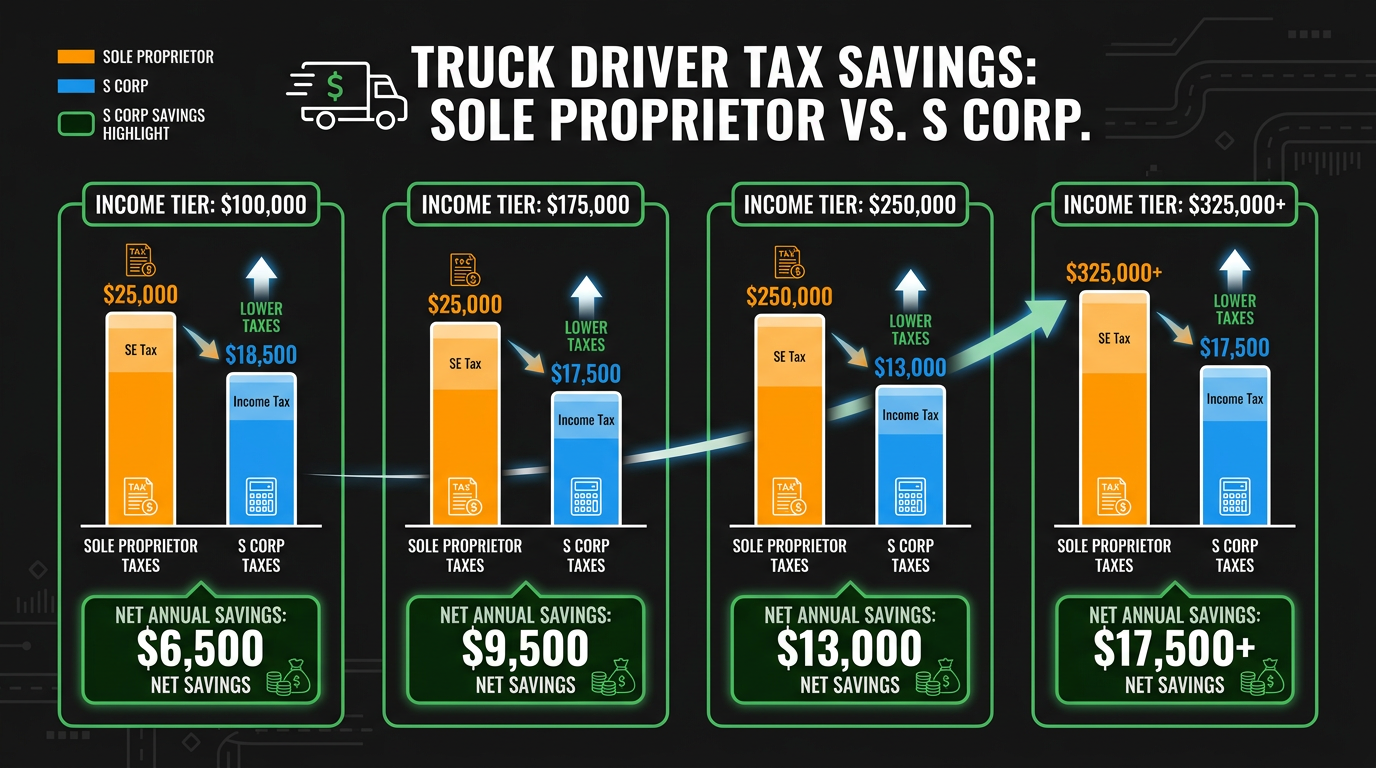
S Corp for truck drivers can mean $4,000 to $9,000 or more in tax savings each year. By paying yourself a reasonable salary and taking the rest as distributions, you skip the 15.3% self-employment tax on those profits. Lettuce handles the setup, payroll, and compliance, so you get the savings without the paperwork.
Every mile you drive as a sole proprietor or single-member LLC, you owe 15.3% self-employment tax on 92.35% of your net earnings. Company drivers with W-2s split that burden with their employer, paying just 7.65%. You're essentially shouldering double what employed drivers face for the same income.
An S corp for truck drivers changes this math completely. Instead of owing self-employment tax on 92.35% of your profit, you pay yourself a reasonable W-2 salary and take the rest as distributions. Those distributions skip the 15.3% tax entirely. What's an S Corp, and how much can you actually save? Most owner-operators earning $80,000 or more in net trucking income may save $4,000 to $9,000 annually.
Ready to see how much you could keep? Let Lettuce simplify your S Corp setup and ongoing compliance.

Is Lettuce right for you?
See if Lettuce can help you keep more of what you earn with our short quiz.
Take QuizWhat Is an S Corp and Why Should Truck Drivers Care?
An S corp isn't a different type of business entity. It's a tax election you make with the IRS that changes how your trucking business gets taxed. Your day-to-day operations stay exactly the same. You still haul freight, manage your routes, and handle maintenance. The difference shows up at tax time, where this IRS election may save you $4,000 to $9,000 annually by reducing the 15.3% self-employment taxes that currently hit 92.35% of your net profit.
Most owner-operators start by forming an LLC for liability protection, then file Form 2553 to elect S corp status. This gives you the best of both worlds: LLC flexibility with S corp tax advantages. S Corps use pass-through taxation, which means your business profits flow directly to your personal tax return and get taxed just once. The trade-off is simple: you'll need to pay yourself a reasonable W-2 salary and run payroll, but the tax savings typically far outweigh these requirements. Ready to explore the process? Our step-by-step S Corp guide walks you through everything, while the LLC vs S Corp comparison shows exactly how the numbers work.
The Core Benefit: Stop Paying Double
Right now, you pay 15.3% self-employment tax on 92.35% of your net profit from your trucking business. That's the combined Social Security (12.4%) and Medicare (2.9%) tax rates, and it hits your entire bottom line. If you net $100,000 this year, you're paying $14,129 just in self-employment taxes before income taxes even start. Company drivers split this burden with their employer, but as a sole proprietor or single-member LLC, you pay both halves.
S Corp tax savings for truck drivers work by changing how your income gets taxed. With an S corp, only your W-2 salary faces payroll taxes. The remaining profits become distributions that skip self-employment tax entirely. Picture this: you net $120,000 and pay yourself a $60,000 reasonable salary (what the IRS considers fair market pay for your work). You save roughly $7,775 compared to sole proprietor status. Even at $80,000 net income, your savings typically range from $4,000 to $6,000 annually. That's real money staying in your pocket instead of going to Uncle Sam.
Unlock Even More Tax Benefits as an S Corp Truck Driver
S corp tax benefits for truck drivers extend far beyond self-employment tax savings. Health insurance premiums become fully deductible business expenses when paid through your S corp, reducing your taxable income dollar for dollar.
You can also contribute significantly more to retirement through a Solo 401(k) because your W-2 wages enable both employee and employer contributions, giving you higher overall limits than what you can access through traditional IRAs.
Your existing deductions stay intact. Vehicle expenses, fuel costs, maintenance, and per diem remain fully deductible under S corp status. Plus, you keep all the standard trucking write-offs like equipment depreciation and business supplies. In high-tax states, S Corps can also help you deduct state and local taxes above the $10,000 federal cap by choosing a PTET election and treating them as business expenses rather than personal itemized deductions.
The Reasonable Salary Rule: What It Means for You
The IRS has a clear requirement that prevents S corp owners from gaming the system: you must pay yourself a reasonable W-2 salary for the work you perform. You cannot set your salary to $1 just to avoid payroll taxes. The IRS requires that shareholder-employees receive wages that reflect what you would pay someone else to do the same job. For truck drivers, this means your salary should align with what other owner-operators or company drivers earn for similar work.
Finding the sweet spot matters because the IRS reasonable salary rules for S corp truck drivers create a balancing act. For a driver netting $100,000, a reasonable salary might be $50,000-$60,000, leaving $40,000-$50,000 for tax-free distributions. Set your salary too low, and you risk an audit where the IRS could reclassify your distributions as wages, costing you penalties and interest. Lettuce takes the guesswork out by calculating a compliant salary based on your income, industry data, and IRS guidelines, then handles your monthly payroll and documents everything to protect you if questions arise.
Is an S Corp Right for You? The $80,000 Threshold
When should a truck driver switch from an LLC to an S corp? The answer depends on whether your tax savings exceed compliance costs. For most owner-operators, this break-even point happens around $80,000 in business income from trucking.
Below this threshold, the additional monthly payroll processing, payroll tax filings, and reasonable salary documentation often cost more than you save. The IRS requires business owners who work in their S corp to receive proper compensation as employees.
If you meet this income threshold, you're likely ready for this tax election if you have steady trucking income and operate as a true business-of-one. The structure works best for established owner-operators with consistent routes and reliable earnings who want to optimize their tax strategy. However, S Corps are not ideal for new drivers, part-time operators, or those whose income swings wildly from month to month. If you're just starting out or your earnings fluctuate dramatically, focus on building your business first.
Think of S Corp election as the next step for established operators ready to formalize their financial structure. Platforms like Lettuce automate much of the compliance burden, making this threshold more accessible for busy drivers.
When to Elect S Corp Status: Timing Your Move
The best time to elect S corp status is January 1st, giving you a full year of tax savings. But don't worry if you missed that window. You can make a mid-year election and still get partial-year savings. The IRS allows S corp elections up to 2 months and 15 days after the start of your tax year, and late election relief extends this window even further. A July election could still save you $3,000-4,000 compared to staying a sole proprietor. When to elect S Corp for truck drivers depends on your income timing, but the best time is whenever you're ready to stop overpaying.
If you already operate as an LLC, electing S corp status won't change your daily trucking routine one bit. Your business name, bank accounts, and contracts stay exactly the same. The election simply tells the IRS to tax you differently. You'll need to file Form 2553 to make the election official, but Lettuce handles this entire process for you. No paperwork headaches, no missed deadlines, no wondering if you filled it out correctly.
How Lettuce Automates S Corp Compliance for Truck Drivers
Most owner-operators know S corps can save money, but avoid them because of the administrative burden. You need monthly payroll, reasonable salary calculations, quarterly filings, and annual Form 1120-S preparation. Traditional CPAs charge thousands just for setup, then hundreds monthly for ongoing compliance. That math rarely works for solo truckers.
Lettuce changes the game by automating everything that makes S corps complex. The platform handles LLC formation, S corp election, and reasonable salary calculations based on your income and industry standards. When money hits your account, Lettuce automatically sets aside funds for payroll and taxes, runs monthly payroll, withholds taxes, and prepares all required filings. After payroll and taxes are covered, the remaining balance is available for you to take as owner distributions whenever you choose.
Plus, you get audit protection and the Lettuce-Back Guarantee — if your S corp tax savings don't exceed what you would have paid as an LLC or sole proprietor, Lettuce refunds your fees.
Frequently Asked Questions About S Corps for Truck Drivers
Owner-operators have specific questions about how S corp status affects their trucking business. Here are the answers that matter most for your bottom line and compliance.
How much can truck drivers save on taxes with an S Corp?
Savings depend on your net income and reasonable salary. At $100,000 net with a $50,000 salary, you save roughly $6,479 annually. At $150,000 net with a $80,000 salary, savings reach $10,484. Higher net income above your salary means bigger savings.
What are the IRS reasonable salary rules for S Corp truck drivers?
The IRS requires S corp owners to pay themselves what they would pay another driver for the same work. Reasonable salaries typically range from $45,000 to $75,000 for owner-operators, depending on experience and regional rates. Setting it too low increases audit risk.
What bookkeeping and payroll do I need as a one-truck S Corp?
You need monthly payroll processing, quarterly payroll tax filings, annual W-2 preparation, and Form 1120-S filing. Lettuce automates all of this, running payroll monthly and handling tax withholdings. Your bookkeeping shift from simple expense tracking to corporate balance-sheet tracking to account for shareholder equity and distributions..
Can I switch to S corp status mid-year?
Yes! You don't have to wait until January to stop overpaying. Even if you missed the standard spring deadline, Lettuce can file for Late Election Relief with your Form 2553. This allows the IRS to backdate your S Corp status to January 1st of the current year, unlocking full-year tax savings rather than just a few months. Lettuce handles the retroactive paperwork, builds a compliant mid-year catch-up payroll plan, and ensures your corporate accounting stays fully audit-protected from day one.
Will my business deductions change if I elect S corp status?
Your core trucking deductions remain the same: fuel, maintenance,, and per diem. S corp status adds new benefits like health insurance premium deductions and higher retirement contributions. Check our complete S Corp deductions list for details.
Ready to Keep More Per Mile?
You've built your trucking business mile by mile, managing every cost and running lean operations. S corp status rewards that hard work without changing how you operate your rig or serve your customers. The IRS requires proper payroll compliance, but the tax savings make it worthwhile for established owner-operators.
When you hit that $80,000 threshold, the math is compelling. Most drivers at this level save $4,000 to $9,000 annually compared to sole proprietor status, though state-specific costs vary. The S Corp setup process involves formation, payroll, and ongoing compliance, but platforms like Lettuce automate the complex work so you can focus on what you do best.
Stop leaving money on the table every tax season. See exactly how much you could save and get your S corp running on autopilot with Lettuce.