

1 min read

Real estate agent salary numbers can be deceiving. What you actually take home depends on your sales volume, commission rate, brokerage split, expenses, and taxes, not some flat industry average. The good news? Smart tax strategies like tracking deductions and considering S Corp status can boost your net income, and automated bookkeeping helps you keep more of every commission.
The average realtor earns around $58,000 a year, but commissions and take-home pay are two very different numbers. Gross commission income (GCI) is the total you earn before splits or deductions. Brokerage cuts, operating expenses, and taxes all take their share before anything reaches your pocket.
Breaking down a real estate agent salary, layer by layer, is where smarter income decisions begin. You're already doing the hard work. Knowing exactly what you keep should be just as clear. Lettuce is built for solo real estate professionals who want to keep more of every commission.
What Is The Average Real Estate Agent Salary For A Solo Professional?
The average real estate agent salary is one of the most searched numbers in the industry, and also one of the most misleading. For solo professionals, the headline figure gives you context, not a complete picture. What you actually earn depends on three things: your closed volume, your commission rate, and your brokerage split.
Why The Average Real Estate Agent Salary Is Just A Starting Point
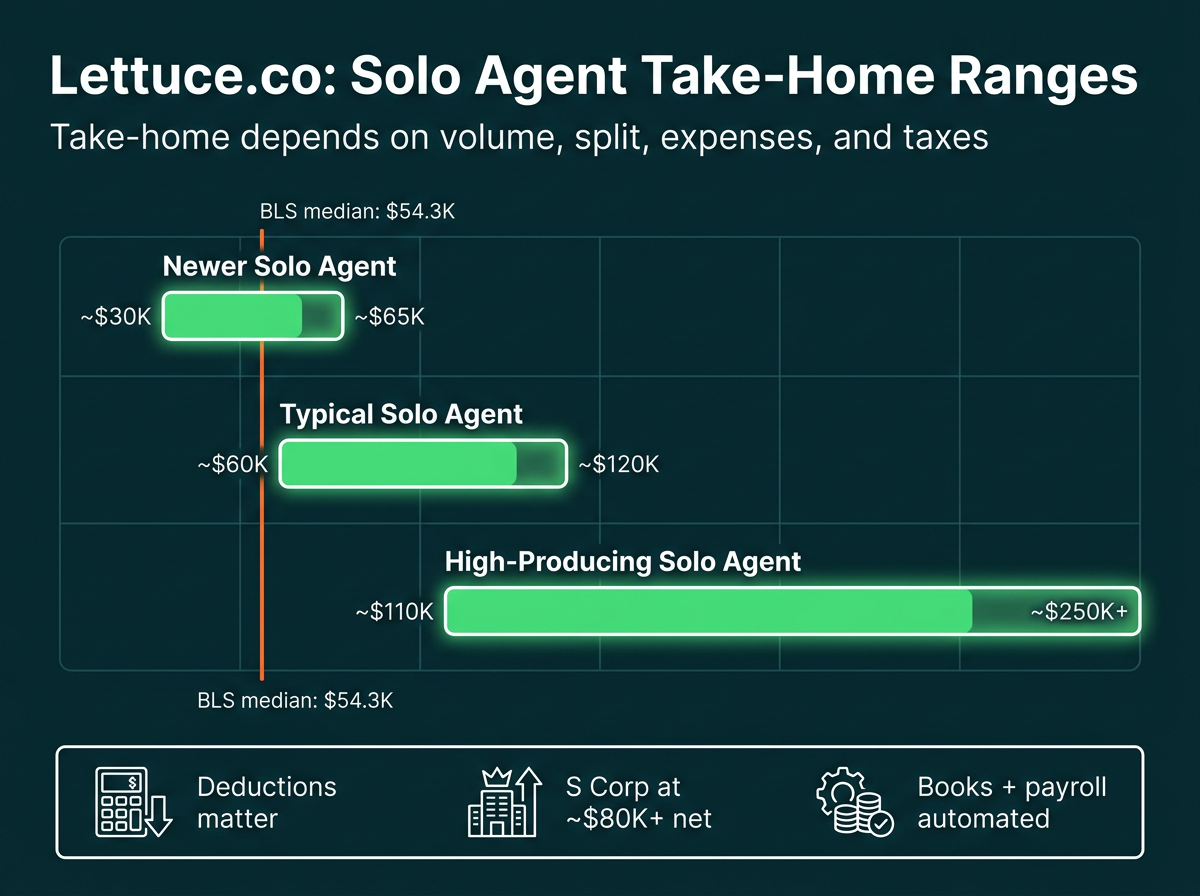
According to BLS data, the median annual wage for real estate sales agents is approximately $54,300. That number includes part-time agents, new licensees, and agents in lower-cost markets. However, a median only tells you what the middle looks like. It says nothing about what you can actually earn.
Experience And Volume Create Wildly Different Outcomes
Two agents can share the same job title and land in completely different income brackets. A first-year agent closing 4 to 6 transactions looks nothing like an experienced solo agent closing 25 or more deals annually. Factor in market differences, average home prices, and brokerage fee structures. The range stretches from under $30,000 to well over $150,000 for agents doing the same work in different conditions.
The Benchmark That Actually Matters For Solo Agents
Generic salary lists are built for employees. You are running a business. The number worth tracking is your annual closed volume multiplied by your average commission rate, then adjusted for your net brokerage split. That formula gives you gross commission income. From there, deductible expenses like MLS fees, marketing, and vehicle costs reduce your earnings. Home office use adds up, too, often more than agents expect. Closing that gap starts with understanding how commissions actually flow through your business.
How Do Real Estate Agent Commissions Turn Into Take-Home Pay?
Gross commission income is business revenue, not personal income. Understanding how commissions turn into take-home pay means tracking every step between the closing table and your bank account.
The math follows a predictable sequence, and knowing each step is how you stop confusing revenue with income and start seeing what each deal is actually worth.
- Commission rates are set through negotiation with your client, establishing the ceiling for everything that follows.
- Your brokerage split reduces gross income by 20–50% before you see a dollar.
- Desk fees, E\&O insurance, and MLS dues are predictable costs that reduce your net before taxes.
- Deductible expenses like mileage and home office reduce your taxable income, so you're only taxed on what's left.
- Self-employment and income taxes apply to your net, and what remains becomes your owner's pay.
Take a $5M year at 2.5% commission: $125,000 GCI. After a 70/30 split, fees, expenses, and taxes, commissions turn into take-home pay of around $47,000, and the table below shows how that shifts across production levels.
Frequently Asked Questions About Real Estate Agent Salary
Questions about real estate agent salary come up constantly for solo professionals, and the answers below cut straight to earnings context, pay structure, and keeping more of what you close.
How much do new real estate agents make in their first year?
First-year earnings vary widely, and most new agents should expect a slow start. The BLS reports a median annual wage of around $54,300 for real estate agents, but that figure spans all experience levels. According to NAR, agents with two or fewer years of experience often earn well below that median, while still covering licensing, marketing, and brokerage fees.
Do real estate agents get paid a salary or only commissions?
Most agents are independent contractors paid entirely by commission, and brokerages pay no base salary. If you operate as an S Corp, the IRS requires you to pay yourself a reasonable W-2 salary before taking owner distributions. That split between salary and distributions is where the self-employment tax savings happen.
What tax strategies help real estate agents keep more of their income?
The biggest levers are claiming a home office, tracking vehicle mileage, and deducting business expenses. For agents earning above a certain income threshold (more on that below), electing S Corp status reduces self-employment taxes.
When does an S Corp make sense for a solo real estate agent?
The crossover point is generally around $80,000 in net self-employment income. Below that, the administrative costs of running an S Corp can outweigh the savings, but above that, the payroll tax savings add up quickly. This S Corp income breakdown shows exactly where the math tips in your favor.
Your Next Move: Keep More Of Every Commission You Earn
Closing more deals grows your income. Keeping more of each commission grows your wealth. Real estate tax deductions, S Corp payroll, and home office and mileage write-offs are the tax strategies that make the difference.
That is exactly what Lettuce handles for solo professionals who want clarity without the manual work. Automated bookkeeping, monthly payroll, and real-time tax visibility come standard, all in one place. And if the savings don't exceed your subscription cost, the Lettuce-Back Guarantee means you get your fees back. No hassle.
Find out how much more you could keep with Lettuce, the financial system built for businesses-of-one.
