
 Natalia Budyldina
1 min read

1099 taxes for real estate agents work better as a system, not a scramble. This article shows you how to set aside and pay taxes as each commission check lands, then explains when steady profit makes an S Corp worth it by reducing how much income gets hit with the 15.3% self-employment tax.
Commission checks feel like wins, until tax season reminds you that no employer withheld a single dollar on your behalf. Every agent who has ever scrambled to cover a surprise quarterly bill knows this feeling. The real problem isn't the tax rate. It's that most agents treat 1099 taxes as an annual event instead of building a system that handles them as income arrives.
The sequence matters more than most agents realize. First: build a system that captures your tax money the moment a commission lands, not when the April bill arrives. Second: once income is consistent, explore whether an S Corp can shrink what's subject to that rate. Three terms make the rest of this concrete. 1099 income means no withholding from a broker or employer, the full tax responsibility lands on you. Quarterly estimated taxes are the IRS's pay-as-you-go system, with four deadlines per year.
Self-employment tax is the 15.3% Social Security and Medicare charge that sole proprietors pay on net earnings. Cash flow first, structure second. Lettuce is built to automate both.

Is Lettuce right for you?
See if Lettuce can help you keep more of what you earn with our short quiz.
Take QuizWhy 1099 Commission Income Creates A Bigger Tax Bill Than Most Agents Expect
Most agents know that commission income comes with a tax bill. Fewer realize just how much bigger that bill is compared to a W-2 paycheck, or why the IRS expects to collect it before April. Two facts explain both: there is no employer setting money aside for you, and the IRS does not wait until year-end to get paid.
You Are Your Own Withholding Department
When a broker cuts you a commission check, nothing is withheld for federal income tax, Social Security, or Medicare. That is by design: most real estate agents are classified as independent contractors, which means the full responsibility for setting aside and paying taxes falls on you. Every dollar of net commission income lands in your account looking like profit, even though a meaningful slice of it belongs to the IRS.
The 15.3% Hit That W-2 Employees Never See In Full
A W-2 employee splits the Social Security and Medicare tax with their employer, each side paying 7.65%. As a sole proprietor or single-member LLC, you pay both halves yourself, for a combined 15.3% self-employment tax on net business income. On top of that, you owe federal income tax at your ordinary rate. This stacking effect is why agents filing as sole proprietors often feel blindsided come tax time, even in a strong commission year.
The IRS Expects Four Payments a Year, Not One
The IRS operates on a pay-as-you-go system, and for self-employed agents that means quarterly estimated tax payments using Form 1040-ES. The four deadlines are April 15, June 15, September 15, and January 15. Miss them, and you may owe underpayment penalties even if you pay the full balance in April. The challenge for commission-based agents is that income rarely arrives in neat quarterly installments, which makes consistent set-asides a cash-flow discipline as much as a tax one.
How To Set Aside Taxes From Every Commission Check Without Spreadsheets
Waiting until the quarter ends to figure out what you owe is how agents end up short.
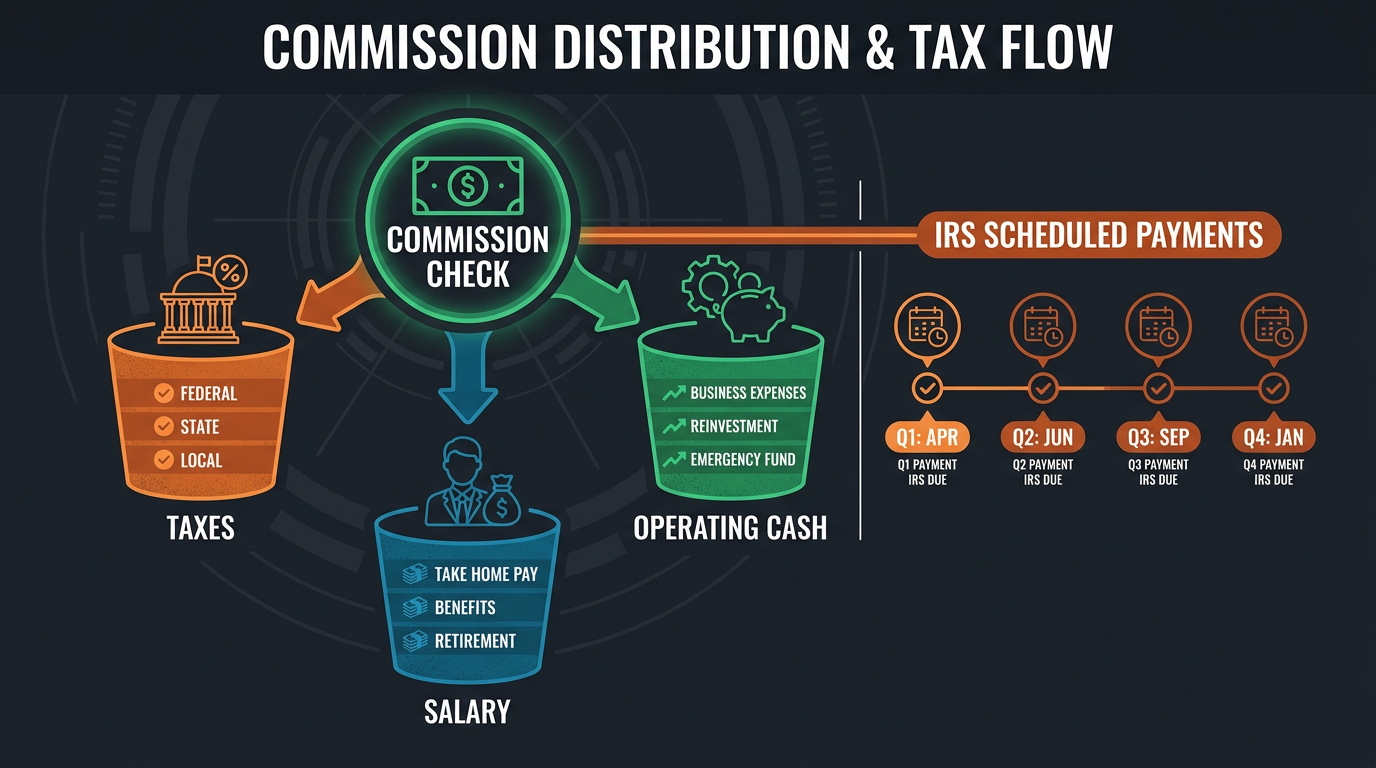
The fix is simple in principle: separate your tax money the moment a commission deposit lands, not after you've paid for marketing, covered a vendor, or moved money to personal accounts. Here's what a working system actually does:
-
Set aside a percentage immediately — a 25–30% reserve from each deposit covers most agents' federal and self-employment tax obligations.
-
Track what's been set aside vs. spent — visibility into your tax bucket means no more guessing when a deadline approaches.
-
Pay on the IRS schedule — four times a year on the IRS estimated tax deadlines.
-
Recalculate each quarter — commission income fluctuates, so your payment amount should reflect what you actually earned, not a fixed guess.
-
Keep tax money separate from operating cash — mixing funds is where the math falls apart under lumpy income cycles.
Lettuce automates S Corp quarterly taxes by splitting incoming deposits into dedicated buckets for salary, taxes, and available cash, then processing payments on the IRS schedule so you stay current without tracking a single deadline. Once your cash flow is running on a system like this, you're ready to ask a more interesting question: can an S Corp reduce what's subject to self-employment tax in the first place?
When An S Corp Starts Making Sense For Commission Income
Once your tax set-aside system is running, the more interesting question is whether your business structure is leaving money on the table. For real estate agents, that answer usually hinges on one thing: consistent commission income. The tipping point is generally around $80,000 in annual profit — the level where self-employment tax savings start to outweigh the added payroll and filing requirements of operating as an S Corp.
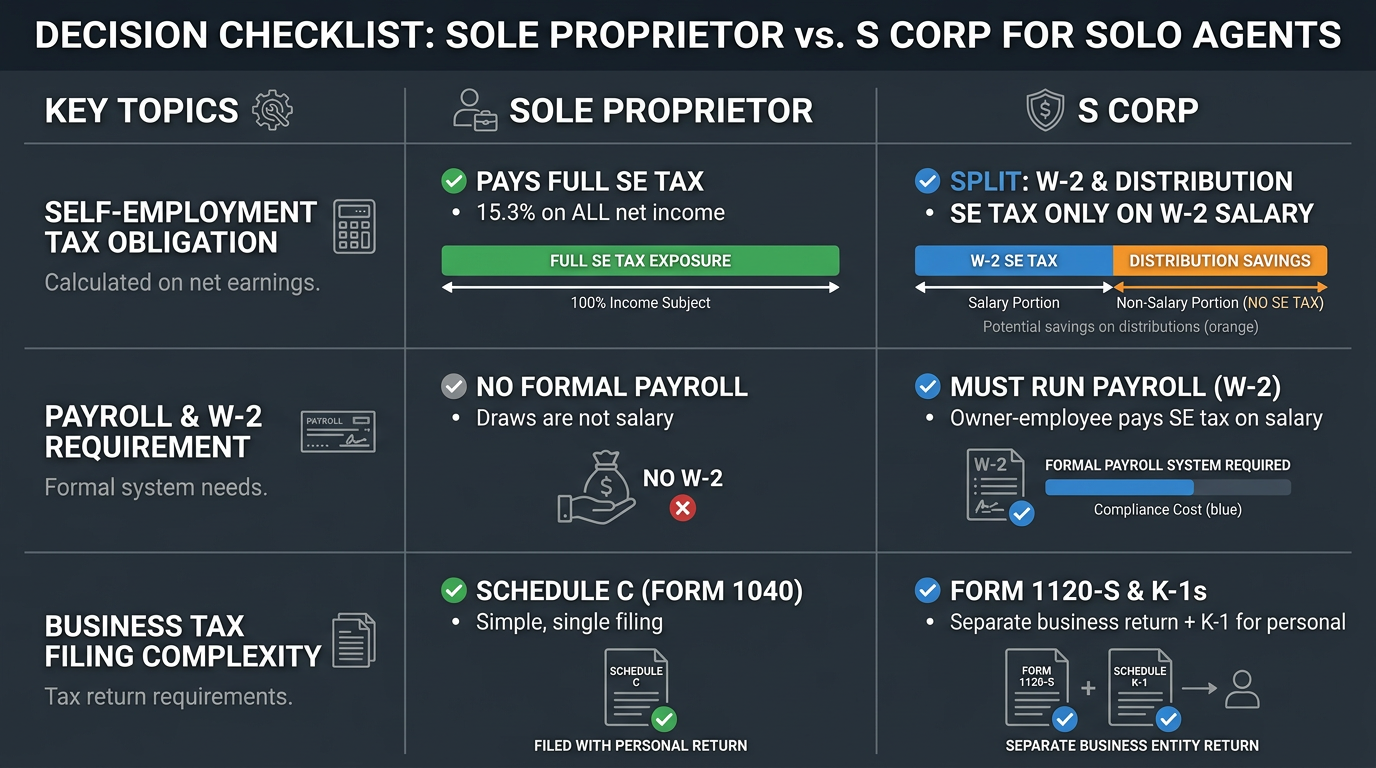
The structural difference is worth understanding clearly. As a sole proprietor or single-member LLC, the IRS treats all your net commission income as self-employment income, which means the full 15.3% self-employment tax applies to every dollar of profit. An S Corp changes that equation.
You pay yourself a reasonable salary subject to payroll taxes, and any remaining profit can be distributed to you as an owner distribution, one that is generally not subject to self-employment tax. The savings come from that gap between your total profit and your salary. As the University of Illinois Tax School notes, the tradeoff is real: S Corps add compliance costs like payroll processing and corporate filings, so the math only works in your favor once the tax savings clear that bar.
| Tax Topic | Sole Proprietor or Single-Member LLC | S Corp | Why It Matters to Agents |
|---|---|---|---|
| Self-Employment Tax Treatment | 5.3% applies to all net business income | 15.3% payroll tax (combined between the employee and employer)applies to reasonable salary only; distributions are generally not subject to self-employment tax | Agents with strong GCI can reduce taxable wages relative to total income |
| Quarterly Tax Handling | Estimated payments due April 15, June 15, Sept 15, Jan 15 based on projected net income | Taxes withheld and remitted through payroll on a regular schedule; distributions handled separately | Payroll-based withholding can replace manual estimated payments |
| Payroll Requirement | None | Required; owner-employee must receive reasonable W-2 compensation before taking distributions | Adds a recurring compliance step; platforms like Lettuce automate this |
| Year-End Filings | Schedule C on personal return (Form 1040) | Form 1120-S (S Corp return), Schedule K-1, W-2; personal return includes K-1 income | More moving parts, but Lettuce prepares all required filings in one place |
| Best Fit by Income Pattern | Variable or early-stage income below ~$80K net profit | Consistent net profit above ~$80K annually | Lumpy commission income may still qualify; consistency matters more than size alone |
The S Corp distributions framework only delivers its full benefit when the salary is set correctly from the start. Too low, and the IRS may reclassify distributions as wages. Too high, and you've erased the savings. Lettuce calculates a defensible reasonable salary based on your actual income, role, and hours, so the structure works the way it's supposed to.
FAQ About 1099 Taxes For Real Estate Agents
Here are the questions agents ask most once they start treating 1099 commission income like the cash-flow system it actually is.
Do real estate agents really have to pay taxes four times a year?
Yes, if you expect to owe at least $1,000 in federal tax for the year, the IRS expects you to pay as you earn. The four payment periods fall in April, June, September, and January. Missing them can trigger underpayment penalties, even if you settle the full balance by April 15.
Why do 1099 real estate agents pay self-employment tax on all their income?
As a 1099 real estate agent, you cover both the employer and employee halves of Social Security and Medicare — 15.3% on net earnings — while a W-2 employee splits that cost with their employer. Federal and state income tax stack on top, which is why the total bill can run much higher than most agents anticipate.
Can a new or part-time real estate agent benefit from an S Corp, or is it better once income is more consistent?
An S Corp requires running W-2 payroll at a reasonable salary, plus separate business filings. Those costs make the structure worth it when your commission income is steady enough that the self-employment tax savings exceed the added compliance work. For agents still building volume, the better first move is getting a reliable tax set-aside system in place, then revisiting the S Corp question once income is more predictable. Lettuce's real estate tax resources can help you track where you stand.
Build A Tax System That Keeps More Of Each Commission Check
The sequence matters. Automate how tax money gets set aside and paid as each commission check lands then, once income is consistent, evaluate whether an S Corp can reduce what's subject to the 15.3% rate altogether. That's not two separate problems. It's one system, and getting it right means keeping more of every dollar you close.
Lettuce combines business banking, bookkeeping, payroll, compliance, and tax filing around how commission income actually arrives, so the back office runs while you focus on closings. And if the savings don't outweigh the cost, the Lettuce-Back Guarantee means you get your money back. Get started today!