 Diane Kennedy, CPA
1 min read

Real estate AI has evolved beyond listing descriptions and chatbots. The best AI stack combines front-office tools that generate leads with back-office automation that saves time, reduces administrative work, and helps independent agents keep more of what they earn.
If you're an agent trying to figure out where AI actually fits into your business, this guide walks through how to think about AI tools as a business-of-one, then puts that thinking into practice.
Here's a number that should stop you mid-scroll: 82% of real estate agents already use AI in their business. Not "are considering it." Not "have heard of it." Are actively using it, right now, in 2026. And yet, when you talk to most agents about which tools they're actually running, the list is thin. ChatGPT for a listing description here, maybe a CRM with some automation there. The gap between adoption and impact is enormous.
That gap is opportunity, and it runs in both directions. Agents who are using AI strategically are closing more deals, spending less time on admin, and keeping significantly more of what they earn. Agents who are dabbling at the edges are paying a premium in time, stress, and yes, actual dollars, particularly when it comes to how they're structured financially.
AI tool adoption in real estate jumped from roughly 11% in 2023 to 35% by 2025, then accelerated sharply into 2026. This is no longer a trend on the horizon. It's the floor. The question is no longer whether to use AI: it's which tools deserve a place in your stack, and where they'll move the needle most.
Most listicles on the best AI tools for real estate agents cover the front end: lead generation, marketing, listing descriptions. And those categories matter. But they leave out an entire layer of your business: the back-office infrastructure that quietly determines how much you actually keep from every commission check.

This guide starts with the category most agents begin with: Lead Generation & Nurturing. You're a 1099 real estate agent. You're running a business-of-one. This is part of the complete AI stack built for that reality.
One thing worth flagging up front: AI isn't just useful for front-office work like lead generation. It's just as valuable on the back-office side, where many 1099 real estate agents leave thousands of dollars in potential tax savings on the table each year.
That's exactly where Lettuce comes in. Lettuce uses AI to automate bookkeeping, payroll, tax management, and S Corp compliance, helping independent agents spend less time on administrative work while keeping more of what they earn.

Is Lettuce right for you?
See if Lettuce can help you keep more of what you earn with our short quiz.
Take QuizHow to Think About AI Tools as a Real Estate Agent
Before diving into specific tools, let's build a decision-making lens, because the biggest mistake most agents make isn't choosing the wrong tool. It's choosing a tool without knowing why.
The real estate AI tools market is crowded, fast-moving, and filled with flashy promises. A tool that's transformative for a high-volume listing agent in a major metro might be completely irrelevant to a buyer's agent building their first database in a smaller market. Knowing where you are, and where you want to go, is the filter that makes this entire list actionable rather than overwhelming.
Start with layers. Think of your business as having two operating levels. The front-office layer is everything client-facing: prospecting, marketing, showing properties, negotiating, and communicating. The back-office layer is everything operational: bookkeeping, taxes, compliance, scheduling, and financial management. Most agents over-invest in front-office AI and under-invest in the back. That's understandable: front-office tools are visible, exciting, and directly connected to revenue. But back-office AI is where the compounding savings quietly accumulate, year after year.
Prioritize ROI over novelty. The best tool is the one that saves you the most time or the most money, not the one with the best demo. A $165/month lead scoring tool that converts one additional listing per quarter is an extraordinary investment. A $600/month marketing platform you use twice before forgetting your login is an expensive mistake. Ask yourself two questions before every subscription: How many hours per month will this save me? And what's my effective hourly rate as an agent?
Consider integration before commitment. Standalone tools create friction. If a new AI platform doesn't connect to your CRM, your calendar, or your banking, it becomes an island. And islands require extra effort to maintain. The best tools in your stack communicate with each other, reducing duplicate data entry and making your workflow feel seamless rather than Frankensteined together.
According to the NAR REALTOR® Technology Survey, the areas where agents are most actively investing in technology include eSignature (79%), CRM software (52%), and AI tools (46%). What's conspicuously absent from that list? Financial management and tax planning tools are a category where adoption remains stubbornly low despite the enormous dollars at stake for self-employed agents. We'll come back to that.
Think about your stage. A newer agent building a database from scratch has different needs than a seasoned producer with 200 past clients and a referral-driven business. The tools in this guide are categorized not just by function, but with explicit "best for" context so you can self-identify which ones fit your current reality.
With that framework in place, let's get into the tools, starting with the category where most agents begin their AI journey.
AI Tools for Real Estate Lead Generation & Nurturing
Lead generation is where the real estate AI revolution started, and for good reason. Finding, qualifying, and nurturing leads is time-consuming, repetitive, and highly susceptible to the kind of pattern-recognition that AI does exceptionally well. The most sophisticated tools in this category don't just help you find leads; they predict which homeowners are most likely to sell before those homeowners have even fully formed the thought themselves.
The use cases here span a wide spectrum: predictive analytics that identify likely sellers in your farm area, AI voice assistants that follow up with new leads in real time, lead scoring systems that rank your existing database by conversion likelihood, and automated nurturing campaigns that keep you top-of-mind across months-long sales cycles. Understanding which part of the funnel is your current bottleneck will help you identify which of these tools deserves your budget first.
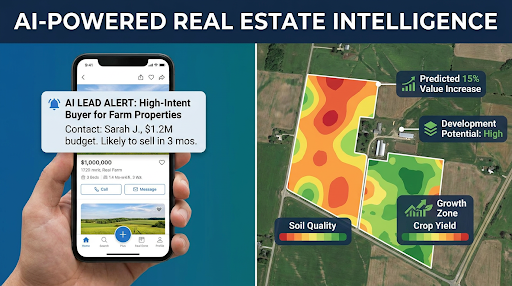
Top Producer Smart Targeting is built for established listing agents who want to dominate a geographic farm. It uses AI to identify the top 20% of homeowners most likely to sell within a given area, then wraps that intelligence in an automated marketing system, email campaigns, postcards, and digital ads, that keeps your name in front of those prospects consistently. Starting at approximately $599/month, it's a meaningful investment, but for agents committed to a farming strategy, the math on a single converted listing closes quickly.
SmartZip is one of the original pioneers in predictive seller analytics. Its models analyze more than one billion data points across 25+ data sources: everything from equity position and length of ownership to neighborhood sales velocity and life event triggers. In testing periods, SmartZip's algorithm predicted 72% of actual listings within its target zones. At approximately $500/month, it competes directly with Top Producer Smart Targeting, and the right choice often comes down to which platform's marketing ecosystem fits your existing workflow better.
Fello takes a different approach: rather than identifying new prospects in a geographic area, it focuses on your existing database. Fello integrates with virtually any CRM and runs AI analysis across your contacts to score them by likelihood to sell. It then deploys automated nurturing campaigns (emails, texts, and market updates) tailored to each contact's predicted timeline. At approximately $165/month, it's one of the most accessible high-ROI tools on this list for agents who have already built a meaningful sphere.
Ylopo sits at the intersection of lead nurturing and paid advertising. When a new lead enters your system, Ylopo's AI voice assistant follows up, in near real time, with a personalized outreach call. The system also runs AI-optimized Meta video ads that adapt based on performance data. At approximately $600/month, Ylopo is best suited for agents running active paid lead campaigns who want to eliminate the lag between lead capture and first contact. That first five-minute window after a lead submits is where conversions are won or lost, and Ylopo is designed to own it.
The common thread across all of these tools is time reclamation. Every hour your AI system spends qualifying and nurturing leads is an hour you're spending with real clients having real conversations. For a deeper look at how these platforms compare across features, HousingWire's breakdown of AI lead generation tools offers useful additional context.
One honest caveat worth stating clearly: every tool in this category has a learning curve, and most of them work best when paired with a solid, well-maintained CRM. AI is only as smart as the data it's working with. A clean, rich contact database will always outperform a disorganized one, regardless of which platform sits on top.
Once you've attracted a lead into your ecosystem, the next job is marketing your listings and your personal brand with the kind of quality that used to require an entire production team to pull off.
That's the shape of the lead generation layer. Paired with a solid CRM and a clean database, these tools reclaim hours every month, hours you can spend closing deals instead of chasing leads.
AI Tools for Real Estate Agents Frequently Asked Questions (FAQs)
What are the best AI tools for real estate agents?
The best AI tools depend on where you're trying to improve your business. For lead generation, platforms like Top Producer Smart Targeting, SmartZip, Fello, and Ylopo help identify prospects and automate follow-up. For content creation, tools like ChatGPT can assist with listing descriptions, emails, and marketing copy. On the operational side, platforms like Lettuce help self-employed real estate agents automate bookkeeping, payroll, tax management, and S Corp compliance, reducing administrative work while helping maximize tax savings.
Can AI really help real estate agents generate more leads?
Yes. AI can analyze homeowner behavior, identify likely sellers, score leads based on conversion potential, automate follow-up campaigns, and personalize communication at scale. Rather than replacing relationship-building, AI allows agents to spend less time on repetitive administrative work and more time meeting clients, negotiating deals, and growing their business.
How should a real estate agent build an AI tech stack?
Start with your biggest bottleneck. Newer agents often benefit most from AI-powered lead generation and CRM automation, while established agents may see greater returns from predictive analytics and marketing automation. Once your front-office systems are working efficiently, adding back-office automation for bookkeeping, payroll, taxes, and compliance creates a more complete AI stack that improves both productivity and profitability.
Can AI help self-employed real estate agents save money on taxes?
While AI doesn't replace professional tax advice, it can simplify the financial tasks that often lead to missed deductions or inefficient business structures. AI-powered financial platforms like Lettuce automate bookkeeping, payroll, and S Corp administration, making it easier for eligible independent agents to stay compliant and potentially keep more of what they earn throughout the year.
Will AI replace real estate agents?
No. AI is designed to augment, not replace, real estate professionals. Buying and selling real estate remains a relationship-driven process that requires negotiation skills, local market expertise, trust, and personalized guidance. AI excels at handling repetitive tasks and organizing information, allowing agents to focus on the high-value work that clients expect from an experienced advisor.
Build Your Lead Gen Layer, Then Keep What You Earn
The tools above will help you find and nurture leads more efficiently, but the agents who come out ahead long-term aren't just the ones generating more business. They're the ones keeping more of what they earn from it. Once your lead gen stack is dialed in, the next place to look is your back office, where structuring your business the right way can mean thousands of dollars in tax savings every year.
See how much you could save with Lettuce's S Corp Tax Calculator, or get started with Lettuce to see if an S Corp structure makes sense for your business.
This article is Part 1 of the Tax Strategy Series for Real Estate Agents, featuring in-depth, practical guidance from Diane Kennedy, CPA—bestselling author, strategic tax consultant, and founder of USTaxAid and KennedyTax.tax. Also read Part 2: Marketing, CRMs & Client Management and Part 3: Valuation, Transactions & the Back-Office Most Agents Ignore.
Explore all of Diane’s tax strategy advice and insights here.
Related Articles:
- Should Real Estate Professionals Elect S Corporation Status?
- Outsourcing Bookkeeping Makes Your Business More Profitable
- 7 Small Business Automations That Work for Solopreneurs
- AI in Finance: The Solopreneur's Simple Guide - Lettuce.co
- How AI for Taxes Puts More Money Back in Your Pocket - Lettuce.co