
 Natalia Budyldina
1 min read

Real estate agent taxes get easier when you stop treating deductions as the whole game. This guide covers the full picture: your tax status, the quarterly system, when an S Corp pays off, the complete deduction list, recordkeeping, and the retirement and health coverage options solopreneurs often miss.
Real estate agent taxes work differently than a W-2 paycheck from the moment your first commission check clears. The IRS treats licensed real estate agents as self-employed by default, which means every commission check arrives without a dollar of tax withheld. You are running a business whether you think of yourself that way or not, and the tax code expects you to act like it.
Most agents respond by hunting for more deductions, but that's solving only part of the problem. The full picture includes the right entity structure, a quarterly payment system, a complete deduction list, clean recordkeeping, and the retirement and health coverage options available to a solopreneur.
If you want one platform that automates the moving parts without making taxes a second job, Lettuce is built exactly for that.

Is Lettuce right for you?
See if Lettuce can help you keep more of what you earn with our short quiz.
Take QuizUnderstanding Your Tax Status as a Real Estate Agent
Before you can fix your tax strategy, you need to know what the IRS actually thinks you are. For most agents, the answer is straightforward: the IRS classifies licensed real estate agents as statutory nonemployees, which means self-employed by default. That single classification drives everything that follows, from how your commission income is reported to why your tax bill can feel like a gut punch every spring.
You're a Business-of-One, Whether You Filed Paperwork or Not
Most real estate agent independent contractors receive a 1099-NEC from their brokerage at year-end, not a W-2. If you haven't formed an LLC or elected a different structure, the IRS treats you as a sole proprietor and expects you to report that income on Schedule C. No entity formation required. The business already exists in the IRS's eyes.
A W-2 employee sees taxes withheld before money ever hits their bank account. You don't. Your brokerage pays you the full commission amount, and the responsibility for federal income tax, Social Security, and Medicare falls entirely on you. Understanding that gap early is what separates agents who plan well from those who scramble.
The Quarterly System, Briefly
Because no employer withholds on your behalf, the IRS requires self-employed taxpayers to pay as they earn through four due dates a year: April 15, June 15, September 15, and January 15. Skip one, and the IRS calculates an underpayment penalty on top of whatever you already owe, accumulating IRS penalties and interest even if you pay the full balance by April.
A practical starting point: set aside roughly 25% to 30% of net income after every closing and treat it as untouchable. 1099 taxes for real estate agents run smoothest when that set-aside happens automatically the moment a commission lands, rather than getting calculated after the fact from memory.
The Real Cost of Self-Employment Tax
Most 1099 real estate agents know taxes take a big bite. Fewer realize exactly where that bite comes from. For commission-based agents, self-employment tax is often the largest single line item — and it lands before federal or state income tax even enters the picture.
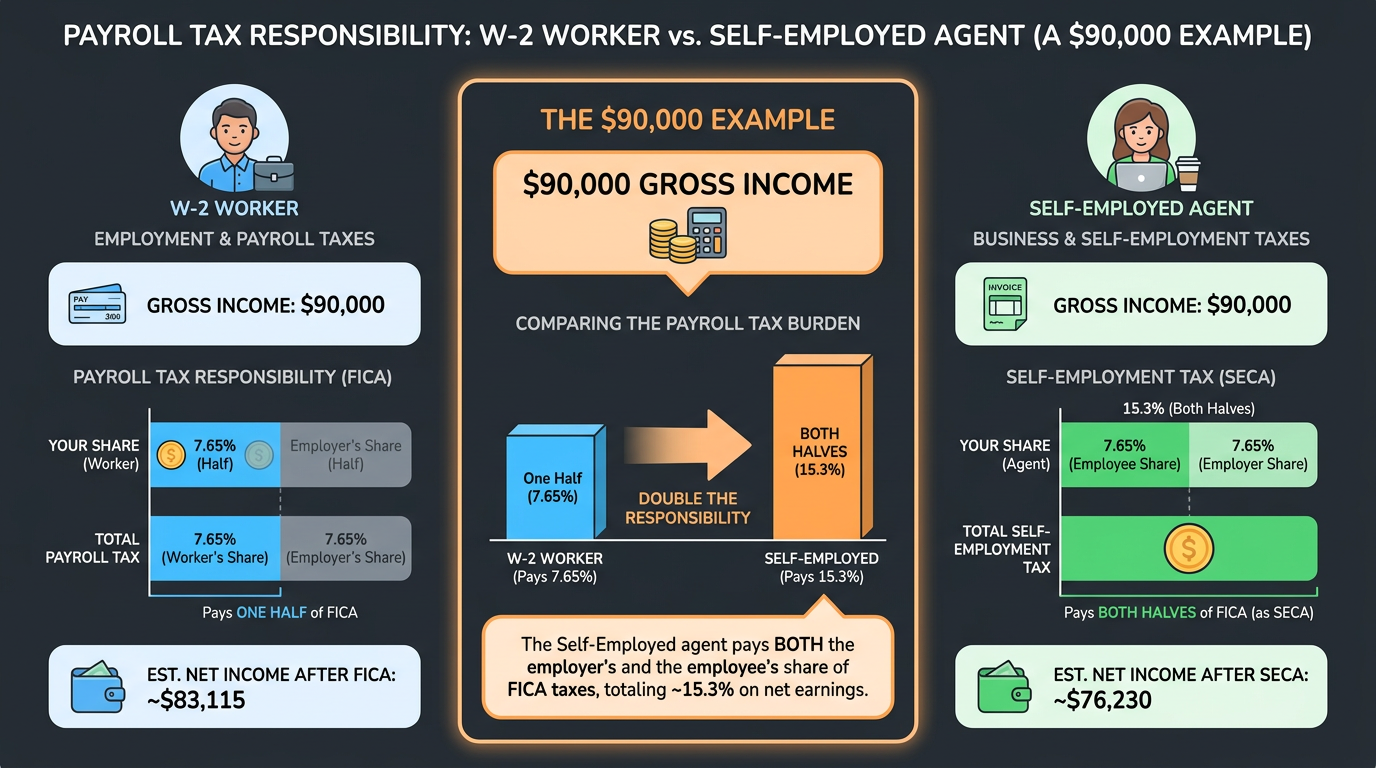
When you're self-employed, there's no employer splitting the tab with you. The IRS self-employment tax rate is 15.3%, covering both the employee and employer shares of Social Security and Medicare. A W-2 worker pays 7.65% and their employer covers the rest. You cover it all.
At $90,000 in net commission income, self-employment tax alone runs roughly $12,900 before a modest deduction for the employer-equivalent half. For most agents, this single number is larger than any deduction they'll ever claim, which is why structure, not just write-offs, is where the bigger savings live.
The S Corp Fix, at a Glance
For agents with consistent commission income, an S Corp separates your income into two buckets: a reasonable real estate agent salary that runs through payroll and stays subject to payroll taxes, and remaining profit paid as distributions that, per the IRS, pass through to your personal return without triggering self-employment tax.
The break-even point is different for everyone, but consistently earning around $80,000 or more is generally where the savings start to outweigh the added payroll and filing work. The IRS is clear that S Corp shareholder-employees who perform services must be paid a reasonable salary through payroll, underpaying yourself to inflate distributions is a known audit trigger, so the salary has to be defensible, not just low.
If the numbers are there, it's often not too late to act midyear — the Form 2553 election has timing rules, but late election relief exists for many situations. Run the S Corporation Tax Calculator to see a concrete savings estimate based on your actual income.
The Complete Deduction List for Real Estate Agents
Deductions are real, and for real estate agents, the list is longer than most people realize. Mileage deductions for real estate agents are usually the biggest line item: the 2026 IRS standard mileage rate is 72.5 cents per mile for business use. Drive 10,000 miles showing properties and coordinating closings, and that's a $7,250 deduction before you touch anything else. The IRS requires you to choose between the standard mileage method and actual vehicle expenses, and either way, documentation matters.
Beyond mileage, the list worth tracking consistently includes:
- Marketing and staging costs: Photography, signage, open house supplies, and digital ad spend are all deductible as ordinary business expenses when they're directly tied to your real estate activity.
- Home office expenses: If your home qualifies as your principal place of business, you may be able to deduct a portion of rent or mortgage interest, utilities, and internet. Agents who work from a brokerage office still have a path to this deduction, depending on how their work is structured.
- MLS dues, licensing fees, and E\&O insurance: These are the recurring costs of staying licensed and active. They're deductible, and Lettuce auto-categorizes them so nothing slips through at year-end.
- Continuing education and professional development: Courses, designations (like ABR or CRS), and conference fees tied to maintaining or advancing your license are deductible business expenses.
- Client gifts and closing costs you cover: Closing gifts, home warranties you pick up for a buyer, and similar client-facing costs are deductible within IRS limits, provided you keep records tying the expense to a specific transaction.
- Business insurance beyond E\&O: General liability coverage and any additional policies tied to running your business also qualify.
Now for the part that reframes the whole conversation. As the Tax Foundation explains, a deduction saves you your marginal tax rate on that expense, not the full dollar. Spend $1,000 on a deductible business cost and you might save around $250 in taxes, which still leaves you $750 out of pocket.
Deductions reduce your taxable income. They do not touch the self-employment tax problem described above, that's why they work best alongside a smarter structure, not instead of one.
Recordkeeping That Actually Holds Up
None of the deductions above matter if you can't document them. A working system means:
- A dedicated business bank account, separate from personal spending. Mixing the two is the fastest way to lose track of what's deductible.
- A contemporaneous mileage log with date, destination, business purpose, and miles driven for every trip you plan to claim.
- Receipts or statements retained for at least three years, longer if you're claiming home office or vehicle depreciation.
- A running log tying client gifts and covered closing costs to the specific transaction they relate to.
Good accounting for real estate agents starts with one clean flow: commission income lands in a dedicated business account, and the system immediately separates what belongs to taxes, salary, and available cash. Without a system, every closing leaves you guessing what you actually get to keep.
Lettuce tracks mileage, home office, and transaction categories in the background automatically, so deductions are captured without a spreadsheet rebuilt from memory at year-end.
Health Insurance and Retirement: What Solopreneurs Often Miss
Fixing your entity structure and deductions still leaves two pieces most agents overlook. As a self-employed agent, you may be able to deduct 100% of your health insurance premiums for yourself and your family through the self-employed health insurance deduction, provided you're not eligible for coverage through a spouse's employer plan.
On the retirement side, a Solo 401(k) or SEP IRA lets you contribute well beyond what a typical employer plan allows, and contributions reduce your taxable income for the year. Both matter more once you're running an S Corp, since your contribution limits are tied to your W-2 salary rather than total profit — one more reason a defensible salary figure matters beyond payroll compliance.
If You Lead a Team
Team leads and broker-owners face a layered version of this same structure question: your own commission income still runs through the same S Corp logic, but overriding commissions from agents on your team add complexity to how income is classified and reported. The Lettuce guide on how real estate team leaders are taxed covers those structural considerations in more depth.
Don't Forget State Taxes
Everything above covers federal obligations, but most states layer their own income tax and, in some cases, their own estimated payment schedule on top. If your state has income tax, your quarterly set-aside needs to account for both: a 25–30% federal reserve isn't enough on its own in higher-tax states. Check your state revenue department's estimated tax rules alongside the federal deadlines above.
Year-End Moves to Make Before December 31
Most of this guide covers systems that run all year. A few decisions, though, only matter if you act on them before the calendar flips, and missing the window means waiting another twelve months.
-
Solo 401(k) accounts must be opened by December 31, even if you fund them later. The account itself has to exist before year-end for that tax year's contributions to count, even though the IRS gives you until your filing deadline (plus extensions) to actually deposit the money. Agents who wait until tax season to think about retirement contributions often find out the account should have existed months earlier.
-
A slow December can be the right time to prepay deductible expenses. MLS renewal fees, continuing education you were planning to take in Q1 anyway, or a marketing package for the new year can sometimes be paid in December instead, pulling the deduction into the current tax year if this year's income is higher than next year's is likely to be.
-
A large closing scheduled for early January might be worth pushing, or pulling forward. If you have some control over when a deal actually closes and one tax year looks meaningfully higher-income than the other, the timing of that single closing can shift which year absorbs the tax hit. This only works with deals that have genuine flexibility in their closing date — it's not a reason to delay a client unnecessarily.
-
Equipment and vehicle purchases have different rules depending on when you buy. A vehicle or equipment purchase made in December versus January can land in different tax years even though the difference in actual use is a matter of days. If a purchase was already planned, the calendar matters more than most agents assume.
-
Check whether your S Corp salary and total distributions for the year still look reasonable. If income ran higher or lower than expected, a mismatched salary-to-distribution ratio is easier to fix with a December payroll adjustment than to explain after the fact if the IRS asks.
None of these moves require rebuilding your whole system. They're single decisions with a hard deadline, which makes them easy to miss if nothing is prompting you to look at them until it's already January.
Putting It All Together: What This Looks Like Day-to-Day
Commission income lands in a dedicated account, and the system immediately separates what belongs to taxes, salary, and available cash. The IRS treats licensed agents as self-employed, which means no employer is doing that math for you.
In the background, deductions get categorized, estimated tax obligations stay current, and S Corp payroll runs on schedule without manual intervention. When year-end arrives, filings pull from live records instead of a spreadsheet scramble rebuilt from memory. That operational calm is what Lettuce builds for commission-based agents.
Three signals tend to point at the same answer on S Corp timing: your commission income is consistently above $80,000, real estate is your primary income stream, and you find yourself scrambling to figure out what you owe after every closing. The IRS requires S Corp shareholder-officers to receive reasonable compensation through actual payroll, not an ad hoc calculation after the fact.
Frequently Asked Questions About Real Estate Agent Taxes
How do real estate agent taxes work if I receive only 1099 commission income through my brokerage?
The IRS classifies licensed real estate agents as statutory nonemployees when they're paid by sales output under a written contract. That means your brokerage doesn't withhold anything. You report net commission income, pay self-employment tax on it, and make estimated payments yourself throughout the year.
Which mileage deductions for real estate agents are worth tracking, and what records do I need?
Every business mile adds up. The 2026 standard mileage rate is 72.5 cents per mile, so 10,000 documented miles equals $7,250 in deductions. To claim them, keep a contemporaneous log with date, destination, business purpose, and miles driven.
Does having a brokerage office disqualify me from claiming a home office deduction?
Not automatically. If your home qualifies as your principal place of business for administrative work, you may still claim the deduction even if you also use a brokerage office. Lettuce's guide on the home office deduction for realtors with a brokerage office breaks down the eligibility test and what documentation supports the claim.
How long should I keep my tax records as a real estate agent?
Generally three years from the filing date for most records, but longer (often six or seven years) if you're claiming vehicle depreciation, home office deductions, or have significant underreported income. When in doubt, keep it longer rather than risk not having it during an audit.
How does the One Big Beautiful Bill affect real estate agent tax planning?
The One Big Beautiful Bill includes provisions that could affect deductions and pass-through income treatment, but none are law yet. Changing your structure or strategy in anticipation of proposed legislation creates risk without guaranteed benefit. The smarter move is to get your current system right now: an S Corp election, clean payroll, and documented deductions give you a solid foundation regardless of what passes.
Run Real Estate Agent Taxes Like a Business Owner
Real estate agent taxes reward agents who treat commission income like a business, not a paycheck. Structure, deductions, recordkeeping, and long-term planning all work together.
Lettuce handles S Corp election setup, reasonable salary calculation, payroll, bookkeeping, and filings in one place built specifically for commission-based agents. If the platform doesn't save you more than it costs, the Lettuce-Back Guarantee means you get your money back. Ready to stop managing taxes between closings?
Explore Lettuce and see what a business-grade tax system looks like for one.