
 Christopher Hyde

In short: Your 2026 Solo 401(k) contribution limit could reach $72,000, but how much you can actually save depends on how you pay yourself. Between employee deferrals, employer profit-sharing, and catch-up contributions, the math adds up fast. Here’s how to choose the right compensation structure, especially as an S Corp owner, so your savings work harder.
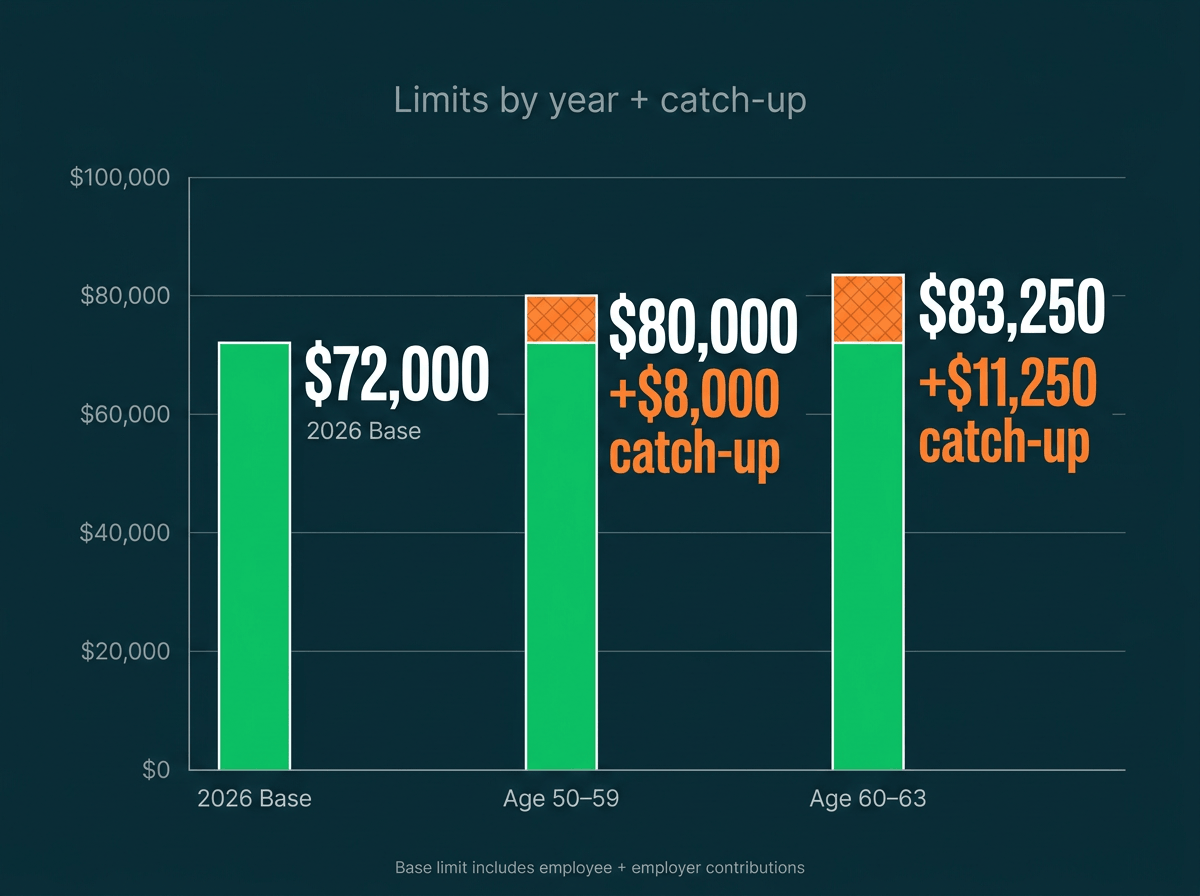
The 2026 Solo 401(k) annual contribution limit is $72,000 ($80,000 for participants eligible for standard catch-up contributions or up to $83,250 for participants age 60 to 63). Many solopreneurs never capitalize on making the maximum annual contribution.
Solo 401(k) contributions may be made from three sources: employee deferrals, which you contribute from your compensation; employer contributions, which the business makes through profit-sharing; and catch-up contributions for eligible participants age 50 or older. Your compensation and the way you pay yourself determine how much you can contribute from each source of funding.
A Solo 401(k) lets you contribute as both employee and employer, and the contribution limits are calculated differently depending on your business structure. See how Lettuce connects payroll, salary, and retirement planning so your numbers actually match what your business earns.

FREE CALCULATOR
Deduction
If you use part of your home regularly and exclusively for business, you can deduct it two ways. See which method puts more money back in your pocket.
CalculateUnderstanding The 2026 Solo 401(k) Contribution Limits
The published contribution limit is not the whole story. Solo 401(k) contribution limits for 2026 work across multiple contribution sources. Getting all three right is how a business-of-one turns a good income year into potentially a great tax savings each year.
Employee Salary Deferrals
As an employee of your own business, you can elect to defer up to $24,500 of your compensation in 2026. Traditional deferrals reduce your taxable income now; Roth deferrals allow your savings to grow tax-free for the future. Either way, you can make contributions to the limit before year-end.
Employer Profit-Sharing Contributions
Your business contributes separately as your employer. For S Corp owners, that means up to 25% of W-2 wages. For sole proprietors, it is roughly 20% of net self-employment income after adjustments. Combined with your employee deferral, the IRS contribution limit rules set the total at $72,000 for 2026, before any catch-up amounts are added.
The 2026 Catch-Up Rules Can Increase the Limit
This is the detail most self-employed owners miss. Persons ages 50 through 59, or ages 64 or older, can add $8,000 above the $72,000 limit; ages 60 through 63 can add $11,250 under SECURE 2.0. These amounts are in addition to the standard $72,000 limit. That can bring the potential 2026 contribution total to $80,000 for participants eligible for the standard catch-up or $83,250 for participants aged 60 through 63. Check contribution deadlines to make sure you don't miss any opportunities to contribute before the applicable deadlines pass.
New for 2026: Certain participants with more than $150,000 prior-year wages paid by their plan's sponsor may be required to make catch-up contributions as Roth contributions. Confirm how this new rule applies with your plan provider, or consult your tax or retirement specialist, before processing year-end payroll.
The Advantage No Other Plan Offers - Larger Contributions at Moderate Income
A SEP IRA allows contributions only from the employer, while a SIMPLE IRA has lower annual contribution limits. The Solo 401(k) offers greater flexibility by allowing contributions in two ways: as employee and employer. This dual contribution structure enables self-employed individuals and business owners to potentially maximize retirement savings and reach higher contribution levels at a lower income amount than with a comparable plan. For a business-of-one, that is an advantage worth exploring capitalizing on.
How Solo 401(k) Contribution Limits Work For Sole Proprietors And Single-Member LLCs
If you run a single-member LLC and file a Schedule C or E, your employer contribution is not based on gross revenue. It's based on adjusted net earnings from self-employment, which is smaller than most online calculators suggest.
For a business-of-one, the real 2026 Solo 401(k) contribution limit is not a fixed number. It's a calculation, and the IRS self-employed contribution worksheet requires a specific sequence where each step feeds into the next.
- Start with net profit from your Schedule C, not total revenue or gross receipts.
- Subtract the deductible portion of your self-employment tax to determine adjusted net earnings from self-employment.
- Calculate the employer contribution using the self-employed contribution rate. For a plan with a 25% stated employer rate, the effective rate is generally 20% of adjusted net earnings.
- Add your employee deferral to the employer contribution, then verify the total against the annual cap.
Track income and deductions carefully before calculating your contribution. Additional expenses reduce net income, and therefore reduce your contribution room, but accurate records help prevent an excess contribution based on overstated business income. Our Solo 401(k) calculator can show your exact 2026 limits before contribution deadlines pass.
How Solo 401(k) Contribution Limits Work With An S Corp Salary
Understanding how Solo 401(k) contribution limits work with an S Corp salary starts with one rule that most salary calculators don't surface: employer contributions are calculated only on W-2 wages. Shareholder distributions do not create retirement-plan contribution room. A salary set low to reduce payroll taxes pulls your employer contribution ceiling down with it, even in a high-profit year.
| Business Structure | Compensation Base | Employee Contribution Basis | Employer Contribution Basis | Common Limitation |
|---|---|---|---|---|
| Single-Member LLC (default taxation) | Net earnings from self-employment income | Lesser of $24,500 or eligible compensation | 20% of net SE income (after SE tax deduction) | Generally 20% of adjusted net earnings; use IRS worksheet; revenue swings can change contribution room |
| S Corp Owner-Employee | W-2 wages | Lesser of $24,500 or W-2 wages | 25% of W-2 wages | Up to 25% of W-2 wages; distributions do not count |
The first priority in setting an S Corp owner's salary is meeting the reasonable compensation requirement. Once that requirement has been met, the smartest salary is not necessarily the lowest amount you can justify, but the amount that appropriately balances payroll tax costs with the capacity to make retirement plan contributions. A Solo 401(k) calculator shows exactly where that balance sits for your income level. The Lettuce resource on S Corp retirement planning walks through the full picture, and if you're weighing plan types, the Solo 401(k) vs. SEP IRA comparison is worth reviewing before you finalize your salary.
Frequently Asked Questions About Solo 401(k) Contribution Limits
The contribution limits are clear on paper. What takes more thought is how the rules apply to your specific setup. The real complexity shows up when your income situation doesn't fit a single box.
Can I max out my Solo 401(k) if I have both W-2 income and self-employment income?
Maxing out your Solo 401(k) alongside W-2 income is possible, but the $24,500 deferral limit applies per person, not per employer. A $10,000 W-2 deferral elsewhere leaves you with just $14,500 in Solo 401(k) salary deferrals, per IRS rules for one-participant plans. The employer profit-sharing contribution is calculated separately. Lettuce's Solo 401(k) calculator can help you determine the maximum contribution allowable based on your income, giving you a clear picture of how much you can save for retirement.
What happens to catch-up contributions if I turn 50 during 2026?
You qualify for the full catch-up amount for the entire year you turn 50, even if your birthday falls in December. The standard catch-up adds $8,000 on top of the $72,000 annual additions limit. If you turn 60, 61, 62, or 63 in 2026, SECURE 2.0 rules raise your catch-up to $11,250 instead.
Can my spouse contribute to the Solo 401(k) if the business pays them?
Yes, if your business pays your spouse W-2 wages for work they genuinely perform, they qualify for their own retirement contributions. The business can also make employer profit-sharing contributions on your spouse's behalf. Together, contributions to two retirement accounts (or plans) effectively double the contribution limits, making two-spousal participation one of the most underused retirement optimization strategies in a business-of-one. Lettuce's S Corp retirement guide walks through the full setup.
What is the deadline to set up and fund my Solo 401(k) for 2026?
An S Corporation owner generally must elect employee salary deferrals before the related wages are paid, and the deferrals must be processed through the corporation's 2026 payroll. The retirement plan generally must be established by December 31, 2026, and employee deferrals should be deposited timely after they are withheld from payroll.
Employer profit-sharing contributions may be funded by the S Corporation's tax-return filing deadline, including extensions. For a calendar-year S Corporation with a valid extension, the contribution deadline is generally September 15, 2027. Limited exceptions may apply.
A new one-participant 401(k) for an unincorporated sole proprietor has a special first-year rule that can allow the plan to be adopted after year-end and the first-year employee deferral to be elected and funded by the unextended individual tax-return deadline. Consult your tax or retirement plan specialist to confirm the deadlines and requirements applicable to your scenario.
The full contribution timeline is broken down in Lettuce's Solo 401(k) guide.

FREE CALCULATOR
Late S Corp Election
Should you backdate your S-Corp election? See how much that could save you compared to starting today, and whether you still qualify.
CalculateTurn Your Solo 401(k) Limit Into A Bigger Tax Win
Before year-end payroll deadlines arrive, confirm whether your 2026 income flows through W-2 wages or net self-employment earnings. The IRS 2026 deferral limit is $24,500, but your Solo 401(k) contribution limits are only as powerful as the compensation structure behind them. A contribution calculator helps you estimate your real contribution room before the numbers are locked in.
Lettuce brings S Corp salary, payroll, and S Corp retirement planning together in one place. Staying ahead of 2026 contribution deadlines becomes part of the system, not a last-minute scramble.
Start mapping your 2026 Solo 401(k) contribution strategy at Lettuce.
Carry Disclaimer: The Lettuce Learning Center is operated by Lettuce Financial Labs Inc. ("Lettuce") and contains generalized educational content about personal finance topics. The information published should not be construed as personalized investment or tax advice and should not be considered as a solicitation to buy or sell any security or engage in a particular investment, accounting, tax or legal strategy. You should consult with qualified tax, legal, accounting, and investment professionals regarding your specific situation.
The accounts, strategies and/or investments discussed in this material may not be suitable for all. All investments involve the risk of loss, and past performance does not guarantee future results. Investment growth or profit is never a guarantee. All statements and opinions included on the Lettuce Learning Center are intended to be current as of the date of publication but are subject to change without notice.
Carry is owned by Lettuce.; the two are affiliated. Any investment advisory services discussed on this website are provided exclusively through its wholly-owned subsidiary, Carry Advisors LLC ("Carry Advisors"), an SEC registered investment adviser.
To access Carry investment advisory services through Carry Advisors, you must be a client of Carry on an eligible membership plan. For more information about Carry Advisors' investment advisory services, please see our Form ADV Part 2A brochure and Form CRS or through the SEC's website at www.adviserinfo.sec.gov.