
 Diane Kennedy, CPA
1 min read

There's no magic income level at which every business should elect S corporation status, despite what internet rules of thumb suggest. Real S corp savings come from paying yourself reasonable compensation and letting the remaining profit skip self-employment tax, but that split brings added payroll, bookkeeping, and compliance costs.
Spend enough time reading tax advice online and eventually you'll run across some version of this: “Once your business makes $50,000, elect S corporation status.”
Sometimes it's $40,000. Sometimes it's $75,000.
And it's usually followed by a promise that you'll save thousands of dollars in taxes.
There's a kernel of truth there. But choosing an S corporation isn't simply a tax-saving trick. You're choosing how you're going to operate your business.
And taxes are only one part of that decision.

Curious if an S Corp is right for you?
Try the Lettuce Tax Calculator to see how much more you can take home each year.
See your savingsWhere the S Corporation Tax Savings Comes From
First, let's look at the math behind the advice. If you're a sole proprietor, your net business earnings are generally subject to self-employment tax, within the applicable rules and limits.
An S corporation works differently.
If you work in your S corporation, you're generally required to pay yourself reasonable compensation for the work you perform. That's wages, reported through payroll, with the appropriate payroll taxes.
But after paying reasonable compensation and other business expenses, additional S corporation profit generally isn't subject to self-employment tax.
That's where the potential savings comes from.
Suppose a business has $150,000 available before paying its owner.
Using a 40% compensation assumption, the owner might receive $60,000 as wages. The remaining $90,000 of S corporation profit generally isn't subject to self-employment tax.
That's where the potential tax savings comes from.
But 40% isn't an IRS rule or safe harbor. Your actual salary must be reasonable for the work you perform.
That's why there isn't a magic income number or a magic salary percentage that works for everyone.
And Then There Are the Costs
An S corporation isn't free.
You may have payroll processing costs, additional tax returns, bookkeeping requirements, state filing fees and other compliance costs.
Some states impose additional taxes or fees on S corporations.
And if virtually all of the company's profit should reasonably be paid to you as compensation for the work you perform, there may not be much left to create the payroll-tax savings you were expecting.
The question isn't: “Can an S corporation save taxes?”
Of course it can.
The better question is: “Will an S corporation save me enough to justify the additional cost and complexity?”
But even that isn't the whole question.
Sometimes Tax Savings Isn't the Reason
I work with an inventor who develops and patents products, builds prototypes and ultimately works toward transactions that can be worth millions of dollars.
There can be substantial expenses long before there's a substantial payday.
We use a corporation.
And the immediate payroll-tax savings isn't necessarily the most important reason.
When banks, investors and potential joint-venture partners see a corporation, there's often an immediate level of comfort. It looks and operates like a business entity designed to accommodate contracts, ownership interests and investment.
In other words, it feels more grown-up.
An S corporation can also allow eligible business tax items, including certain credits, to flow through to the shareholder, subject to the applicable tax rules and limitations.
And, depending on state law and how the business is operated, conducting business through a separate legal entity may provide liability protection.
Those things can matter enormously.
There are plenty of reasons an S corporation may make sense from the beginning.
Tax savings is just one of them.
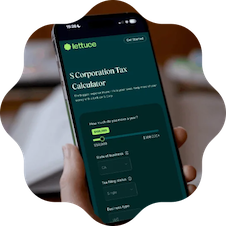
FREE CALCULATOR
S Corp Tax
The biggest expense in your life is your taxes. Use this calculator to see what you could save with an S Corp.
CalculateThe Question Doesn't End When You Make the Election
Here's something that gets discussed much less often. Suppose an S corporation really did make sense when you elected it.
Does it still? Businesses change. Profit changes.
The work performed by the owner changes. Reasonable compensation changes. State taxes change. Payroll and compliance costs change.
An S corporation that produced substantial savings a few years ago might provide very little benefit today.
Or the opposite may happen.
A business that didn't originally generate enough profit to justify an S election may grow to the point where the numbers suddenly become compelling.
That's why entity planning shouldn't be a one-time conversation.
You need to periodically run the numbers again.
And to do that, you need to know what the numbers actually are.
This Is Where Current Bookkeeping Matters
Imagine waiting until March of 2027 to discover that your business changed dramatically during 2026.
Your tax return can tell you what happened.
It can't go back in time and let you make different decisions.
Current bookkeeping lets you see what's happening while there's still time to do something about it.
How much profit is the business actually generating?
How much are you paying yourself?
What is the corporation costing you to operate?
Are distributions growing?
Has the relationship between your compensation and the company's profit changed?
Those are the numbers that tell you whether the S corporation strategy is actually working.
And they're the numbers you can use with an S corporation calculator to test the potential tax savings rather than relying on a rule you heard online.
The Kernel of Truth
Is it true?
Yes. An S corporation can reduce payroll taxes in the right circumstances.
Does it work for me?
Maybe. Your profit, reasonable compensation, state taxes, compliance costs and larger business objectives all matter. Tax savings may be one reason to choose an S corporation, but it doesn't have to be the only one.
Can I prove it?
Run the numbers - and keep running them. Current financial records let you measure whether the strategy you chose is still producing the result you expected.
An S corporation isn't a tax hack. It's a business structure. Choose it like one.
The Bottom Line: When Does an S Corporation Make Sense?
There is no magic profit level at which every business owner should elect S corporation status.
An S corporation can create meaningful employment-tax savings when the business generates enough profit above reasonable compensation to justify the additional payroll, tax preparation, bookkeeping and compliance costs.
But tax savings aren't the only reason S corporation treatment may make sense. Your business structure, growth plans, state tax rules and larger business objectives can all be part of the decision.
And the analysis shouldn't stop once you've made the election.
The S corporation that made perfect sense five years ago may not be the right answer today, and the business that wasn't ready for an S corporation two years ago may be ready now.
That's why the best S corporation strategy isn't based on a magic number.
It's based on your numbers.
Frequently Asked Questions About S Corporations
What is an S Corporation?
An S corporation is generally a corporation or other eligible entity that has elected to be taxed under Subchapter S of the Internal Revenue Code.
Unlike a traditional C corporation, an S corporation generally doesn't pay federal income tax at the corporate level on its ordinary business income. Instead, taxable income and certain other tax items pass through to its shareholders.
At what income should I elect S Corporation status?
There is no universal income or profit level at which every business owner should elect S corporation status.
The decision depends on factors including business profit, reasonable compensation, payroll costs, tax-preparation and compliance costs, state taxes, and the owner's particular circumstances.
How does an S Corporation save taxes?
For an owner who works in the business, reasonable compensation paid as wages is generally subject to payroll taxes.
Additional S corporation business profit that passes through to the shareholder generally isn't subject to self-employment tax.
That difference can create tax savings when there is sufficient business profit remaining after paying reasonable compensation and other expenses.
Is the 40% S Corporation salary rule an IRS rule?
No. There is no general IRS rule saying an S corporation owner should pay themselves 40% of business profit as salary.
An owner who performs services for the corporation generally must receive reasonable compensation for those services. What constitutes reasonable compensation depends on the facts and circumstances.
Does an S Corporation owner have to take a salary?
An S corporation shareholder who performs substantial services for the corporation generally must receive reasonable compensation as wages.
Simply taking distributions instead of wages doesn't eliminate the reasonable-compensation requirement.
Are S Corporation distributions tax-free?
Not necessarily.
S corporation distributions generally aren't subject to payroll or self-employment tax, but that doesn't mean the underlying S corporation income is tax-free. Shareholders generally report their share of the corporation's taxable income whether or not all of that income is distributed to them.
Distributions can also have separate tax consequences depending on factors such as the shareholder's stock basis.
What are the additional costs of having an S Corporation?
An S corporation may involve payroll processing, a separate business tax return, additional bookkeeping and accounting requirements, state filing fees and other compliance costs.
Some states also impose additional taxes or fees on S corporations.
Those costs should be considered when determining whether the potential tax savings justify the election.
Can an LLC elect to be taxed as an S Corporation?
Yes, an eligible LLC can generally elect to be treated as an S corporation for federal tax purposes if it meets the applicable requirements.
This is one reason it's important to distinguish between the business's legal entity and its federal tax classification. An LLC doesn't necessarily have to become a corporation under state law simply to obtain S corporation tax treatment.
Does an S Corporation provide liability protection?
S corporation status itself is a federal tax classification, not a form of liability protection.
Liability protection generally comes from the underlying legal entity, such as a corporation or LLC, and depends on state law and how the business is operated.
Is an S Corporation always better than a sole proprietorship?
No. An S corporation introduces additional costs and administrative requirements.
For a business with relatively little profit above the owner's reasonable compensation, the potential payroll-tax savings may not be enough to justify those additional costs.
As profitability changes, however, the calculation can change.
Should I reconsider an S Corporation election after I've made it?
Yes. An S corporation election shouldn't necessarily be treated as a decision you make once and never revisit.
Changes in profitability, reasonable compensation, state taxes, ownership, compliance costs and the business itself can change whether S corporation treatment continues to make sense.
Why does bookkeeping matter for an S Corporation?
Current bookkeeping tells you how much profit the business is generating, how much compensation is being paid, how much is being distributed and what the entity costs to operate.
Those numbers allow you and your tax professional to evaluate whether the S corporation strategy is actually producing the expected benefit rather than discovering the answer after the year is over.
Whether an S corporation still makes sense for your business isn’t a question you answer once and forget—it’s one you need real numbers to keep answering. Lettuce runs your payroll, calculates your reasonable compensation, and keeps your bookkeeping current, so you can see whether your S corporation is actually paying off instead of guessing. Try Lettuce and get started today!
This article is part of the Tax Strategy Series, featuring in-depth, practical guidance from Diane Kennedy, CPA—bestselling author, strategic tax consultant, and founder of USTaxAid and KennedyTax.tax. Explore the full series and catch every installment here.
Related Articles: