 Diane Kennedy, CPA
1 min read

Businesses-of-one face a costly blind spot: overpaying on taxes simply because of how their entity is structured. Operating as a sole proprietor or single-member LLC means the full weight of self-employment tax falls on you alone. The S Corp election offers a smarter path, splitting income to unlock real savings while keeping your liability protection intact.
We've already established what a business-of-one is and just how many of you there are: 29.8 million strong, generating $1.7 trillion a year. We've also flagged something important: this model is genuinely hard in ways most financial advice never addresses.
Now let's get specific. We're walking through the six financial challenges every solo operator faces, then zeroing in on the one that costs the most: the self-employment tax trap that's quietly draining thousands of dollars a year from businesses-of-one who've outgrown the sole proprietor default. If you're earning six figures and still structured the simple way, this is the section of the guide that pays for itself.

Curious if an S Corp is right for you?
Try the Lettuce Tax Calculator to see how much more you can take home each year.
See your savingsThe Unique Financial Challenges of Running a Business-of-One
Running a business-of-one is one of the most empowering professional choices you can make. It’s also one of the most financially complex, and the complexity doesn’t announce itself. It accumulates quietly, in the gaps between what the generic advice covers and what your actual situation demands.
These challenges are real, they’re solvable, and understanding them is the first step to getting ahead of them.
“The difference between running a business-of-one and running any other business? You’re the CEO, the CFO, and the accountant — all before your first client call of the day.”
Challenge 1 — Taxes Are Entirely Your Responsibility, With No Employer to Share the Load.
As a W-2 employee, your employer covers half of your Social Security and Medicare taxes: the 7.65% employer match that most people never think about because they never see it. As a business-of-one, you pay both halves. That’s the full 15.3% self-employment tax on every dollar of net profit before federal income tax, before state income tax, before anything else.
Most solo earners don’t feel the full weight of this until their first significant tax season, and when it hits, it hits hard. The good news: it’s a known, quantifiable problem with a known, quantifiable solution. But you have to know it exists first. Understanding the difference between income tax and self-employment tax is foundational knowledge every business-of-one needs.
Challenge 2 — Quarterly Estimated Taxes Require Proactive Discipline.
The IRS doesn’t wait for April to collect. As a self-employed professional, you’re expected to make estimated quarterly tax payments in April, June, September, and January. Miss them, underpay them, or pay them late, and you’re looking at penalties on top of your tax bill. Most solopreneurs learn this the hard way, usually in their first or second year. A proper system eliminates this risk entirely by calculating your obligation in real time and keeping you ahead of each deadline.
Challenge 3 — Bookkeeping Falls to You, and the Cost of Doing It Poorly Is High.
Expense categorization, receipt management, income reconciliation, mileage tracking: every piece of this falls on you unless you’ve built a system to handle it. Miss a legitimately deductible expense, and you’re paying income tax on money you didn’t have to. Miscategorize an expense, and your books are wrong, which means your tax filing may be wrong. Keeping clean, accurate records as a self-employed professional is the financial foundation everything else is built on, and it’s chronically underappreciated until something goes sideways.
Challenge 4 — Cash Flow Is Irregular, and That Irregularity Creates Real Risk.
A $20,000 month followed by a $6,000 month is not unusual for a business-of-one, and managing through that volatility requires discipline that nobody teaches you. The particular danger: spending money in a good month that’s already been mentally allocated to your quarterly tax payment. Maintaining healthy cash flow as a solopreneur means building a system where your tax reserve is set aside automatically, before it can be spent.
Challenge 5 — Benefits Are Entirely Self-Funded.
Health insurance. Retirement contributions. Disability coverage. Life insurance. None of it is provided by an employer, and none of it is cheap when you’re buying it individually. What most solopreneurs don’t realize is that these can be structured tax-efficiently, the premiums and contributions can meaningfully reduce your taxable income, but only if you know how to set them up correctly.
Challenge 6 — Your Entity Structure Is a Decision With Real Financial Consequences.
Sole proprietor, single-member LLC, S Corp: these aren’t just bureaucratic formalities. They are choices that carry distinct tax profiles, liability protections, and compliance requirements. Many business-of-one professionals default to sole proprietorship out of simplicity, not strategy. And for lower income levels, that’s fine. But above a certain earnings threshold, that default choice starts costing you thousands of dollars per year. Understanding whether you need professional financial guidance is one of the most important questions a growing solo operator can ask.
These six challenges are not unique to any particular type of solopreneur. They apply across the board: to the freelance developer and the independent therapist, to the marketing consultant and the independent real estate agent. They are the financial landscape of the business-of-one, and they are solvable. But they require a solution tailored to this model.
Of all six, one stands so far above the rest in dollar impact that it deserves its own section. In fact, it may be the most expensive mistake in the entire solo economy, and most of the people making it don’t know it yet.
The $10,000 Tax Problem: Why Businesses-of-One Overpay
Here is the uncomfortable truth: if you’re a business-of-one earning more than $100,000 in net profit and you’re operating as a sole proprietor or single-member LLC, you are almost certainly overpaying your taxes. Not because of anything you’ve done wrong. Because of how the tax code is structured and because the workaround built into it requires a step that most solo operators have never taken.
The core problem is the self-employment tax, and it compounds fast.
As a sole proprietor or single-member LLC, 100% of your net profit is subject to the 15.3% self-employment tax (12.4% Social Security + 2.9% Medicare). There’s no employer to split it with. The entire burden is yours. On $150,000 in net profit, self-employment tax alone exceeds $21,000 before you’ve paid a dollar of federal or state income tax.
The solution is the S Corp election and it’s one of the most powerful tax strategies available to solo operators.
An S Corp election is a tax status filed with the IRS via Form 2553 that fundamentally changes how your income is treated. Instead of your entire net profit being subject to self-employment tax, you split your income into two buckets:
- A reasonable salary — the portion of your income you pay yourself as an employee of your own company, subject to payroll taxes (self-employment tax equivalent)
- Owner distributions — the remaining profit distributed to you as the business owner, which is not subject to self-employment tax
You retain your LLC’s liability protection. You gain a dramatically more efficient tax structure. And the savings are substantial.
Here’s the math made concrete:
Say you earn $120,000 in net profit as a business-of-one. As a sole proprietor, all $120,000 is hit with the 15.3% self-employment tax, that’s over $18,000 in self-employment tax alone. With an S Corp election, you set a reasonable salary of $70,000 (based on your industry and role). The remaining $50,000 flows to you as owner distributions and skips the 15.3% SE tax entirely. That’s approximately $7,650 in annual savings from this single structural change, before any other deductions are applied.
Ready to capture those savings? You can elect S Corp status with Lettuce, with Form 2553 and any required state filings prepared and submitted for you.
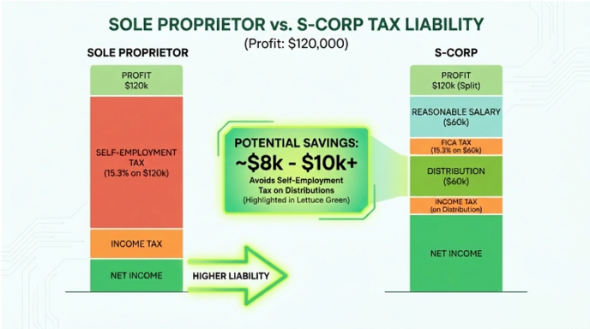
According to Lettuce’s own analysis, businesses-of-one earning over $100,000 in net profit could be overpaying their taxes by as much as $10,000 or more per year. Over five years, that’s $50,000 in unnecessarily surrendered income. That’s not an abstraction. That’s a retirement account, a health insurance fund, a reinvestment in your business.
Who qualifies for an S Corp election? Any business-of-one earning approximately $60,000 or more in net profit can begin to benefit from the S Corp structure. The higher your income, the greater the potential savings. Explore tax-efficient business structures to understand where you fall on that spectrum.
Why don’t more solopreneurs do it? Because without the right system, the S Corp structure genuinely is complicated. It requires running payroll, calculating a defensible reasonable salary, filing quarterly payroll tax forms, issuing yourself a W-2 at year-end, and maintaining ongoing IRS compliance. These aren’t insurmountable steps but they are steps that most solopreneurs don’t have the time, expertise, or infrastructure to manage on their own.
This is exactly where Lettuce enters the picture. But before we get there, let’s address a related question head-on with the clarity it deserves.
Quick Answers: S Corp for Businesses-of-One
How Is a Business-Of-One Taxed?
A business-of-one is subject to self-employment tax (15.3% of net profit) plus federal and state income tax. Unlike W-2 employees who split the Social Security and Medicare tax burden with their employer, solo operators pay the full self-employment tax themselves. This makes entity structure decisions (sole proprietor vs. LLC vs. S Corp) especially consequential. At higher income levels, the S Corp election can substantially reduce the self-employment tax burden.
What Is an S Corp Election, and Should a Solopreneur Consider it?
An S Corp election is a filing with the IRS (Form 2553) that changes how your business income is taxed. It allows you to divide your net profit into a reasonable salary (subject to payroll taxes) and owner distributions (not subject to self-employment tax). For businesses-of-one earning $60,000 or more in annual net profit, the S Corp election is one of the highest-leverage tax strategies available. The savings typically range from $5,000 to $20,000+ per year depending on income level.
Who Qualifies for S Corp Status?
Any U.S.-based business-of-one operating as an LLC or corporation with net profits of approximately $60,000 or more per year. The benefits grow with income — the more you earn, the more you save.
How Much Can a Solopreneur Save With an S Corp?
On $120,000 in net profit with a $70,000 reasonable salary, the tax savings are approximately $7,650 per year from self-employment tax reduction alone. At $200,000 in profit, savings can exceed $15,000 annually. Use the Lettuce Tax Savings Calculator to see your personalized estimate.
Does an S Corp Election Affect my Liability Protection?
No. If you’re already operating as an LLC, you retain your liability protection after electing S Corp tax status. The election changes your tax treatment, not your legal structure.
The tax picture is one piece of the larger puzzle. To fully understand what makes the business-of-one model unique and why it demands its own category of thinking, we need to set it against the traditional small-business model and examine what’s actually different.
Ready to stop overpaying the IRS? Lettuce automates your S Corp election, payroll, bookkeeping, and business tax filing so you can capture every dollar of savings without the paperwork headache. Try Lettuce today!
This article is Part 2 of the Business-of-One Definitive Guide Series, featuring in-depth, practical guidance from Diane Kennedy, CPA—bestselling author, strategic tax consultant, and founder of USTaxAid and KennedyTax.tax. Also ready Part 1: What Is a Business-of-One? The Definitive Guide for Solo Entrepreneurs, Freelancers & Independent Contractors and Part 3: The Business-of-One Operating System: Tools You Need to Run Profitably
Explore all of Diane’s tax strategy advice and insights here.
Related Articles: