
 Alex Zelaya
1 min read

Understanding the difference between income tax vs. self-employment tax can save solopreneurs thousands each year. Unlike W-2 employees, solopreneurs pay both sides of the 15.3% payroll tax. Electing S Corp status changes that — only your salary gets hit with self-employment tax, letting the rest of your profits pass through untouched.
You're not just paying income tax on your business profits. You're also funding both sides of Social Security and Medicare taxes at 15.3%. That's the hidden cost of being your own employer and employee.
Here's why this matters: the income tax vs self-employment tax distinction creates opportunities for profitable solopreneurs. You can shift part of your earnings from self-employment tax to tax-free S Corp distributions. You'll discover real scenarios and the compliance steps that keep you audit-safe.
Lettuce handles the S Corp conversion, payroll, and compliance automatically so you can focus on what you do best.

Is Lettuce right for you?
See if Lettuce can help you keep more of what you earn with our short quiz.
Take QuizWhat’s the Difference Between Income Tax and Self-Employment Tax for Freelancers?
You're paying two separate taxes that hit your cash flow in different ways. Income tax follows the familiar progressive brackets you know from your W-2 days. Self-employment tax is flat and relentless. It’s your version of payroll tax, and you pay both sides of it.
What Is Income Tax?
Income tax applies to your total taxable income after deductions and credits. Your net earnings from Schedule C get added to any other income sources, then the progressive brackets kick in. The more you earn, the higher your top rate climbs, but only on income above each threshold.
You report everything on Form 1040, and standard deductions and business write-offs reduce what gets taxed.
What Is Self-Employment Tax?
While income tax feels familiar, self-employment tax is a flat 15.3% on your business profit:
- 12.4% for Social Security
- 2.9% for Medicare
You calculate it on Schedule SE using your self-employment income. No brackets, no deductions, no mercy. If you made $400 or more in self-employment income, you owe it.
This funds the same Social Security and Medicare benefits that W-2 workers get through payroll deductions.
Why Do Solopreneurs Pay More Than W-2 Employees?
Here's the kicker: employees split payroll tax 50/50 with their employer. As a business-of-one, you pay the full 15.3%.
You get to deduct half of it as a business expense, but that cash still leaves your account. A $100,000 profit means $15,300 in self-employment tax before any income tax calculations.
That's why your options matter as your income grows and why understanding the alternatives becomes so valuable.
How Does S Corp Status Reduce Self-Employment Tax?
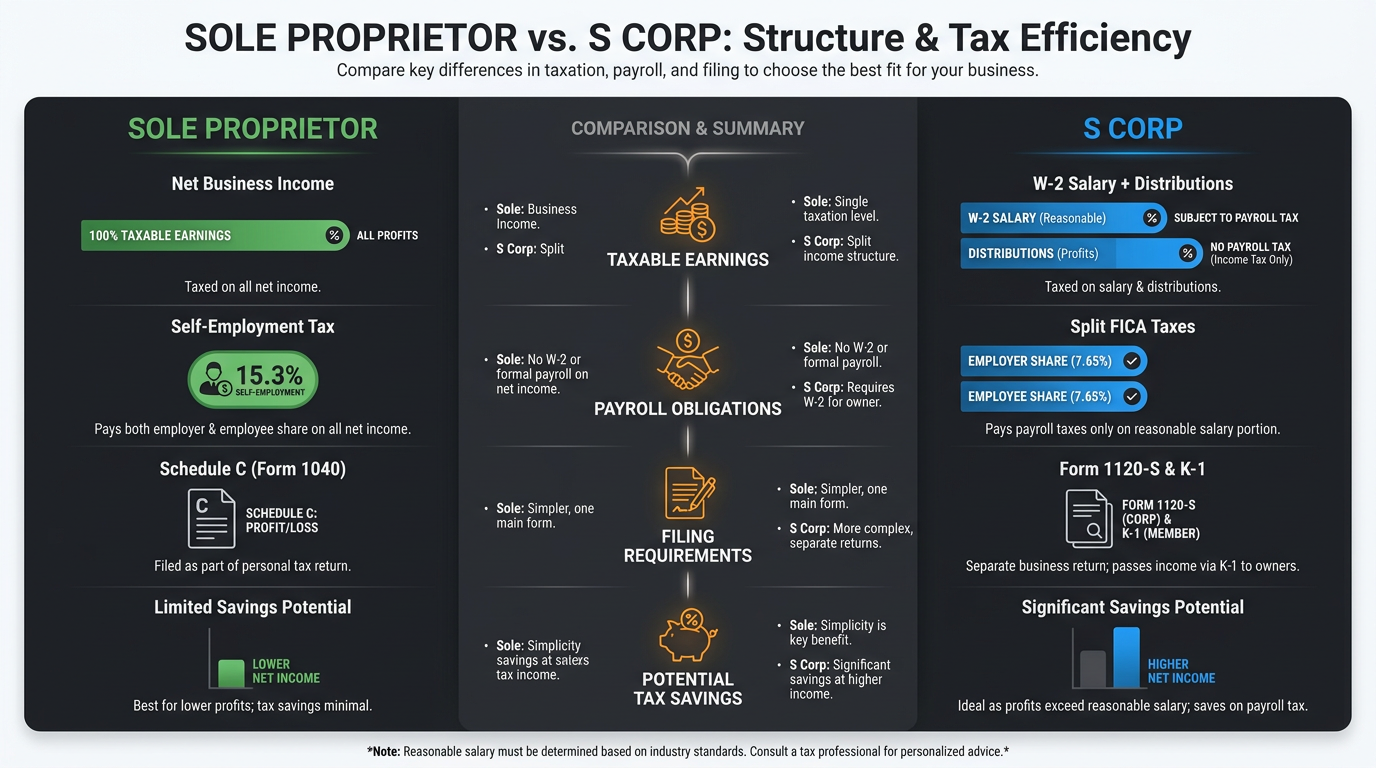
The savings opportunity emerges when you shift from paying self-employment tax on all your profit to paying payroll tax on just your salary.
Instead of paying payroll tax on your entire business profit, you:
- Pay yourself a reasonable W-2 salary
- Take remaining profit as distributions
- Avoid self-employment tax on the distribution portion
| Tax Structure | Sole Proprietorship | S Corporation |
|---|---|---|
| Profit Subject to Self-Employment Tax | 100% of net profit | Only W-2 salary portion |
| Payroll Tax Rate | 15.3% on all profit | 15.3% on salary only |
| Distribution Treatment | No distributions available | Not subject to payroll tax |
| Required Forms | Schedule C, Schedule SE | Form 1120-S, W-2, Schedule K-1 |
| Reasonable Salary Requirement | Not applicable | Must pay market rates for the role |
| Audit Risk | Higher (Schedule C filers) | Lower (corporate structure) |
| Compliance Requirements | Quarterly estimated taxes | Monthly payroll, annual corporate filing |
The IRS requires that S Corp owners who work in the business receive reasonable compensation as employees before taking distributions. This salary must reflect market rates for your role and responsibilities, considering your industry and hours worked.
Once you meet this threshold, additional profits can flow as tax-free distributions that completely avoid the 15.3% self-employment tax hit.
The key is documenting your salary decision and maintaining proper corporate compliance through regular payroll and annual filings.
How Much Can You Save With an S Corp?
The math behind S Corp tax savings for self-employed professionals is straightforward. When you shift profit from self-employment tax to distributions, you avoid the 15.3% rate on every dollar above your W-2 wages.
-
Steady consultant earning $95,000: Pay $60,000 salary, take $35,000 distributions. Save approximately $5,355 annually on the distribution portion, plus deduct employer FICA on your wages.
-
Variable income year at $65,000: Set $45,000 market-rate salary, distribute $20,000. Annual savings of roughly $3,060 while maintaining compliant wage levels during leaner periods.
-
High-earning strategist at $180,000: Establish $110,000 salary, distribute $70,000. Avoid payroll tax on distributions for five-figure annual savings, though Additional Medicare Tax applies to wages over threshold.
-
Peak performer at $250,000: Structure $140,000 salary, take $110,000 distributions. Save approximately $16,830 annually while staying compliant with IRS officer compensation requirements.
These scenarios assume you document your salary methodology properly and maintain clean payroll records. The key is finding your sweet spot between tax optimization and compliance risk.
What’s the Simplest Way to Explain Income Tax vs. Self-Employment Tax?
Income tax applies to your total taxable income after deductions and credits.
SE tax is specifically 15.3% on your business profit for Social Security and Medicare.
You pay both separately:
- Income tax on Form 1040
- SE tax on Schedule SE
Why Do Self-Employed People Pay Both Employer and Employee Taxes?
When you work for someone else, your employer pays half of Social Security and Medicare taxes (7.65%) and you pay the other half.
As a self-employed individual, you're both employer and employee, so you pay the full 15.3%.
The employer portion is deductible, but cash still leaves your business.
How Can I Stop Overpaying Self-Employment Tax as a Solo Business Owner?
The most effective strategy is S Corp election, which splits your profit between W-2 salary (subject to payroll tax) and distributions (not subject to SE tax).
Most solopreneurs save $5,000-$15,000 annually by paying payroll tax only on salary while distributions avoid the 15.3% entirely.
What Happens If I Set My S Corp Salary Too Low?
The IRS requires market-rate compensation based on your role, industry, and hours worked. Set it too low and you risk audit scrutiny and penalties.
Platforms like Lettuce calculate your appropriate salary automatically using IRS guidelines, so you maximize savings while staying compliant.
Do I Still Owe Income Tax on S Corp Distributions?
Yes, distributions are still taxable income on your personal return.
The advantage is avoiding the additional 15.3% SE tax layer. You're trading payroll tax for regular income tax rates, which creates substantial savings when your profit exceeds your salary requirements.
How Can Lettuce Help Solopreneurs Manage S Corp Taxes?
The solution is clear: stop overpaying self-employment tax as a solo business owner with the S Corp strategy. This approach shifts part of your profit from the 15.3% self-employment tax to tax-free distributions.
The key is setting a reasonable salary that satisfies IRS requirements while maximizing your distributions.
Most solopreneurs save $8,000+ annually and reclaim 20+ hours monthly when they streamline the entire process.
Lettuce automates S Corp payroll, calculates your salary using IRS guidelines, and manages your taxes monthly through automated payroll. No quarterly estimates, no compliance guesswork, no leaving money on the table.
Ready to put your tax strategy on autopilot? Get started with Lettuce.
