

 Alex Zelaya
1 min read

Electing S Corp status is one of the smartest moves therapists can make once profits start climbing. It can save thousands annually on self-employment tax, unlock corporate credibility and healthcare premium credits, and preserve your liability protection. Once profits hit $80,000, timing your S Corp election right means bigger savings.
Most therapists in private practice pay 15.3% self-employment tax on 92.35% of income earned. You're covering both the employer and employee share of Social Security and Medicare taxes. If you haven't elected S corp status, you're likely overpaying thousands in taxes every year.
Here's the game-changer: S corp election changes how your income is taxed, not how your practice runs. Your client relationships, session scheduling, and daily operations stay exactly the same. One tax strategy change can save therapists thousands by reducing that hefty self-employment tax burden.
See how much you could save with Lettuce's S Corp setup and automated tax optimization.

Is Lettuce right for you?
See if Lettuce can help you keep more of what you earn with our short quiz.
Take QuizWhy Private Practice Therapists Overpay Taxes (And How to Stop)
Private practice therapists are the definition of solopreneurs. You bill clients directly, set your own schedule, and handle every aspect of your practice. But here's the tax reality: as a sole proprietor or default LLC owner, you're paying the 15.3% self-employment tax rate on 92.35% of your profit. That's covering both the employer and employee portions of Social Security and Medicare taxes that W-2 employees split with their bosses.
The numbers add up fast. A therapist billing $90,000 in session fees pays roughly $12,717 in SE tax alone, before income tax even enters the picture. Most therapists don't realize they're essentially paying double what employees pay for the same Social Security and Medicare benefits. The cost of staying in default tax mode? You're leaving $5,067 on the table annually when a simple structural change could cut that burden significantly.
How S Corp Status Changes the Game for Therapists
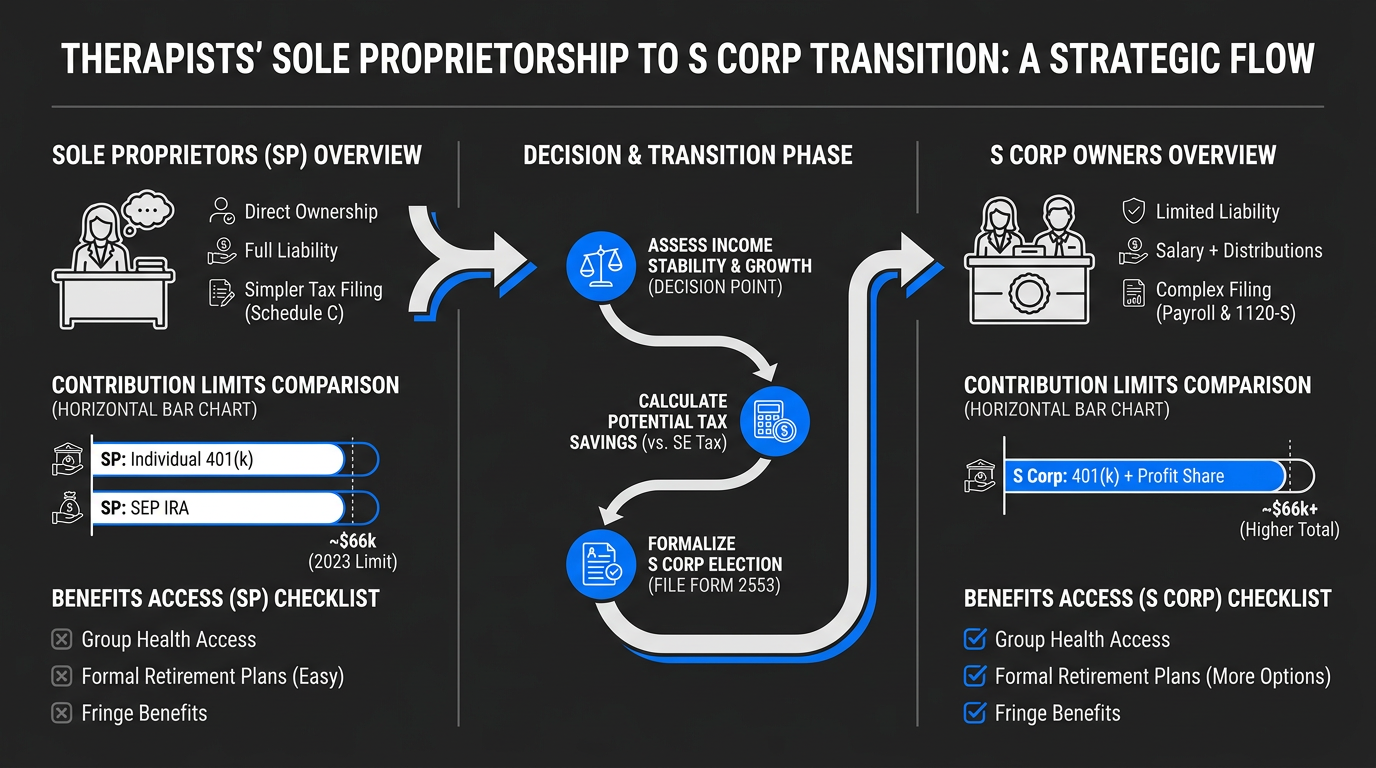
Here's the beautiful truth about S Corp election for therapists: you're not starting over or changing your business structure. An S Corp is a tax election, not a new legal entity. If you already have an LLC, you simply file Form 2553 to tell the IRS you want to be taxed as an S Corp. Your practice keeps its name, EIN, and operations intact. You're just changing the tax math.
The game-changer is how the IRS lets you split your income: part as a reasonable salary (subject to payroll taxes) and part as owner distributions (free from self-employment tax). Your clients still book sessions the same way, you still provide therapy in your office or via telehealth, and you still run your practice exactly as before. The only difference? The IRS treats shareholder-employees differently for tax purposes, which means thousands more dollars stay in your pocket each year.
Unlocking the Three Biggest S Corp Benefits for Therapists
S Corp status delivers more than just a lower tax bill. Here are the three biggest financial and legal advantages therapists in private practice can unlock.
1. Self-Employment Tax Savings
As a sole proprietor, you pay 15.3% self-employment tax on 92.35% of your profit. With S Corp status, only your reasonable salary is subject to payroll taxes, while distributions avoid self-employment tax entirely. A therapist earning $100,000 in profit typically saves $4,949 annually through this structure alone.
2. Healthcare Premium Credits Towards Your Salary
Running payroll through your S Corp allows you to use your health insurance premiums to satisfy your mandatory "reasonable salary" requirements without paying 15.3% FICA payroll tax on those dollars. Through Professional Employer Organization (PEO) structures, solo practitioners gain eligibility for employer-level group plans with better coverage and lower premiums than individual market options, a major upgrade for therapists stuck with expensive individual health plans.
3. Stronger Liability Protection and Professional Credibility
Operating as an S Corp through an LLC creates a legal barrier between your personal assets and business risks. Client billing disputes, or business debts cannot touch your personal home, savings, or investments. This liability protection holds as long as you maintain proper separation between business and personal finances. S Corp status also signals professional sophistication to lenders and landlords, who view formal business structures as lower-risk partners when you apply for office space or business loans.
Many therapists see total annual benefits exceeding $10,000 while their daily practice operations remain completely unchanged.
Liability Protection and Professional Credibility
Operating as an S Corp through an LLC creates a legal barrier between your personal assets and business risks. Client billing disputes, or business debts can't touch your personal home, savings, or investments. This liability protection becomes your financial safety net, but only if you maintain proper separation. Courts can remove this protection when you mix business and personal finances, so keeping distinct bank accounts and formal documentation preserves your shield.
S Corp status also signals that your practice operates with professional sophistication. When applying for office space or business loans, S Corp status demonstrates the financial structure that lenders and landlords expect from established practices. They prefer tenants and borrowers with formal business structures over independent work arrangements, viewing S Corps as lower-risk partners.
When you're ready to start an LLC or need liability insurance to complement your entity protection, these structural choices position your practice for sustainable growth and credibility in the marketplace.
When and How to Make the Switch: Timing Your S Corp Election
The magic number for therapists isn't January 1st — it's when your practice hits around $80,000 in profit for maximum tax savings. While your client work continues uninterrupted, capturing maximum tax savings requires careful calendar planning.
You don't have to wait for a new tax year either. The IRS allows retroactive elections under certain conditions. Submit Form 2553 within two months and 15 days of the start of the year, or explore late election relief if you've missed that window.
Stop thinking of the S Corp election as something only "real businesses" do. Your thriving private practice earning $80,000+ is exactly the type of business the IRS designed these tax benefits for. This isn't about becoming corporate — it's about recognizing that your successful practice deserves the same tax advantages as any other profitable business.
The filing process takes minutes, but the financial impact lasts for years. When you're ready to stop overpaying taxes and start keeping more of what you earn, the S Corp election is your next strategic move.
Therapist S Corp FAQs
Private practice therapists ask these questions when they're ready to stop overpaying taxes and start keeping more of what they earn.
When should a therapist switch to an S Corp for maximum tax savings?
Switch when your practice earns $80,000+ annually in profit. At this threshold, the self-employment tax savings outweigh the additional compliance costs. Since the IRS requires this tax status to cover the entire calendar year, you should file your paperwork ahead of time to lock in your savings starting January 1st.
How much can therapists save on taxes by becoming an S Corp at $80,000 profit?
A therapist earning $80,000 in profit typically saves $3,654 through reduced self-employment tax. This assumes a reasonable salary of around $50,000, leaving $30,000 in distributions exempt from the 15.3% self-employment tax.
What is a reasonable salary for a therapist in an S Corp, and how is it calculated?
The IRS requires compensation comparable to what you'd pay another therapist for similar work. Factors include your location, specialization, hours worked, and practice income. For most therapists, this salary represents 50-70% of their total practice income. Lettuce calculates this automatically using IRS guidelines.
Can S Corp status help therapists access better healthcare options?
Yes, S corporation status enables two healthcare advantages. First, your S Corp can deduct health insurance premiums as a business expense, and then you claim the personal deduction on your individual return. Second, platforms like Lettuce can unlock access to group-rate plans typically reserved for larger employers.
Can I elect S corp mid-year or retroactively, and what deadlines matter?
You can elect S corp status mid-year with the election effective from the start of that tax year. The standard deadline is 2 months and 15 days of the start of the year. Late elections are possible under IRS relief procedures within 3 years and 75 days.
What should therapists know about states like California, New York, or Washington?
Some states impose additional taxes on S Corps. California charges an $800 minimum franchise tax, New York has income-based minimum taxes, and Washington applies the B\&O gross receipts tax. These state-level costs rarely eliminate the federal tax benefits, but factor them into your savings calculation before electing.
Ready to Save? Start Your S Corp in 10 Minutes
S Corp status creates a compound effect for therapists earning $80,000 or more. You save thousands on self-employment taxes, gain access to group healthcare plans, professional credibility, and you're looking at real money in your pocket that grows every year.
The numbers don't lie. If your private practice is clearing $80,000, the math is clear. The Form 2553 election transforms how your income is taxed without changing how you run your practice. You can start an S Corp for therapists today and begin saving immediately.
Calculate your tax savings and learn how to start an S Corp with Lettuce handling everything from formation to ongoing payroll and compliance, so you can focus on your clients while keeping more of what you earn. Get started today!
