

 Alex Zelaya
1 min read

Your consulting fees should reflect true costs, including self-employment tax, benefits, and overhead, not just your time. Choosing the right pricing model, whether hourly, project-based, or retainer, helps you capture your value and create predictable income. Once you're consistently earning $80K+ in profit, electing S corp status can save thousands each year.
You just landed a $15,000 project. Before you celebrate, do you know how much you'll actually keep? Most solo consultants focus on what to charge but skip the math on what they'll take home after self-employment taxes hit. That 15.3% rate applies to your net earnings from self-employment.
Figuring out consulting fees is step one of running a profitable practice for full-time, self-employed consultants. Knowing how to keep more of those earnings is step two. This guide covers pricing models, rate-setting math, and the business structure choices that determine your actual take-home pay from every client payment.
When you're ready to maximize your earnings and automate tax optimization, Lettuce handles the complex stuff so you can focus on what you do best.

Is Lettuce right for you?
See if Lettuce can help you keep more of what you earn with our short quiz.
Take QuizHow to Set Your Consulting Rate
Setting your consulting rate isn't about copying competitor pricing. It requires building rates from your actual business costs up. How do solo consultants set consulting fees that cover self-employment tax and overhead while staying competitive? They start with what they actually need to earn and work backward to create sustainable pricing that reflects the true cost of running a solo practice.
Your Rate Must Cover the Real Cost of Self-Employment
Your consulting rate needs to support a sustainable business, not just match what you earned as an employee. When you were on payroll, your employer covered half your Social Security and Medicare taxes, plus benefits, office space, and equipment. As a solo consultant, you cover all of that. A sustainable rate reflects these hidden costs that many new consultants forget to include in their pricing.
Start With Your True Floor Rate
Begin with your previous salary, then add the cost of benefits, overhead, downtime, and taxes to build your true floor rate. The BLS reports that management consultants earn a median of $101,190 annually. But as a solo consultant, you need to gross up that target by 30-40% to account for non-billable time, business expenses, and tax obligations.
Beyond Basic Costs: Factor in the 15.3% Self-Employment Tax
Solo consultants pay both sides of payroll taxes; always factor in the 15.3% self-employment tax before quoting clients. This covers Social Security (12.4%) and Medicare (2.9%) on your net profit. Unlike employees who split this cost with their employer, you're responsible for the full amount. Set aside 30-35% of every payment to cover federal taxes, payroll taxes, and state taxes, and avoid quarterly payment surprises.
Research Your Market Position Strategically
Research what peers in your niche charge, not to copy, but to position yourself strategically. Look at consultants with similar experience levels and specializations, not just anyone who calls themselves a consultant. Use this data to justify your rates to clients and identify opportunities to differentiate. If you're consistently the lowest bidder, you're probably underpricing your expertise and leaving money on the table.
Pricing Models: Which One Fits Your Consulting Practice?
Choosing the best consulting fee pricing model for a solo consultant depends on your experience level, client relationships, and ability to scope work accurately. Different approaches work better at different stages of your practice, whether you're billing hourly, project-based, or through retainer agreements.
-
Hourly pricing bills clients for time spent and protects you from underestimating complex work. This model works best when you're still learning to scope projects accurately, but it caps your earnings at hours worked.
-
Project-based pricing charges clients for specific deliverables rather than time, letting you capture the full value of your expertise. This model suits experienced consultants who can scope work accurately, are efficient with their time, and often yield higher effective rates than hourly billing.
-
Retainer agreements provide predictable monthly income in exchange for ongoing access to your expertise. This model offers the most valuable pricing structure for consultants, making cash flow planning and tax management much easier.
-
Retainers require strong client relationships and clear scope boundaries before someone commits to monthly payments. Most successful consultants follow a natural progression: hourly → project-based → retainer as their practice matures and client trust builds.
The highest-paying consulting roles typically move away from hourly billing once consultants can demonstrate consistent value and secure recurring client relationships.
Looking for a straightforward starting point? Try the Freelance Rate Calculator to estimate pricing that supports your business as a whole.
What Consultants Don't Realize They Owe the IRS
Landing that first $100K consulting contract feels amazing. Then tax season arrives, and reality hits. Many consultants discover they owe far more than expected because they didn't account for the full tax burden of self-employment. Understanding exactly how much of your consulting fees you'll actually keep after self-employment taxes is the difference between profitable consulting and financial stress.
You're Your Own Payroll Department
When you worked for someone else, your employer automatically withheld taxes from every paycheck. As a self-employed consultant, that automatic tax withholding ends. You're responsible for calculating, setting aside, and paying your own taxes. No automatic deductions, no employer handling the paperwork. The IRS expects you to manage this yourself.
Beyond the Withholding Shock: The Hidden 15.3% Tax Hit
Here's what catches most consultants off guard: you pay both the employer and employee portions of Social Security and Medicare taxes. That's 15.3% on all net profit before you even calculate income tax. Corporate employees split this cost with their employer. Solo consultants pay the full amount. This SE tax applies to 92.35% of profit your solo business generates.
Making Matters Worse: Quarterly Deadlines You Can't Miss
The IRS doesn't wait until April of the following year for your money. They expect quarterly estimated payments on April 15, June 15, September 15, in the year earned and January 15 of the following year. Miss a deadline, and you'll face underpayment penalties even if you eventually pay the full amount. These aren't suggestions—they're requirements that can cost you hundreds in penalties if ignored.
The Real Numbers Behind a $100K Consulting Practice
A strategy consultant billing $100K with $80K in net profit owes approximately $11,304 in SE tax alone. That's before federal income tax, state tax, or any other obligations. The Schedule SE calculation takes 92.35% of your net earnings and multiplies by 15.3%. Add income taxes, and your effective tax rate easily hits 35-40%. Use the Lettuce Tax Calculator to see your personal numbers.
Lettuce Automates Your Tax Compliance
When you send professional invoices through Lettuce, it automatically calculates and sets aside the right amount from each client payment. No more guessing at quarterly amounts or scrambling to make deadlines. The platform handles S Corp payroll and submits payments on schedule, so you can focus on your consulting work instead of tax compliance.
You've Set Your Rates, Now Keep More of What You Earn
You've figured out what to charge. Now comes the part most consultants miss: structuring your business to keep more of those fees. When does an S corp make sense for a solo consultant earning $80K or more in profit? Once your practice hits consistent profitability, the tax structure you choose can save or cost you thousands every year.
The Self-Employment Tax Reality for Solo Consultants
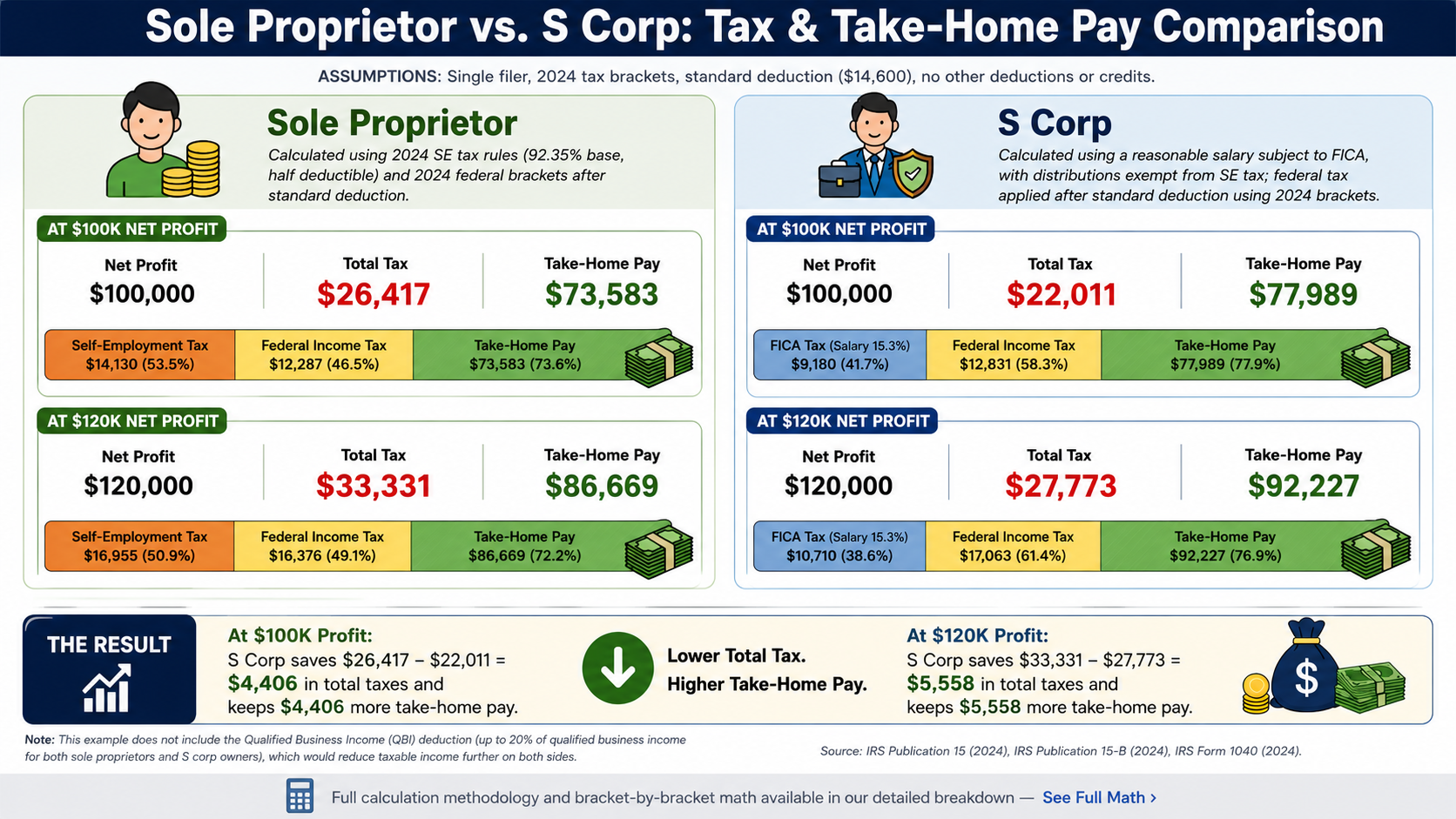
As a sole proprietor or single-member LLC, you pay 15.3% self-employment tax on 92.35% of net profit. That's both the employer and employee share of Social Security and Medicare taxes, with no way to reduce it. A consultant earning $100K in net profit pays $14,130 in SE tax before income tax even starts.
Here's How S Corp Election Changes Your Tax Picture
Electing S corp status lets you split your income strategically. You pay yourself a reasonable salary subject to payroll taxes, then take the remaining profit as owner distributions, which aren't subject to SE tax. Only your W-2 salary gets hit with the 15.3% rate.
The Difference Is Dramatic: Real Savings Numbers
A solo operations consultant with $100K net profit electing S corp status might set a $60K reasonable salary. Self-employment tax drops from $14,130 to about $9,180, saving $4,950annually. At $150K in profit, annual savings exceed $10,000. At $200K+, you're keeping an extra $12,000 or more each year.
When to Make the S Corp Election
S corp election makes the most sense once your consulting practice consistently clears $80K in annual profit. Below that threshold, the paperwork requirements often outweigh the savings. Remember: S Corp is a tax election, not a new entity. If you already have an LLC, you're halfway there. Lettuce files Form 2553 and handles the election, payroll, and ongoing compliance automatically.
What to Know Before Electing S Corp Status
Understanding S Corp requirements for solo consultants helps you make an informed decision about this business structure change. S corp election comes with real compliance obligations, so know what you're committing to and whether the savings justify the overhead.
-
Pay yourself a reasonable salary: The IRS requires S corp owners who work in the business to receive W-2 wages that reflect fair compensation for their role. For a strategy consultant earning $100K profit, a reasonable salary might be $60K-70K based on industry standards and hours worked. Lettuce calculates this defensible amount using IRS guidelines.
-
Run actual payroll and file quarterly returns: S corps must process payroll with proper withholdings, file Form 941 quarterly, issue W-2s by January 31, and submit Form 1120-S annually. These aren't suggestions, but they're IRS requirements that Lettuce handles automatically.
-
Consider your profit consistency: S corp benefits typically outweigh compliance costs once you're consistently earning $80K+ in annual profit. If your consulting income fluctuates significantly, you may want to wait until your income stabilizes.
-
Understand state-level requirements: While federal S corp election offers tax benefits, some states impose additional fees or don't recognize the election. Lettuce handles federal compliance and alerts you to state obligations, backed by our Lettuce-Back Guarantee.
-
Election timing is flexible: You don't need to wait until January. Lettuce can file Form 2553 for mid-year elections and even retroactive elections in certain cases, getting your tax savings started sooner.
Ready to see if S corp status fits your consulting practice? Take our S Corp Quiz to get a personalized recommendation based on your income and business goals.
Setting Rates and Structuring Your Business for the Long Game
Sustainable solo consultants understand that consulting fees and business structure work hand in hand. Your rate reflects the real value you deliver, not just what you think the market will bear. But getting paid well is only half the equation. The IRS requires S corp owners who work in their business to pay themselves reasonable compensation, making proper structure essential for protecting your earnings long-term.
A well-set rate gets money in the door. An S corp election keeps more of it in your pocket. Both decisions become straightforward when you have the right systems handling payroll, compliance, and salary calculations automatically. The consultants who thrive aren't necessarily the smartest or most talented, but they're the ones who price strategically and structure intelligently from the start.
Frequently Asked Questions About Consulting Fees and S Corp Status
Solo consultants face unique decisions about pricing and business structure that employees never encounter. Here are direct answers to the questions that come up most often when building a profitable consulting practice.
How do I know if my consulting fee is too low?
Your rate is too low if you're working more hours to hit your income goals or struggling to meet financial goals. Calculate your true hourly cost: previous salary plus benefits, overhead like rent, software, insurance, and self-employment taxes. If your current rate doesn't cover this baseline plus profit margin, raise your prices.
Which pricing model is best for a solo consultant: hourly, project-based, or retainer?
Start with hourly pricing while you learn to scope work accurately. Move to project-based pricing once you can predict deliverables and timelines confidently. Retainers work best for established consultants with strong client relationships and clearly defined ongoing services.
When should a solo consultant elect S corp status, and what changes after that?
S corp election makes sense once you consistently earn $80K+ in annual profit. You'll need to run payroll, pay yourself a reasonable salary, and file additional tax forms. The benefit: significant self-employment tax savings that grow with your income.
How does Lettuce automate tax payments and compliance for solo consultants?
Lettuce calculates your reasonable salary, runs monthly payroll, and automatically withholds federal and state taxes. The platform also handles S corp formation, compliance filings, and year-end tax preparation. Everything runs on autopilot once you're set up.
Set Smarter Consulting Fees and Keep More of What You Earn
Setting profitable consulting fees starts with understanding your true costs, including the 15.3% self-employment tax that hits 92.35% of profit. Choose hourly rates for early-stage work, project pricing for experienced consultants, and retainers for established practices.
But smart pricing is only half the equation. Once your consulting practice consistently earns $80K+ in profit, stop overpaying the IRS. S corp election lets you split income between salary and distributions, reducing self-employment taxes by thousands annually. The savings speak for themselves.
Ready to see your potential savings and take the next step? Lettuce handles S Corp formation, payroll, and quarterly tax payments automatically, so you can focus on what you do best. Get started today!
