
1 min read
%20(1).png)
Most solopreneurs spend 20+ hours a month on financial admin that smarter banking could automate. The best business checking account (a bank account in your company's name) is your financial foundation. The IRS recommends this separation for airtight records, and FDIC insurance protects deposits up to $250,000.
Freelancers and S Corp owners (businesses structured to reduce self-employment taxes) also need accounts that handle ACH transfers (electronic bank-to-bank payments) and payroll. Lettuce was built for solo business owners who need all of that in one place. Find out what smarter banking looks like at Lettuce.

Is Lettuce right for you?
See if Lettuce can help you keep more of what you earn with our short quiz.
Take QuizWhat To Look For In A Business Checking Account For Solopreneurs
Not every business checking account is built for the way solopreneurs actually work. A dedicated account creates a clear financial boundary, and why solopreneurs need one comes down to tax clarity, legal protection, and cleaner books. The SBA recommends keeping business finances separate from day one, and the account opening process is more straightforward than most expect. Look for no monthly fees, no minimum balance, real-time visibility into your cash flow, and FDIC coverage up to $250,000 per ownership category.
If you're operating as an S Corp, your banking setup needs to do more heavy lifting. The IRS compensation rules require S Corp owners to pay themselves a reasonable salary. That means you need payroll support, tax withholding, and automated income allocation, where the account separates what you owe from what you can spend. Keep these criteria in mind as you compare the accounts below.
1. Lettuce: Best For S Corp Owners Who Want Automated Tax, Payroll, And Bookkeeping
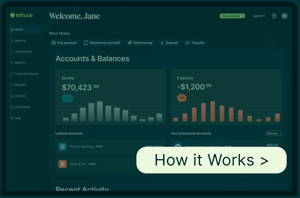
Lettuce is built for solopreneurs who want more than a place to store business income. It combines business checking, bookkeeping, payroll, and tax filing in one platform, while also helping you form or convert to an S Corp with no setup fees. When income lands in your account, Lettuce automatically splits it between your Primary account and a dedicated Salary & Taxes account, so you can clearly see what is available to spend and what needs to be reserved.
That structure matters because S Corp owners have more moving pieces to manage than the average freelancer. Lettuce runs monthly payroll, withholds and pays federal and state taxes, and prepares required filings like your W-2 and Form 1120-S, which means quarterly estimated tax payments and manual admin are no longer hanging over your head. If eligible, you may also use tax strategies like business use of home, business use of vehicle, health insurance premiums, and retirement contributions inside the same system.
For solopreneurs who want their bank account connected directly to compliance, Lettuce goes far beyond standard business banking. It is purpose-built for businesses-of-one that want cleaner books, more time back, and a simpler way to run an S Corp. The Lettuce-Back Guarantee adds extra peace of mind: if your tax savings do not exceed your subscription cost, you get your fees back.
2. Bluevine: Best Low-Fee Business Checking Account With High-Yield Interest
Bluevine is a strong option for solopreneurs who want a simple checking account with low overhead and a chance to earn interest on idle cash. Most business checking accounts force a trade-off between low fees and yield, but Bluevine is one of the few that combines both in a way that feels useful for service-based businesses with steady digital deposits.
Its appeal is straightforward: no monthly fee on the base experience, no transaction limits, and the ability to earn APY on eligible balances depending on plan tier and account activity. Bluevine also offers expanded FDIC insurance through a deposit sweep network, which may appeal to higher-earning solopreneurs keeping larger balances in the account. The platform has added invoicing and payment features as well, making it easier to collect client payments without layering on another tool.
Where Bluevine is less specialized is on the S Corp side. It integrates with accounting software and supports everyday banking well, but it does not run your payroll, handle tax withholding, or automate income allocation for compliance. For consultants and freelancers who want an affordable digital account with yield, it is a compelling choice. For S Corp owners who want the tax and payroll side built in, Lettuce goes much further.
3. Novo: Best Business Checking With No Monthly Fee And Fast Digital Access
Novo is a good fit for solopreneurs who want a clean, digital-first banking experience without monthly fees or minimum balance requirements. There is something reassuring about knowing your business checking account will not cost you money during a slower month, and Novo leans into that simplicity.
The experience is designed for speed and flexibility. You can access a virtual debit card right away, move money with fast ACH processing, and connect the account to tools like Stripe, QuickBooks, and Shopify. Novo also includes invoicing and Reserve subaccounts, which help you set money aside for taxes or planned expenses without opening separate accounts elsewhere.
The trade-off is that Novo gives you manual organization, not fully automated back-office management. It does not accept cash deposits, support is limited to email and in-app channels, and outgoing wires rely on a third-party provider.
4. Relay: Best Online Business Checking For Cash Flow Control And Multi-Account Setup
Relay works especially well for solopreneurs who like to organize cash flow into clear buckets. Its biggest advantage is the ability to open multiple sub-accounts under one login, which makes it easier to separate money for taxes, payroll, operating expenses, and savings without needing multiple banks.
That structure can be powerful if you already manage your business with a systems mindset. Relay also keeps costs low, supports common accounting integrations, and makes it easier to issue cards with spending controls if you work with contractors or want tighter oversight across expense categories. For business owners who follow a Profit First-style approach, that visibility can feel refreshingly practical.
Still, Relay is best understood as a flexible banking tool rather than an all-in-one S Corp platform. It gives you the framework to separate funds, but you are still responsible for deciding how much to move, when to run payroll, and how to stay ahead of taxes.
5. Mercury: Best For Tech Consultants And Startups Who Want Modern, Automated Banking
Mercury is a strong choice for tech-forward solopreneurs who want polished digital banking and strong integrations across their finance stack. For consultants, fractional operators, and founders who already use tools like Stripe, QuickBooks, and Xero, Mercury can reduce friction by keeping money movement and reconciliation closely connected.
Its value is in operational efficiency. You get no monthly fees, support for international wires, permission controls, and options for putting idle cash to work through treasury features. That setup can be especially appealing when income is uneven or when client payments move through several platforms before landing in your books.
But Mercury is still a banking product, not a tax-and-compliance system. It helps modernize how money moves, yet it does not handle S Corp payroll, monthly tax payments, or annual filings for you.
6. Axos Basic Business Checking: Best For ATM Access And Traditional Bank Features
Axos Basic Business Checking is a practical option for solopreneurs who want a no-fee account with stronger access to cash and more traditional banking functionality. If ATM access matters to you, or if you simply want online banking that feels familiar and dependable, Axos earns a spot on the list.
The account keeps things simple with no monthly maintenance fee and no minimum balance requirement. It also stands out for ATM fee reimbursements, mobile check deposit capacity, and QuickBooks connectivity, which together make it easier to manage everyday business banking without adding much friction. For freelancers who occasionally handle cash or want broader ATM flexibility, that can be a meaningful advantage.
The main limitation is that Axos is a standalone bank account, not an integrated financial platform. It does not earn interest, and it will not help you automate payroll, tax withholding, or S Corp compliance.
Best Business Checking Account For Solopreneur: Frequently Asked Questions (FAQs)
Banking decisions feel simple until you're actually running a solo business. Once payroll, taxes, and bookkeeping enter the picture, your bank account is part of your financial strategy, not just a place to park money. The questions below cut through the noise so you can choose a tax-friendly business checking account that fits how you actually work.
Do I really need a separate business checking account as a solopreneur or freelancer?
Yes, and the IRS recommends it. Keeping separate accounts simplifies recordkeeping and helps you substantiate deductions. When personal and business money mix, it becomes harder to prove which expenses qualify as legitimate business costs. A dedicated account keeps your records accurate and audit-ready year-round.
Which business checking account is best for S Corp owners who want automated payroll and taxes?
The IRS requires S Corps to run payroll and deposit employment taxes regularly. Your bank needs to support payroll deposits and tax withholdings automatically. A tax-friendly business checking account for S Corp owners handles payroll, taxes, and bookkeeping in one place. Lettuce's guide on opening a business bank account as a solopreneur cover the details.
How do online business checking accounts compare to traditional banks for solo businesses?
Online accounts offer lower fees and no minimum balances. Traditional banks often require in-person visits, paperwork, and waiting periods, but they're better if you handle cash regularly or want branch support. Regardless of which you choose, both are FDIC-insured up to $250,000. For most digital solopreneurs, online banking fits the way you actually work.
What features should I prioritize if I want to minimize fees and manual bookkeeping?
Look for no monthly fees, automatic transaction categorization, and direct integrations with your accounting tools. The right account gives you real-time cash flow visibility without manual data entry. When your bank connects to your bookkeeping, you spend less time on admin and more time on your business.
Can I switch my business checking account mid-year without tax headaches?
Switching mid-year is straightforward as long as you maintain accurate transaction records during the transition. If you're also thinking about an S Corp election, the timing of that switch affects your tax filings for the whole year. Lettuce's guide on mid-year S Corp elections covers what to watch for.
Choose the Business Checking Account That Works for You, and Make Taxes Less Taxing
The best business checking account does more than store money. It fits your workflow, keeps your finances organized, and supports solid recordkeeping that protects you at tax time. The FDIC also notes that keeping business and personal deposits separate affects how your funds are insured.
Lettuce handles checking, payroll, bookkeeping, and tax filing in one place. Every feature fits how businesses-of-one operate. See how the right banking setup fits into your full financial picture at Lettuce.
