

1 min read

Choosing between an S Corp vs C Corp comes down to how your business is built and where it's headed. For solopreneurs, the S Corp structure typically wins — combining legal protection with real self-employment tax savings. C corps are designed for companies chasing outside investment, making them unnecessarily complex for a business of one.
If you've been going back and forth on S Corp vs C Corp, you can stop. An S Corp is a tax election you file with the IRS, not a business entity. A C Corp is a separate legal entity built for companies raising outside investment.
For a business-of-one, the smart move is an LLC plus S Corp election. That combination gives you legal protection and can save $8,000 or more in self-employment taxes.
Lettuce automates the entire process, from formation to filing. You keep more of what you earn.

Is Lettuce right for you?
See if Lettuce can help you keep more of what you earn with our short quiz.
Take QuizC Corp Vs S Corp: The Quick Facts (And Why C Corps Are a Detour)
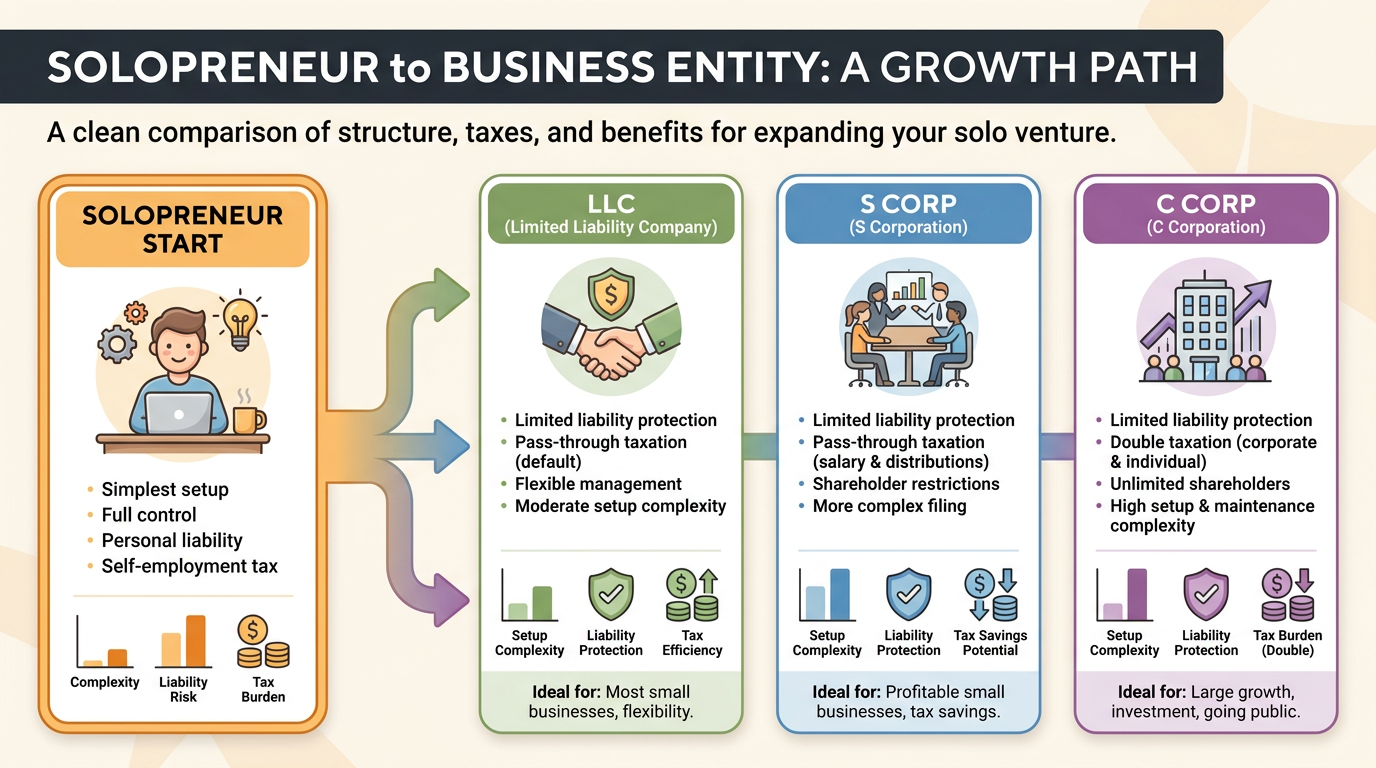
When weighing S Corp vs C Corp for solopreneurs, the choice gets overcomplicated quickly. Most of the confusion comes from treating them as equivalent options when they're designed for completely different businesses. Three structures dominate the conversation, and only one is built for a business-of-one.
| Structure | Best For | Taxation | Payroll Required | Admin Complexity | Audit Risk |
|---|---|---|---|---|---|
| LLC (Single-Member) | Solopreneurs or freelancers under $80K annual business income | All profits are subject to 15.3% SE tax | No | Low | Higher (Schedule C filers) |
| LLC + S Corp Election | Businesses-of-one earning $80K+ in annual business income | Salary subject to SE tax; distributions exempt from SE tax | Yes (IRS required) | Moderate | Lower than Schedule C |
| C Corp | Venture-backed startups, multi-owner businesses | Corporate tax + personal tax on dividends | Yes | High | Moderate (varies by income and complexity) |
C Corps carry double taxation by design. That structure exists for companies raising outside capital, not for a business-of-one, and the LLC + S Corp path is where the real savings live for solopreneurs.
Why LLC Plus S Corp Works Better Together
LLCs and S Corps aren't competing choices. One protects your assets. The other reduces your tax bill. An LLC with an S Corp election gives you both, and it's the structure most solopreneurs earning $80K+ should be running.
They're Not an Either/Or Choice
An LLC is a legal structure that protects your personal assets. An S Corp election is a tax status you file with the IRS using Form 2553. You keep your LLC's liability protection and gain S Corp tax treatment at the same time. See how they work in an LLC vs. S Corp comparison.
The Tax Split That Changes Everything
A standard single-member LLC pays 15.3% self-employment tax on all net profit. Under S corp tax treatment, you split income into two buckets: a reasonable salary and owner distributions. Your salary is subject to that tax. Distributions are not. The IRS requires you to pay yourself a fair wage. Anything above that threshold becomes a distribution, with no SE tax applied.
Your Existing LLC Is Already Halfway There
Already have an LLC? No need to dissolve it or start over.
Lettuce files your S Corp election directly with the IRS. Your business name, contracts, and bank accounts stay untouched.
When to Elect S Corp Status: The $80K+ Annual Business Income Signal
Knowing when to elect S Corp status for tax savings comes down to one number: your net profit. Once you're consistently clearing $80K per year, the math starts working in your favor.
Timing is also more flexible than most people think. Mid-year and even late-year elections can still put real money back in your pocket for the current tax year.
-
At $80K+ in annual business income, most solopreneurs save $8,000+ in self-employment taxes per year.
-
Every month you delay the election is another month of full self-employment tax you didn't need to pay.
-
File Form 2553 with the IRS to start your S Corp election, with deadlines more flexible than most solopreneurs expect.
-
The IRS provides late election relief for up to 3 years and 75 days after your desired S Corp start date.
-
S Corp election rewards solopreneurs running a full-time, profitable business, not a side gig or hobby.
If you're earning $80K+ in annual business income and running your business full-time, you're leaving real money on the table. See the full breakdown of timing and thresholds, and let Lettuce handle the filing from there.
S Corp Vs C Corp FAQ: What Solopreneurs Really Need to Know
You don't need a law degree to make the right call here. The answers are simpler than the internet makes them sound, and here's what solopreneurs earning $80K+ actually need to know, from election timing to payroll basics.
Is an S Corp or a C Corp better for a solopreneur earning $80K+?
For a solopreneur earning $80K+ im annual business income, an S Corp is the clear choice. C Corps create double taxation, meaning the business pays taxes, and you pay taxes again on distributions. With S Corp status, profits flow straight to your personal tax return, skipping the double-tax hit. See S Corp taxes for a full breakdown.
Can I convert my existing LLC to an S Corp without forming a new business?
Yes. You keep your LLC exactly as it is and file Form 2553 with the IRS to elect S Corp tax treatment. No new entity, no name change, no starting over. Lettuce handles the election filing as part of the setup. The S Corp guide covers everything you need before you file.
Do I need payroll, and what does a reasonable salary actually mean?
Yes, S Corp owners must run payroll and pay themselves a reasonable salary. The IRS defines this as what you'd pay someone else to do your job. It's not arbitrary. Lettuce calculates your salary based on your income, industry, role, and hours worked. You stay compliant without overpaying in payroll taxes.
When can I make the S Corp election, and do I have to wait for January?
No waiting required. You can elect mid-year and start capturing savings on income earned for the current year. The IRS also offers late election relief for eligible businesses that missed the deadline. The sooner you elect, the more of the tax year you put to work.
How does Lettuce automate S Corp compliance and tax filings?
Lettuce handles payroll, bookkeeping, tax payments, and all required filings, including Form 1120-S, Schedule K-1, W-2s, and 1099s. Payroll runs automatically on the 10th, covering federal and state tax withholdings. No quarterly estimated payments to track. See how it works to explore the full automation setup.
Make the System Work for You: Your S Corp Savings on Autopilot
At $80K+ in annual business income, an LLC with S Corp election is your clearest path to keeping more of what you earn. According to the IRS, S Corp owners must run payroll, and the platform handles every step automatically.
Lettuce runs your entire S Corp back-office in one place, from how S Corp status works to annual filing. Your subscription pays for itself, or Lettuce refunds it, backed by the Lettuce-Back Guarantee.
See exactly what an LLC with S Corp election saves you this year. Get started today!
