

1 min read

When weighing a C Corp vs LLC, the right structure can significantly impact your tax bill. For most solopreneurs, an LLC with S Corp election offers real self-employment tax savings when the math makes sense. C Corps are built for investor-backed startups, not businesses-of-one. Lettuce handles the setup automatically.
Most solopreneurs treat C Corp vs LLC as an either/or decision. It's not. An LLC is your legal shield. An S Corp election is a tax status you apply on top, changing how the IRS taxes your income. C Corps are built for investor-backed startups, not for solopreneurs and freelancers.
The real opportunity is combining your LLC with an S Corp election. For solopreneurs earning $80K+, the right structure can save $8,000 or more per year in self-employment taxes.
Lettuce automates every step, from formation to payroll to compliance, so you can stop overpaying.
Curious if an S Corp is right for you?
Try the Lettuce Tax Calculator to see how much more you can take home each year.
See your savings
Breaking Down C Corp, LLC, and S Corp: What Each Structure Actually Does
When most people compare a C Corp vs LLC, they treat it like a two-option quiz. For solopreneurs, there's a third path worth knowing: an LLC with S Corp tax status layered on top. Each structure handles liability, taxation, and admin differently, and the right fit for a business-of-one depends on what your income and goals actually require.
|
Structure
|
How It Works
|
Tax Treatment
|
Liability Protection
|
Admin Load
|
Best For
|
|
C Corp
|
Separate legal entity owned by shareholders
|
Corporate tax (21%) on profits + personal tax on dividends \= double taxation
|
Yes
|
High (board meetings, bylaws, complex filings)
|
Startups seeking outside investors or venture funding
|
|
LLC (Default)
|
Legal entity that separates personal and business assets
|
Pass-through; all net profit subject to self-employment tax (15.3%)
|
Yes
|
Low (minimal state filings, no payroll required)
|
New businesses or those earning under $60K–$80K
|
|
LLC + S Corp Election
|
LLC legal structure with S Corp status elected via IRS Form 2553
|
Pass-through; income split into salary (SE tax applies) and distributions (no self-employment tax)
|
Yes
|
Moderate (payroll required, annual filings)
|
Solopreneurs earning $80K+ who want to reduce self-employment taxes
|
For most solopreneurs weighing a C corp vs LLC, the answer isn't either one alone. The C Corp is designed for businesses with investors and boardrooms, not for a business-of-one. The LLC and S Corp combination gives you legal protection and real tax savings, often $8,000 or more annually, without the paperwork built for companies with shareholders.
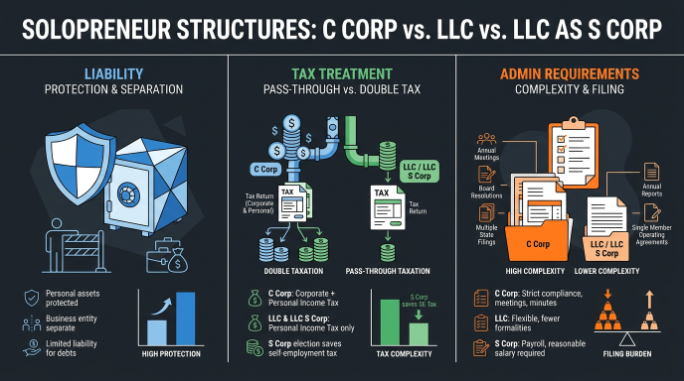
Myth-Busting: You Don't Have To Pick Just One (LLC + S Corp \= The Smart Stack)
The biggest misconception in the LLC vs S Corp for tax savings conversation? That you have to choose one or the other. An LLC is your legal home, and an S Corp is the tax strategy you layer on top.
Start With the LLC, Then Elect S Corp Status
An LLC gives you a legal structure that protects your personal assets. You elect S Corp tax treatment by filing Form 2553 with the IRS. As the IRS outlines, qualifying LLCs can do this without changing their entity at all. Unlike a C Corp, this setup stays simple for a business-of-one. Same business name. Same LLC. Just a more tax-efficient election.
How the Tax Savings Actually Work
As a sole proprietor or single-member LLC, self-employment tax hits 15.3% on every dollar of net earnings. With S Corp status, you split income into a reasonable salary and owner distributions. Salary gets taxed normally. Distributions don't carry that 15.3% rate. On $100K in net earnings, that split can save $8,000 or more. The salary vs. distributions breakdown explains the mechanics in full.
Lettuce Automates the Whole Stack
Lettuce automates the journey: LLC filing, S Corp election, monthly payroll, and ongoing compliance. The platform calculates your salary, runs payroll, and handles every required filing. You skip the paperwork and keep more of what you earn. See how the structure works for a full picture.
When To Elect S Corp Status: The $80K Threshold And The Lettuce Advantage
If you're a business-of-one earning $80,000 in annual business income or more, the better move between LLC and S Corp isn't a debate. It's a sequence, and every year you delay is money you don't get back.
-
The savings are real and concrete. Wondering at what income level an S Corp is worth it? At $80K, the election can save you $2,000 or more per year in self-employment taxes alone.
-
Already have an LLC? You're most of the way there. S Corp isn't a new company or a name change. It's a tax election you file with the IRS on top of your existing LLC, and your business operations stay the same.
-
You don't have to wait until January. A mid-year election is possible, and in some cases, you can elect retroactively. Timing matters, and acting mid-year still puts real money back in your pocket this year.
-
The rules are straightforward when the right system handles them. S Corps require payroll, a reasonable salary, and a separate business return. The right system makes all of that run on autopilot.
-
Lettuce automates the entire process. From salary calculation to monthly payroll to your Form 1120-S, the platform handles every S Corp requirement so you stay compliant without spending hours on paperwork.
FAQ: C Corp Vs LLC Vs S Corp For Solopreneurs
Choosing the right structure raises real questions, especially when it's your own income on the line. The answers below give you a clear framework to make the right call for your business.
Should a solopreneur choose a C Corp or LLC for tax savings?
For most solopreneurs weighing a C Corp or LLC for tax savings, an LLC taxed as an S Corp wins. C Corps pay corporate tax on earnings, then you pay personal income tax on dividends. That's double taxation on the same dollar. The SBA notes that entity choice directly shapes your tax bill.
Is an LLC or an S Corp better for a business-of-one earning $80,000 or more?
At $80K+ in annual business income, electing S Corp status on your LLC saves more than staying a single-member LLC. For a business-of-one, you split income into a reasonable salary and owner distributions. Distributions aren't subject to self-employment tax (15.3%). Most solopreneurs at this level see S Corp tax savings of $2,000 or more.
If you want an overview of how your work setup affects your take-home pay, use the W-2 vs 1099 vs S Corp Calculator.
Can you turn an existing LLC into an S Corp without changing your business name?
Yes, and it's simpler than most solopreneurs expect. An S Corp is a tax election, not a new legal entity. You file Form 2553 with the IRS. Your LLC keeps its name, contracts, and bank accounts. Nothing about your business identity changes publicly, only your tax treatment with the IRS.
Why is a C Corp usually not the best structure for freelancers and consultants?
C Corps make sense when you're raising outside investment, because investors expect that structure. For a solo consultant or freelancer, there's no investor upside to offset the extra tax layer. The IRS S Corp guidance outlines pass-through treatment as a cleaner fit for solo service businesses. Review the S Corp trade-offs before you decide.
How does Lettuce automate S Corp setup and compliance?
Once you've decided, setup doesn't have to be complicated. Lettuce handles LLC formation, S Corp election, payroll, and all required filings: Form 1120-S, Schedule K-1, and W-2. The platform calculates your reasonable salary, runs payroll monthly, and pays taxes automatically. No quarterly estimates, no manual filings.
Your Next Move: Put the LLC + S Corp Stack on Autopilot
The smartest path for solopreneurs earning $80K+ in annual business income is straightforward: LLC protection on top, S Corp tax treatment underneath. Once you split income between a reasonable salary and owner distributions, the savings can easily top $2,000 a year. That's money staying in your pocket, not going to self-employment taxes.
The LLC + S Corp stack is built to run quietly in the background. Lettuce handles formation, S Corp election, payroll, tax payments, and compliance in one place. You stay focused on your work. The platform handles the rest automatically.
Get started today to see how much you could save with Lettuce. If the platform doesn't save you more than your subscription costs, you get your money back. That's the Lettuce-Back Guarantee.
