

 Alex Zelaya
1 min read

C Corp tax rates look appealing at 21%, but for most solopreneurs, that headline misses the real cost: double taxation. An LLC with an S Corp election is usually the smarter stack for liability protection, self-employment tax savings, and simpler ongoing operations.
The federal C Corp tax rate for 2026 is 21%. That number is easy to find. What's harder to see is the double tax hit. Profits leaving a C Corp as dividends get taxed at the corporate level, then again on your personal return.
If you're researching C Corp tax rates, you're asking the right money question but looking at the wrong structure. For most solopreneurs, an LLC with an S Corp election delivers liability protection and pass-through tax savings in one move.
Lettuce automates the whole stack, so you get the benefits without managing the complexity yourself.
Curious if an S Corp is right for you?
Try the Lettuce Tax Calculator to see how much more you can take home each year.
See your savings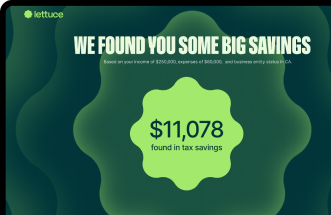
How C Corp Tax Rates Work For Solopreneurs
For solopreneurs trying to figure out how C Corp tax rates work with double taxation, the rate itself is the least important part of the picture.
One Business, Two Tax Bills
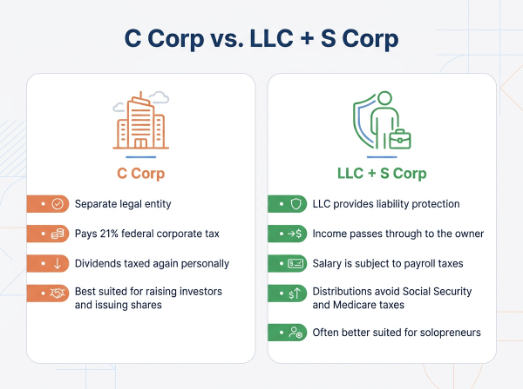
A C Corp pays tax on its profits at the entity level. Then, when the owner takes money out as dividends, the IRS taxes those distributions again at the individual level. That's double taxation: the same dollar taxed twice before it reaches your pocket. Unlike an S Corp, a C Corp doesn't pass income through to the owner's return, so there's no way around that second layer.
The 21% Rate Is Only Half the Story
The Tax Policy Center illustrates this clearly: at a 21% corporate rate plus a 15% to 20% qualified dividend rate, a business owner can lose a third or more of profits to taxes before spending a dollar. For a one-person service business, that math rarely works in your favor. The headline rate looks clean; the combined effective rate does not.
What Should Actually Drive Your Decision
The real question isn't what rate applies at the corporate level. It's how much after-tax income lands in your hands. For most solopreneurs, an S Corp's pass-through treatment avoids the dividend tax layer entirely, which means more of your profit moves directly to you without the C Corp's structural detour.
Why LLC Plus S Corp Beats C Corp For Most Businesses-Of-One
Here's the framing problem that trips up most solopreneurs: they treat an LLC, an S Corp, and a C Corp as three options on the same menu. They're not. Once you understand what each one actually is, the question of whether an LLC with an S Corp election is a better fit than a C Corp for a one-person business almost answers itself.
An LLC is a legal structure. It creates the wall between your personal assets and your business. An S Corp is a tax election you file with the IRS to change how your business income is taxed. These two things operate at completely different levels, which means you don't have to pick between them. You can, and most solopreneurs should, have both.
Layer The Tax Election On Your Existing LLC
Filing Form 2553 tells the IRS to treat your LLC as an S Corp for tax purposes. No new entity, no starting over, no conversion to a C Corp required. Your LLC stays intact as your legal home base; the S Corp election just changes how profits flow to you and what gets hit with payroll taxes.
Keep Liability Protection Without The Double Tax
A C Corp is a separate legal entity that pays corporate income tax on profits, and then you pay personal income tax again when those profits come to you as dividends. The SBA describes S Corp pass-through treatment as one of its core advantages over C Corps precisely because it sidesteps that second layer of taxation.
Pay Self-Employment Tax On Salary Only, Not On Everything
Under a sole proprietorship or a single-member LLC with no tax election, the full net profit faces self-employment tax. With an S Corp election, only your reasonable salary carries that burden; the remaining profit flows as an owner distribution, which is not subject to Social Security or Medicare taxes.
Skip The Myth That S Corp Means Complexity
Many solopreneurs assume a C Corp is somehow simpler because it feels more "official." In practice, a C Corp adds its own compliance layers, including corporate returns, dividend documentation, and the double taxation math., without the payroll tax savings that make an S Corp worth running.
Lettuce handles the LLC-to-S Corp conversion, including Form 2553, payroll setup, and ongoing filings, so the operational lift lands on the platform, not on you.
Time The Election To Capture Maximum Savings
An S Corp election doesn't have to wait until January. Mid-year elections are possible and can still generate meaningful savings within the same tax year. The sooner the election is in place, the sooner distributions will no longer be subject to self-employment tax.
If you're running a one-person service business, a C Corp solves a problem you don't have while creating one you don't need. The smarter stack is two layers working together: an LLC for legal protection and an S Corp election for tax efficiency.

FREE CALCULATOR
Late S Corp Election
Should you backdate your S-Corp election? See how much that could save you compared to starting today, and whether you still qualify.
CalculateWhere S Corp Tax Savings Show Up In Real Solo Income
The difference between C Corp tax rates and S Corp tax savings for a solo business owner comes down to which dollars get taxed, and how many times. Here's where the real math lives.
-
Full profit, full self-employment tax. A single-member LLC with no election exposes your entire net profit to the 15.3% self-employment tax, both the Social Security and Medicare sides.
-
An S Corp splits your income into two buckets. Only your reasonable salary is subject to Social Security and Medicare taxes; owner distributions are not.
-
That split is where the savings appear. On a $120,000 net income with a $60,000 salary, you're shielding the remaining $60,000 from payroll taxes entirely.
-
C Corp doesn't solve this; it adds to it. You pay corporate tax at 21%, then personal tax again on dividends., with no payroll tax savings on the distribution side.
-
The threshold where it clicks is roughly $80,000. Many consultants and self-employed professionals at that income level may save thousands of dollars annually by electing S Corp status, depending on their salary and specific facts.
The S Corp advantage is a structural rate. That's the insight the C Corp rate chart doesn't show you.
Frequently Asked Questions About C Corp Tax Rates
Choosing the right structure means looking beyond the headline tax rate. Here are direct answers to the questions solopreneurs most often ask about C Corps and S Corp elections.
How much self-employment tax can you save with an LLC taxed as an S Corp instead of a C Corp?
With an LLC taxed as an S Corp, only your reasonable salary is subject to the 15.3% Social Security and Medicare tax. Distributions above that salary are not subject to those taxes, which is where real savings appear for solopreneurs earning $80,000 or more. A C Corp delivers none of that relief; it replaces one tax problem with another, swapping self-employment tax for corporate tax plus personal income tax on dividends.
Do you have to choose between an LLC and an S Corp?
No, and this is one of the most common misunderstandings in the entity structure conversation. An LLC is a legal structure that protects your personal assets. An S Corp is a tax election you file on top of it using Form 2553. You keep the LLC, change how the IRS taxes your income, and get both liability protection and pass-through savings at once.
When does a C Corp ever make sense for a solopreneur?
Rarely. A C Corp makes the most sense when a business plans to raise venture capital, issue multiple share classes, or retain significant profits inside the company at the 21% corporate rate rather than distributing them. For a one-person service business with income flowing to a single owner, the double taxation on dividends almost always outweighs any structural benefit a C Corp offers.
Choose The Stack That Keeps More Of What You Earn
The C Corp rate is easy to Google. What's harder to see is the second tax hit that follows when profits move from the company to you. For most businesses-of-one, that extra layer costs more than it saves.
An LLC with an S Corp election keeps income in pass-through territory, applying payroll taxes only to your reasonable salary and leaving distributions untouched by Social Security and Medicare. If you're earning $80,000 or more from consulting work, the structure question is worth running the actual numbers on.
Lettuce handles LLC formation, S Corp election, payroll, bookkeeping, and ongoing filings in one platform, backed by the Lettuce-Back Guarantee. Sign up today and see what the smarter stack could mean for your take-home pay.
