

 Alex Zelaya
1 min read

C corporations are rarely the right fit for solopreneurs. Built for investor-backed companies, they come with double taxation and heavy compliance costs that eat into your bottom line. For most businesses-of-one, the smarter move is an LLC paired with an S Corp election — a combo that offers legal protection and serious tax savings without the corporate complexity.
Most solopreneurs researching C corps end up in the same place: realizing it wasn't built for them. A C corporation, or C corp, is a separate legal entity that pays its own taxes. Then you pay taxes again on any profits you take home. That's double taxation, where the company pays taxes and so do you, built for investor-backed companies, not businesses-of-one.
The good news: you can have both legal protection and tax savings without a C corp. An LLC plus S Corp combo is the only structure most solopreneurs need.
Lettuce automates the whole setup, from LLC formation and S Corp election to year-end filings.
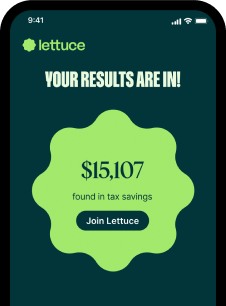
Curious if an S Corp is right for you?
Try the Lettuce Tax Calculator to see how much more you can take home each year.
See your savingsC Corp, LLC, Or S Corp? Why The Old Debate Misses The Point
When solopreneurs compare C corp vs S corp vs LLC, they often treat it like a forced choice. Pick one, commit, move on. But that framing misses the real play: combining structures.
The Myth of the Single Structure
You don't have to choose between legal protection and tax savings. The IRS confirms that an LLC can elect to be taxed as an S corporation, giving you legal protection at the state level and a lower tax bill at the federal level. The "pick one" debate is already outdated.
Why C Corps Don't Work for Solo Businesses
C Corps exist to serve companies chasing venture capital, managing dozens of shareholders, or preparing for an IPO. The SBA notes that C Corps face corporate income tax, and shareholders pay tax again on any dividends. For a business-of-one, that's two layers of taxation on money you already earned.
The Smart Stack: LLC + S Corp
The LLC + S Corp combination, or what we call the Smart Stack, is the setup most solopreneurs actually need. The LLC creates a legal wall between your personal assets and your business, giving you personal asset protection from day one. The S Corp election lets you split income into salary and distributions. The distribution portion isn't subject to self-employment tax, saving solopreneurs $8,000 or more a year. One smart combination. Two powerful advantages. See exactly how they stack up.
Table: How C Corp, LLC, And S Corp Structures Really Compare
How a C Corp compares to an LLC or S Corp for a business-of-one isn't just a legal question. It's a financial one, and those differences have a direct impact on your bottom line. Each structure carries its own tax rules, liability protections, and compliance requirements.
| Structure | What It Is | Best For | Tax Treatment | Owner Payroll Required | Complexity | Solopreneur Fit |
|---|---|---|---|---|---|---|
| C Corp | Separate legal entity taxed at the corporate level | Investor-backed companies, startups planning to raise capital | Corporate tax on profits + personal tax on dividends (double taxation) | No | High | Poor |
| Single-Member LLC | Legal entity that separates personal and business assets | Solos wanting liability protection with minimal setup costs | All profit taxed as self-employment income (SE tax) at 15.3% | No | Low | Fair |
| Smart Stack (LLC Taxed as S Corp) | LLC legal structure + S Corp tax election, giving you a liability shield and SE tax reduction together | Solopreneurs wanting both a liability shield and SE tax savings in one structure | Owner salary taxed as employment income; distributions avoid SE tax | Yes, per IRS guidelines | Moderate | Best Fit |
For most solopreneurs, the LLC vs. S Corp decision comes down to one thing: reducing self-employment taxes without adding unnecessary complexity, and the LLC + S Corp combination is the only structure that delivers both legal protection and up to $8,000+ in annual tax savings in a single, streamlined structure. How S Corp taxes work explains the savings at different income levels. Why C Corps fall short for solos? It starts with how they're taxed.
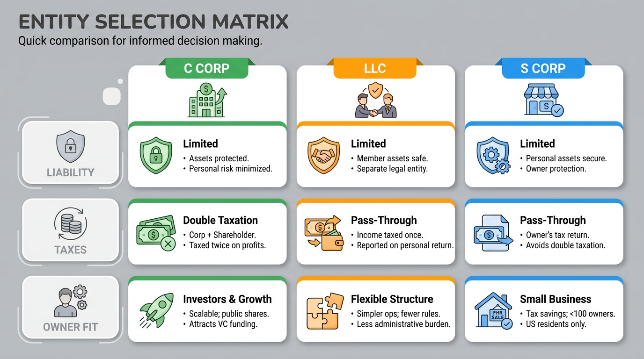
Why C Corps Don't Fit: Double Taxation, Complexity, And Cost
A C Corp is a separate legal entity that pays its own taxes, and for most solopreneurs, it's rarely the right fit. The SBA is clear: C Corps are designed for businesses raising outside capital or planning to go public.
If that's not your roadmap, the structure works against you. Double taxation alone is enough reason to look elsewhere, and that's before the added complexity and costs.
- C Corps pay corporate tax on profits, then taxed again personally on any dividends you receive.
- Corporate formalities like board meetings, recorded minutes, and annual reports are mandatory, not optional.
- Higher compliance costs mean extra filings, added complexity, and a bigger accounting bill each year.
- C Corp status signals nothing to clients that your work doesn't already communicate.
For a business-of-one, that overhead adds up fast with very little return. The LLC + S Corp combination solves both problems at once, and the S Corp drawbacks worth knowing about are far more manageable than paying tax twice.
LLC + S Corp: The Smart Stack For Solopreneurs
The LLC + S Corp structure gives solopreneurs something no single entity can: legal protection and a lower tax rate on the same income. Your LLC shields your assets, and your S Corp election changes how your income is taxed.
For solopreneurs earning $80,000 or more, the savings from this structure are real. Self-employment tax runs 15.3% on net earnings, and the S Corp election reduces the portion of your income subject to that rate.
- Your LLC keeps personal assets protected, giving the S Corp election a clean legal foundation to work from.
- The S Corp election splits your income into a W-2 salary and owner distributions.
- The IRS requires a reasonable salary, but distributions above that threshold avoid self-employment tax entirely.
- Solos earning $80,000+ can save $8,000 or more per year with this structure.
- With the right platform, LLC formation, payroll, bookkeeping, and year-end filings run on autopilot from day one.
Ready to see how the numbers work for your income? Start with the LLC vs. S Corp breakdown, then see how Lettuce works for solopreneurs on the LLC + S Corp structure.
Frequently Asked Questions About C Corps, S Corps, And The Smart Stack
When you're running a business-of-one, questions about C Corps, S Corps, and LLCs come up fast, and the stakes feel higher than the jargon suggests. The answers are simpler than most people expect, and getting them right can change how much you keep from every dollar you earn.
Should a solopreneur ever choose a C Corp?
Rarely. C Corps are built for startups chasing venture capital or planning an IPO, not for consultants and freelancers running lean. According to the SBA, C Corps face double taxation. Profits are taxed at the corporate level, then taxed again when distributed to owners. For most solos, a C Corp is a tool built for a job you're not doing.
Is an S Corp really better than a C Corp for solopreneurs?
The S Corp disadvantages for solopreneurs, like payroll requirements and state-level fees, are manageable for solos earning $80,000 or more. For solos at that income level, the savings often reach $8,000 or more per year.
Do I have to pay myself a salary as an S Corp owner?
Yes. IRS guidance on owner salaries requires S Corp owner-employees who perform services to receive reasonable compensation as W-2 wages. Skipping a salary is one of the most common audit triggers. Lettuce calculates your salary based on your income, role, and industry, keeping you compliant and audit-ready.
Can I switch to an S Corp if I'm already operating as a sole proprietor or LLC?
If you're already operating, you're not starting from scratch. You file Form 2553 with the IRS to make the S Corp election. Mid-year or retroactive elections are possible in many cases. Lettuce handles the entire filing process, including IRS correspondence, as part of setup.
How does Lettuce automate the LLC + S Corp stack?
When income hits your Lettuce account, the platform automatically routes it into two accounts: one for salary and taxes, one for expenses and distributions. Payroll runs on the 10th of every month, with federal and state taxes paid on your behalf. Year-end filings, including your Form 1120-S and Schedule K-1, are covered.
Ready To Stop Overpaying? Build Your Smart Stack With Lettuce
For most solopreneurs, the LLC + S Corp combo is the only structure you need. It gives you legal protection and real tax savings without the complexity and compliance costs of a C Corp.
Every plan is backed by the Lettuce-Back Guarantee. If your savings don't exceed your subscription cost, you get your fees back. Full stop. For solopreneurs, Lettuce handles everything from S Corp formation to payroll, bookkeeping, and year-end filings in a single platform.
Find out how much you could keep with Lettuce and see the full financial system built for businesses-of-one. Get started today!
