
 Christopher Potter
1 min read

You can have 2 health insurance plans, but it won't double your payouts. Coordination of benefits decides which plan pays first. S-corp owners must handle premiums properly to keep the self-employed health deduction, and dual coverage can affect HSA eligibility. Compare costs and tax impact before adding a second plan.
Many solo owners may find themselves covered by two health insurance plans, and some S-Corp owners may also be overlooking a deduction for qualifying health insurance premiums. Two plans don't mean double payouts. Your primary pays first; the secondary may cover eligible costs the primary doesn't, like deductibles. Health insurers follow coordination of benefits rules established by state insurance regulations and individual plan provisions to determine which policy pays first.”See how S-corp owners handle health insurance and how Lettuce works for solo owners.

Is Lettuce right for you?
See if Lettuce can help you keep more of what you earn with our short quiz.
Take QuizWhy Would You Need Two Health Insurance Plans?
Most people don't set out to have two health insurance plans. The reasons range from a surprise life event to a deliberate strategy you planned yourself. Get it wrong, and you're paying for two plans that cover the same thing. Get it right, and you're filling gaps that one plan never could.
When Life Events Create Dual Coverage
Life events like marriage, divorce, or a job change can put two active plans in your wallet before you've had time to think about it. A spouse gets a new job with benefits. You enroll in your own plan while still temporarily covered under a parent’s plan. According to Connecticut's Office of Health Affairs, carrying both policies most commonly starts with everyday life changes, not deliberate planning.
When Two Plans Are a Deliberate Choice
S-corp owners and self-employed professionals sometimes add a second plan to fill real gaps. Those gaps might be a specialist network that the first plan doesn't cover, a lower deductible, or stronger prescription coverage. Lettuce Pro members operating as S-corps can access group-rate health plans reserved for larger companies. That access sometimes removes the need for a second plan altogether. If you do need two, the goal is to reduce total out-of-pocket costs, not just add a second bill.
Why the Scenario You're In Matters
Accidental overlapping coverage can lead to claim confusion or paying two premiums for the same benefits. Intentional two-plan coverage, done right, can close real gaps. Understanding your setup before you file a claim saves time and money. S-Corp owners also face specific IRS rules on which premiums are deductible and which are not, worth reviewing before you commit to two plans.
What Really Happens When Two Health Plans Cover the Same Claim
Having two plans doesn't mean two full payouts. Coordination of benefits (COB) rules determine how your insurers split the bill, and according to the U.S. Office of Personnel Management, combined payments from both plans will never exceed 100% of your actual costs. Traditional medical plans generally won’t pay more than the total covered expense. One plan pays first as the primary, the second may cover some of what remains, and once both insurers have current coverage information, the primary plan processes the claim first, and the secondary plan evaluates any remaining eligible amount under its own terms.
| Scenario | Primary Plan | Secondary Plan | Your Out-of-Pocket Result |
|---|---|---|---|
| Routine in-network visit | Pays per plan terms (copay, coinsurance) | May cover remaining copay or coinsurance | Potentially lower copay or coinsurance |
| High-cost procedure | Pays after deductible is met | May cover part of the remaining deductible | Lower total cost |
| Service excluded by primary | Depends on whether the secondary policy independently covers it | Does not cover. Exclusions are not overridden by a second plan. | Potential benefit only if the secondary plan independently covers the service |
| Out-of-network provider | Pays at out-of-network rate, if covered at all | May cover partial gap, subject to its own network rules | Savings vary by plan |
| Prescription drugs | Applies its own formulary | May cover remaining cost after primary pays | Depends on both formularies |
A plan that looks comprehensive on paper may still leave meaningful gaps once COB rules are applied to your specific claims. For S-corp owners who want stronger coverage without paying two sets of premiums for overlapping benefits, Lettuce Pro's group-rate healthcare offers access to plans typically reserved for larger companies. Knowing exactly what each plan covers before you commit is what separates a smart coverage decision from an expensive assumption.
How to Determine Your Primary vs. Secondary Plan
Understanding primary vs. secondary health insurance coordination is simpler than it sounds. The rules that decide which plan pays first follow a clear order. Knowing that order helps you get the most out of both policies.
The Basic Rule
Generally, coverage through your own active employment is primary over coverage under which you are enrolled as a dependent. However, the applicable plan terms and special coordination rules may change the payment order. The secondary plan, often through a spouse or parent, covers remaining eligible costs, like your deductible or coinsurance. Think of it as a relay. One plan runs first, then passes the remaining balance to the next.
Special Cases That Change the Order
A few situations flip the standard order. For children covered by two parents' plans, the "birthday rule" applies. Whichever parent's birthday falls earlier in the year has the primary plan. For Medicare, employer size matters. If your employer has fewer than 20 employees, Medicare often pays first.
The S-Corp Owner Rule
For S-corp owners specifically, in many cases, coverage through your own active employment or business will serve as your primary plan, although coordination of benefits rules may produce different outcomes in certain situations. A plan through your spouse's employer is not deductible through your S-corp.
Make Both Plans Work Harder
Getting the plan order right keeps your self-employed deductions accurate and your out-of-pocket costs as low as possible. When the secondary plan knows exactly what the primary already covered, it fills in the right gaps. That's how you get real value from carrying two plans.
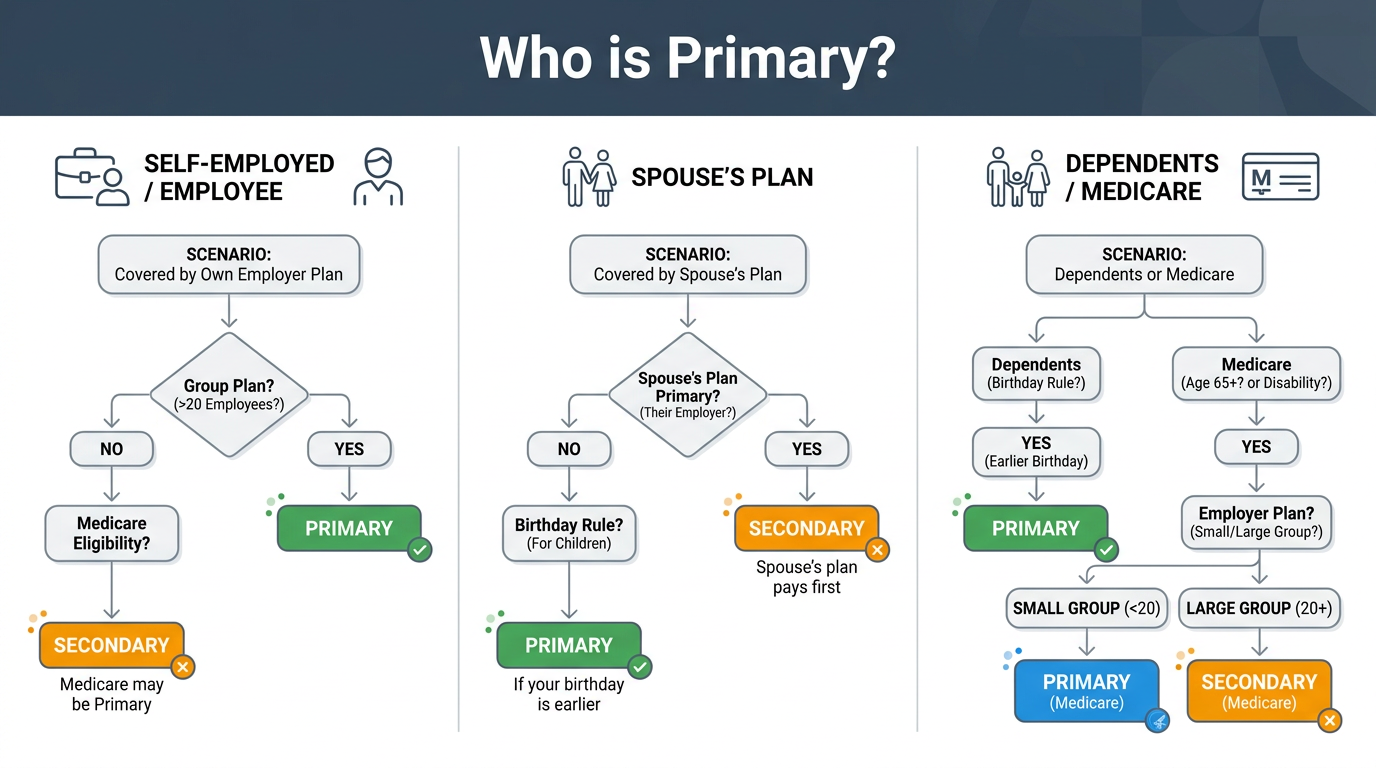
This chart is illustrative only. Actual primary-payer status depends on the applicable plan terms, coordination-of-benefits rules, Medicare eligibility basis, and employer size.
When Dual Coverage Helps And When It Just Adds Cost
A second plan earns its place only when it lowers what you spend out of pocket. Premiums, deductibles, coinsurance, and provider access all count toward that math.
The real question for any S-corp owner isn't whether you can carry two plans; it's whether you can do it without overpaying. Run these five checks before you commit to a second plan.
- Compare monthly premiums for both plans against your actual yearly healthcare spending before committing.
- Watch for deductible overlap: separate deductibles on both plans can cancel out your savings.
- Confirm that out-of-network rules align. A secondary plan with a narrow network often costs more than it covers.
- Review IRS guidance on S-corp health coverage: A second plan may make you ineligible to contribute to an HSA if it provides disqualifying medical coverage before the HDHP deductible is met.
- Factor in tax treatment: only premiums paid through your S-corp are reported correctly on your W-2.
For S-corp owners who want group-rate coverage without stacking plans, Lettuce Pro healthcare is worth exploring. How those premiums get reported on your W-2 determines whether you keep the self-employed health insurance deduction.
Frequently Asked Questions About Having Two Health Insurance Plans
Health coverage decisions for solo owners aren't just personal. They affect your taxes, your deductions, and your bottom line. The questions below address the most common scenarios, including what happens when one plan is through your business and one is through a spouse.
Can you have two health insurance plans if one is through your employer and one is through your spouse?
Yes, you can have two plans in this scenario. When both spouses have separate coverage, each person's own plan is usually primary, and coordination of benefits rules determine which plan pays first automatically. If you run an S-corp, your S-corp health plan is generally primary for you, and your spouse's plan acts as secondary.
Do two health insurance plans mean both insurers pay the full bill?
No, and this is one of the most common mix-ups. The primary insurer pays first, as set by coordination of benefits rules. The secondary then covers your remaining out-of-pocket costs, like your share of a bill after the primary pays, up to its policy limits.
Can an S-corp owner deduct premiums for both plans?
It depends on where the coverage comes from. Premiums paid or reimbursed by the S-corp and properly reported on the shareholder’s W-2 may qualify for the self-employed health insurance deduction if the coverage is established by the S-corp and the other IRS requirements are met.If you are eligible to participate in your spouse’s employer-sponsored health plan, your self-employed health insurance deduction may be limited or unavailable for those months. . It may also disqualify you during months when that spousal coverage is available to you.
Does having two health plans affect HSA eligibility?
If either plan provides disqualifying medical coverage before the HDHP deductible is met, HSA contribution eligibility may be lost — that applies even if your primary plan qualifies on its own. Certain permitted coverage, such as standalone dental or vision insurance, generally doesn’t cause disqualification. Confirm both plans qualify as HDHPs before making contributions.
Choose The Coverage Setup That Keeps More Money In Your Business
A smart health insurance strategy for self-employed business owners isn't about stacking plans. It's about the right coverage, the lowest total cost, and premium deductions that reduce what you owe. The IRS S-corp guidance is specific, and following those rules correctly matters more than the number of plans you carry.
That's where setup and system meet. When your health coverage, payroll, and tax strategy work together in one place, you stop guessing. You start keeping more of what you earn. Lettuce is built for exactly this.
Find out how much more you keep when your health coverage, payroll, and S-corp taxes run through Lettuce.