 Christopher Potter
1 min read

The HMO vs. PPO decision hits differently when there's no HR team to walk you through it. One keeps costs low and predictable inside a tighter network. The other trades higher premiums for provider freedom. Here's how to weigh both against your health needs, budget, and tax strategy.
When you're self-employed, every healthcare decision lands squarely on your desk. No HR department to guide you, no corporate benefits team to explain the coverage details. Just you, your business income, and the weight of choosing between HMO and PPO plans that could save or cost you thousands.
The PPO vs HMO decision for self-employed professionals comes down to more than monthly premiums. You're balancing provider flexibility, out-of-pocket costs, and how each plan fits your work style. Whether you travel for clients, need specialist care, or want predictable costs, understanding these plan differences helps you choose with confidence instead of crossing your fingers.
Ready to make health insurance work for your business? Lettuce helps solopreneurs access group-rate healthcare plans while automating tax deductions and compliance.

Curious if an S Corp is right for you?
Try the Lettuce Tax Calculator to see how much more you can take home each year.
See your savingsWhat Is an HMO?
A Health Maintenance Organization operates like a membership club for your healthcare. You choose a primary care physician who becomes your healthcare quarterback, coordinating all your care and referring you to specialists when needed. This structured approach means you can't just book an appointment with any doctor you want. Care generally must remain within the HMO’s network, except for emergency services. Depending on the plan, you may also need to select a primary care physician and obtain referrals before seeing certain specialists.
The upside of this structured approach is cost predictability that appeals to solopreneurs prioritizing cost control. HMO premiums are typically lower, often meaningfully so, than comparable PPO plans, and your out-of-pocket costs stay predictable since you benefit from the network's pre-negotiated lower rates.
An HMO for self-employed professionals works best if you're comfortable with a more guided healthcare experience and want to minimize monthly expenses. You'll trade provider flexibility for budget certainty, and if you're operating as an S Corp, those health insurance premiums generally become tax-deductible when paid properly through payroll.
What Is a PPO?
A Preferred Provider Organization (PPO) gives you the freedom to see any healthcare provider you want, whether they're in your plan's network or not. Unlike other plan types, PPOs don't require you to choose a primary care doctor or get referrals before seeing specialists. You can book directly with that cardiologist or dermatologist without navigating extra administrative steps first. This makes PPOs attractive for self-employed professionals who value control over their healthcare decisions.
This flexibility comes at higher costs across the board. PPO premiums typically run more than HMO plans, and you'll also face higher deductibles and coinsurance rates when you use out-of-network providers. Your annual healthcare budget can grow substantially if you frequently go outside the network. But if you travel often for work, have established relationships with specific doctors, or need regular specialist care, the extra expense might be worth it.
If tax savings are important, determine whether the plan is HSA-qualified. HMO and PPO plans can both be paired with an HSA if they meet IRS high-deductible health plan requirements.
Lettuce Pro members can access group-rate PPO coverage that helps offset some of these higher costs while maintaining the provider flexibility that busy solopreneurs need.
Breaking Down the Differences for Solopreneurs
When you're self-employed, every healthcare dollar comes directly from your business income, making the HMO vs PPO for freelancers decision more personal than corporate employees face. Beyond monthly premiums, you need to compare deductibles and maximum out-of-pocket limits because these expenses can swing your annual healthcare budget by thousands.
HMO vs. PPO: Key Differences at a Glance
When you're shopping for coverage as a solopreneur, this HMO vs PPO comparison breaks down the factors that directly impact your business operations and budget.
| Question | HMO | PPO |
|---|---|---|
| How much will this plan cost me each month? | Lower cost. HMO plans typically have lower monthly premiums and lower out-of-pocket costs, which matters when every dollar comes out of your own pocket. | Higher cost. PPOs charge higher premiums in exchange for greater flexibility. Out-of-pocket costs can also run higher, especially if you use out-of-network providers. |
| Do I need to pick a primary care doctor? | Yes. With an HMO, all of your care is coordinated through a designated primary care physician (PCP) within your network. | No. PPOs do not require you to choose or work through a primary care physician. |
| Do I need a referral to see a specialist? | Sometimes. Many HMOs require a referral from a primary care physician before you see an in-network specialist, but requirements vary by plan. | No. You can book directly with any specialist without going through a gatekeeper. |
| Can I see an out-of-network doctor? | No. HMOs only cover out-of-network care in true medical emergencies. | Yes. Many PPOs provide some out-of-network coverage, though reimbursement levels vary significantly by carrier and plan design. |
| Will I need to file insurance claims myself? | No. Your insurer pays the provider directly, so there is little to no paperwork on your end. | Sometimes. With out-of-network providers, you may need to pay upfront and file a claim for reimbursement, which can affect your cash flow as a solopreneur. |
| Which type of solopreneur does this suit best? | Budget-focused solopreneurs who want predictable costs and work primarily in one location. | Flexible solopreneurs who travel frequently, have an existing specialist, or need provider choice across states. |
The choice comes down to your priorities: HMOs offer cost predictability with some restrictions, while PPOs give you greater flexibility at a higher price. According to plan types defined by HealthCare.gov, both can work well for self-employed individuals, depending on your specific needs and work style.
Whether you choose an HMO or PPO does not, by itself, determine whether the premiums are deductible. Eligible self-employed individuals may deduct qualifying premiums when the applicable IRS requirements and limitations are satisfied.
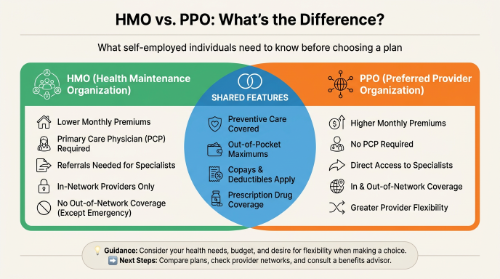
HMO vs. PPO: How They Compare
The clearest way to compare your options is to see them side by side.
What Only HMOs Require
HMOs operate with more structure and lower costs. You'll choose a primary care physician who coordinates your care and provides referrals to specialists when needed. All your care must stay within the plan's network, except for true emergencies. What is the trade-off for these requirements? Lower premiums that help keep your monthly business expenses predictable.
What Only PPOs Offer
PPOs give you freedom at a price. You can see any doctor without a referral and get partial coverage for out-of-network care when you need it. This flexibility makes PPOs ideal if you travel frequently for work or have established relationships with specialists. The cost of this freedom shows up in higher premiums and out-of-pocket expenses.
What Both Plans Share
Here's what matters most for your bottom line: both HMO and PPO premiums are 100% tax-deductible for self-employed individuals, within IRS limits. Whether you choose the structure of an HMO or the flexibility of a PPO, you'll get emergency coverage, prescription drug benefits, and access to a provider network. Understanding how this deduction works can save you thousands annually, and if you're operating as an S Corp, proper handling of these deductions becomes even more valuable for your tax strategy.
How HMO and PPO Affect Your Tax Deductions
Good news: your choice between HMO and PPO won't change your tax benefits. Self-employed individuals can deduct 100% of their health insurance premiums as a deduction that reduces their taxable income directly, regardless of plan type. The IRS treats both HMO and PPO premiums the same way under the self-employed health insurance deduction rules. Whether you pay $400 monthly for an HMO or $600 for a PPO, every dollar reduces your taxable income (up to your net self-employment earnings).
You gain the real advantage when you automate this deduction so you never miss it. Lettuce tracks your premium payments and ensures they're properly categorized for tax time. Instead of comparing tax differences between plan types, focus on which plan actually fits your health needs and budget as a solopreneur. Special payroll reporting rules apply to S Corp shareholders owning more than 2% of the company
How to Choose: A Simple Decision Framework
Your health insurance choice affects every dollar you earn and every doctor visit you make. The right plan gives you control over both your health and your finances. Here's how to match a plan to your actual life and business.
- Think about how often you see doctors: Regular checkups and ongoing care? HMOs' predictable costs work in your favor. Healthy and rarely need care? An HMO’s lower premium may be more economical, unless broad provider access or out-of-network coverage is important to you.
- Consider your specialist relationships: Do you already have doctors you trust, or do you need regular specialist care? PPOs let you keep those relationships without jumping through referral hoops. Starting fresh? HMOs can guide you to quality providers within their network.
- Look at your monthly cash flow: Higher premiums for flexibility, or the lowest possible monthly cost? Remember that health insurance premiums are 100% tax-deductible for self-employed individuals, within IRS limits, reducing your actual cost.
- Factor in travel and work locations: Work across state lines or travel frequently for business? PPOs may offer broader networks and out-of-network benefits, but coverage away from home varies by plan, so verify the network and service area.
- Calculate your real annual costs: A $300 HMO premium might beat a $450 PPO premium if you rarely need care. But if you see specialists regularly, that PPO could save you thousands in referral delays and out-of-network charges.
- Consider group coverage opportunities: If you're operating as an S Corp, Lettuce Pro members can access group-rate healthcare typically reserved for larger companies. This changes the cost equation entirely.
The Healthcare.gov plan comparison tool helps you weigh these factors, but your choice as a self-employed person involves unique considerations like tax deductions and S Corp health insurance strategies. Choose the plan that fits how you actually work and live. Your business deserves a health insurance strategy as smart as you are.
Confidently Choose and Keep More of What You Earn
Your self-employed health insurance decision boils down to three factors: your health needs, your monthly budget, and how you work. HMOs offer lower premiums with structured care, while PPOs provide flexibility at higher costs. Neither choice is wrong if it matches your lifestyle and supports your business operations.
Managing health insurance costs is just one piece of running a lean, tax-efficient solo business. Whether you choose HMO or PPO, your premiums are generally tax-deductible. Savvy business owners automate these deductions and streamline their entire financial back office.
Ready to stop juggling spreadsheets and start maximizing your tax savings? Lettuce handles your bookkeeping, payroll, and tax strategy so you can focus on what you do best.
Lettuce offers health benefits to eligible Lettuce Pro members through its professional employer organization (PEO). Health/medical coverage is provided by Curative. This article is for informational purposes only and does not constitute medical, insurance, tax, or legal advice. Benefits, plan availability, coverage, premiums, eligibility, and potential savings vary by state and individual circumstances and are subject to change. Coverage is subject to the terms and conditions of the applicable benefit plan. Nothing in this article should be interpreted as a recommendation to purchase, enroll in, or decline any specific insurance plan. Consult a licensed insurance agent, tax professional, and/or healthcare provider before making decisions about your health coverage or benefits.