
 Christopher Potter
1 min read

Finding the cheapest self-employed health insurance by state takes more than comparing sticker prices. Your true cost depends on premiums, subsidies, deductibles, and out-of-pocket maximums, plus tax perks like the self-employed health insurance deduction. Before you choose a plan, weigh provider networks and prescription coverage too, so "cheap" actually saves you money.
The cheapest self-employed health insurance by state is not one national winner. Marketplace premiums for a 40-year-old average 625 per month before credits, and that figure varies by location. ACA marketplace plans are coverage options sold on Healthcare.gov or your state's exchange. Premiums are your monthly cost, and deductibles are what you pay before coverage kicks in. Subsidies reduce your premium based on income. A lower premium HDHP may also allow HSA contributions, creating additional tax savings.
Those variables work together, and the gap between them is where your savings live. The number that actually matters is your net cost, what you pay after subsidies and tax treatment. Your state's market, your income, and your business structure all affect the final figure. Lettuce ties your health plan into S-corp payroll and taxes, so your coverage fits your tax strategy from day one.

Is Lettuce right for you?
See if Lettuce can help you keep more of what you earn with our short quiz.
Take QuizHow Much Does Individual Health Insurance Cost On Average In 2026?
A useful 2026 benchmark is $625 per month for a 40-year-old before premium tax credits. That figure is the national average benchmark premium—the second-lowest-cost Silver plan used to calculate Marketplace premium tax credits—not the average price of every Marketplace plan.
Your 2026 Baseline: $625 Before Credits
According to KFF marketplace data, the average 2026 Marketplace benchmark premium for a 40-year-old is $625 per month before premium tax credits. That reflects a 26% increase from 2025, and a separate Urban Institute analysis puts the benchmark premium increase at 21.7% between 2025 and 2026, one of the sharpest single-year jumps on record. Enrollees receiving the tax credits that reduce monthly premiums for self-employed people can see their net monthly cost drop by hundreds of dollars, depending on income.
The additional Marketplace savings available through 2025 ended on December 31, 2025. For 2026, premium tax credit eligibility generally ends when household income exceeds 400% of the federal poverty line, and households that remain eligible may receive less assistance than under the temporary enhanced credits.
The Number That Matters More Than Your Monthly Premium
Premiums are just one piece of your annual cost. KFF reports that the average Marketplace deductible across 2026 plan selections is $3,786, and deductibles vary substantially by plan and metal tier. For 2026, a Marketplace plan's annual out-of-pocket limit can't exceed $10,600 for an individual or $21,200 for a family, although many plans have lower limits. A Bronze plan often carries a lower monthly premium but higher cost-sharing. A Silver plan may cost more each month but can come with lower deductibles and cost-sharing, especially for people who qualify for cost-sharing reductions. See how ACA metal tiers work for self-employed owners for a full breakdown.
Use the Average as a Benchmark, Not a Budget
State averages vary widely, but a state-level figure is only a benchmark. Compare the plans available in your ZIP code and check premium tax credit eligibility before choosing coverage. For an eligible more-than-2% S-Corp shareholder, the self-employed health insurance deduction may reduce taxable income when the coverage is established under the S-Corp and the other IRS requirements are met.
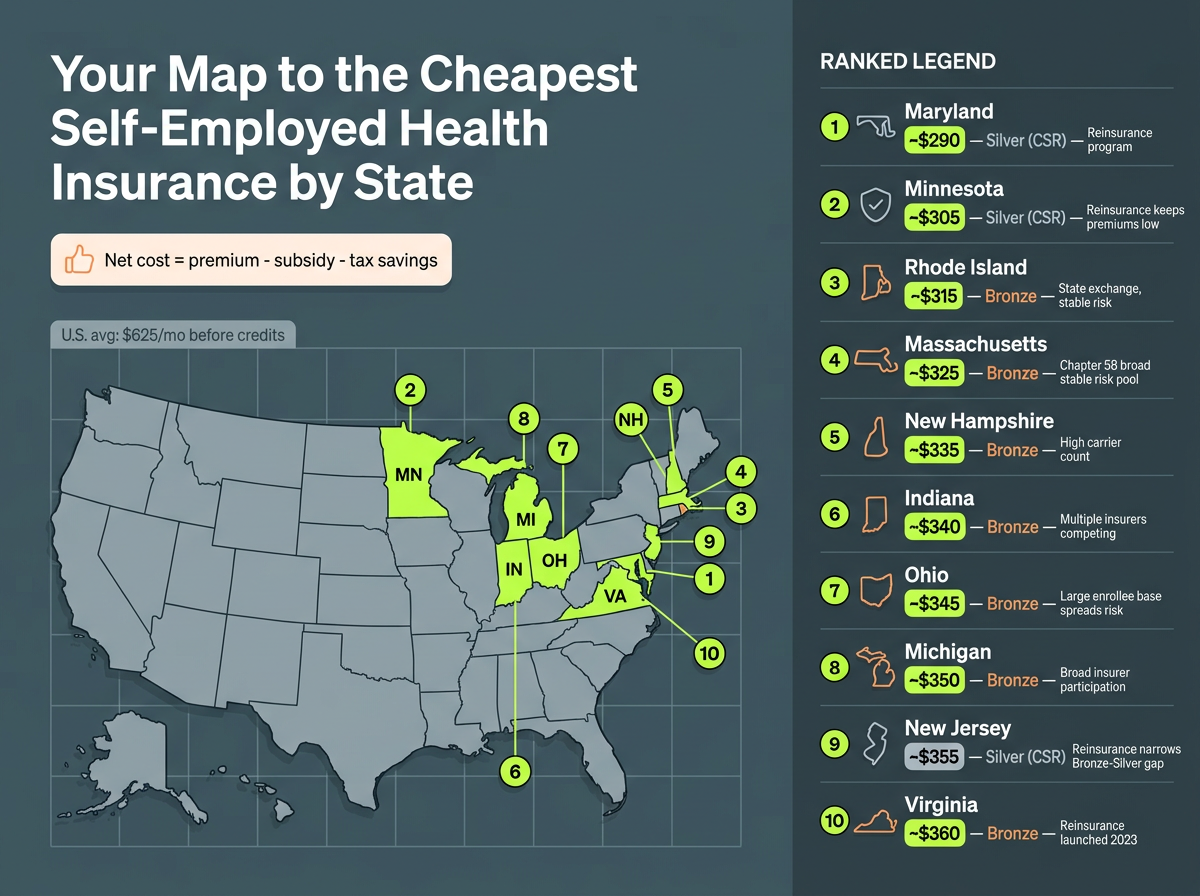
The 10 Least Expensive States for Individual Health Insurance in 2026
Some states consistently rank among the least expensive for individual health insurance, and the gap between them and the priciest markets can exceed $200 a month for the same age and plan type. The states below held their ground even as national ACA premiums rose an average of 21.7% in 2026, largely because of state reinsurance programs or strong insurer competition that absorbs cost pressure before it reaches your monthly bill.
| State | Avg. Monthly Premium (Age 40) | Best Value Tier | Key Reason for Low Cost |
|---|---|---|---|
| Maryland | ~$290 | Silver (if CSR-eligible) | State reinsurance program reduces insurer claims exposure |
| Minnesota | ~$305 | Silver (if CSR-eligible) | Reinsurance program keeps premiums well below the national average |
| Rhode Island | ~$315 | Bronze | State-based exchange with reinsurance and stable risk pool |
| Massachusetts | ~$325 | Bronze | Chapter 58 universal coverage law creates a broad, stable risk pool |
| New Hampshire | ~$335 | Bronze | High carrier count on federally facilitated exchange |
| Indiana | ~$340 | Bronze | Multiple insurers competing on the federally facilitated exchange |
| Ohio | ~$345 | Bronze | Large enrollee base spreads risk across urban and rural markets |
| Michigan | ~$350 | Bronze | Broad insurer participation across urban and rural counties |
| New Jersey | ~$355 | Silver (if CSR-eligible) | State reinsurance program active since 2019 narrows Bronze-Silver gap |
| Virginia | ~$360 | Bronze | State reinsurance program launched in 2023, reducing benchmark premiums |
Premiums are estimated 2026 figures based on KFF marketplace data and may vary. Verify current rates at Healthcare.gov or your state exchange.
A lower monthly premium is a strong starting point, but your real annual cost also depends on deductibles and out-of-pocket maximums. Knowing the difference between what you pay monthly and what you pay when you actually need care is where smart coverage decisions start, and the self-employed health insurance deduction can shift which plan costs you less once taxes are factored in alongside your broader health insurance options as a freelancer. The cheapest state before subsidies may not be the cheapest state for your household.
How Do I Find The Lowest-Cost Health Insurance Plan If I Am Self-Employed In My State?
Your subsidy eligibility only shows up when you shop through official channels like Healthcare.gov or your state exchange. Aggregator sites skip that math, and that means missing premium tax credits that could meaningfully lower your monthly cost.
- Create or log into your Healthcare.gov account as a self-employed filer to see real net premiums based on your projected income.
- Compare plans by net premium after subsidy first, then deductible, then doctor access, then max out-of-pocket.
- Keep your projected income updated throughout the year so your premium tax credit remains accurate.
- Use the KFF Health Insurance Marketplace Calculator to model how different income levels affect your subsidy before you commit to a plan.
- Revisit your income projection mid-year if your earnings shift and update your Marketplace application promptly so your financial assistance can be recalculated using the new estimate.
- Getting the shopping process right puts you ahead of most solos. See how health insurance and income reporting connect for self-employed owners, because your S-corp structure can impact what you pay on taxes, not just premiums.
Can An S-Corp Help Lower My Self-Employed Health Insurance Costs Through Tax Savings?
An S-Corp doesn't reduce the insurance premium itself. However, a more-than-2% S-Corp shareholder may qualify for the self-employed health insurance deduction when eligible premiums are paid or reimbursed by the S-Corp, properly reported on the shareholder's W-2, and the other IRS requirements are satisfied. The savings show up through tax treatment, not a lower insurance price.
Your Tax Return Is Where the Real Savings Land
When your S Corp pays or reimburses health insurance premiums, those premiums get added to your W-2 wages. From there, you can choose to deduct them directly on your personal return using Form 7206, reducing your taxable income before other deductions apply. The IRS confirms this for more-than-2% S-corp shareholders. Your premium stays the same. Your after-tax cost drops.
Coverage Choice and Entity Structure Go Hand in Hand
A plan that looks average on price can become your best pick once you count the deduction. If you're in the 22% federal tax bracket, for example, a $500/month premium effectively costs closer to $390 after the self-employed health insurance deduction. That math can make a mid-range plan a smarter pick than the cheapest bronze option on the market. Evaluate your coverage options and entity structure together, not as separate decisions.
Let the Platform Handle the Hard Part
Capturing this deduction correctly requires proper payroll setup and W-2 reporting, which is where most solopreneurs miss it. Lettuce handles how your S-corp pays health insurance premiums through payroll automatically, so the deduction is captured and reported correctly every year.
Frequently Asked Questions About Cheapest Self-Employed Health Insurance By State
Health insurance shopping looks different when you're self-employed, and most guides are written for people with HR departments. These are the answers that actually move the needle when you're comparing plans on your own.
Which states have the cheapest self-employed health insurance for freelancers and solopreneurs?
Finding the cheapest self-employed health insurance by state starts with your subsidy bracket, not just the state average. A state with average premiums can cost you less than a low-premium state if your income puts you in a stronger subsidy tier. Use KFF data to benchmark state averages, then run your actual numbers on Healthcare.gov.
Are bronze plans always the cheapest option for self-employed people in 2026?
Bronze premiums are the lowest, but deductibles are the highest. If your income qualifies for cost-sharing reductions, a silver plan can cost less overall once you factor in deductibles and out-of-pocket costs. The KFF subsidy calculator helps you compare both options at your income level.
Can I lower my health insurance costs if my business income changes during the year?
Your premium tax credit may change when your projected household income changes. If your expected income rises or falls, update your Marketplace application as soon as possible so your financial assistance can be recalculated. For 2026, repayment caps no longer apply, so excess advance premium tax credits must be repaid in full. The health insurance for freelancers guide on Lettuce walks through how to keep your coverage and costs aligned year-round.
Can my S-Corp structure open up better health insurance options?
Lettuce Pro members running W-2 payroll through an S-Corp can access group-rate coverage like the plans larger companies use. That's a separate pool from the individual ACA marketplace, with different pricing and plan structures. See exactly how S-Corp health insurance fits into your payroll setup. If tax savings don't exceed your subscription cost, the Lettuce-Back Guarantee refunds your fees.
Can premiums vary enormously within the same state?
Yes. Premiums can vary substantially by ZIP code and rating area within the same state.
Choose The Lowest Net Cost, Then Let Your Back Office Keep Up
The cheapest self-employed health insurance by state is the plan with the lowest net cost after subsidies and tax treatment. Benchmark premium data confirms premiums vary widely, and your real savings show up when coverage, entity structure, and payroll are aligned.
Self-employed health insurance tax savings depend on how premiums are reported through payroll and claimed correctly. Your S-corp structure determines whether those premiums reduce your taxable income. When payroll, bookkeeping, and tax filings work as a coordinated back office, the deduction lands exactly where it should.
See how your health insurance premiums, payroll, and tax filings finally work as one system with Lettuce.
Lettuce offers health benefits to eligible Lettuce Pro members through its professional employer organization (PEO). Health/medical coverage is provided by Curative. This article is for informational purposes only and does not constitute medical, insurance, tax, or legal advice. Benefits, plan availability, coverage, premiums, eligibility, and potential savings vary by state and individual circumstances and are subject to change. Coverage is subject to the terms and conditions of the applicable benefit plan. Nothing in this article should be interpreted as a recommendation to purchase, enroll in, or decline any specific insurance plan. Consult a licensed insurance agent, tax professional, and/or healthcare provider before making decisions about your health coverage or benefits.