
 Natalia Budyldina
1 min read

If you're earning $80,000 as a solopreneur, you're paying 15.3% self-employment tax on every dollar of profit. That's $12,000+ a year, straight to the IRS. Form 2553 is the form you file to notify the IRS that your business wants S Corp tax treatment. One form. The math changes in your favor.
With eligibility rules, deadlines, missed-election relief options, tax-saving strategies, and a line-by-line walkthrough in hand, you can file Form 2553 with confidence.
Lettuce automates the entire S Corp election process, so you can focus on the work that earns the income.
Before you fill anything out, let's take a closer look at what Form 2553 does and why it can have such a big impact on your taxes.

Is Lettuce right for you?
See if Lettuce can help you keep more of what you earn with our short quiz.
Take QuizWhat Is Form 2553 — And Why Does It Matter for Your Business?
What is Form 2553? It's the official IRS form a small business files to be treated as an S Corporation for federal tax purposes. File it once, and your entire tax treatment changes going forward.
What Form 2553 Actually Changes (And What It Doesn't)
Filing Form 2553 does not alter your legal business structure. Your LLC stays an LLC. Think of it as changing how the IRS reads your income, not rewiring your business.
Without Form 2553, a single-member LLC is generally taxed as a sole proprietorship by default, meaning all of its profit is subject to self-employment tax. Filing Form 2553 changes that tax treatment without changing the business itself.
Why It Feels Like a Pay Raise
As a sole proprietor or single-member LLC, you pay 15.3% self-employment tax on every dollar of profit. S Corp status lets you split that income into two buckets: a salary and owner distributions. Only the salary faces that 15.3% tax. The distributions do not.
For many solopreneurs, that difference can translate into thousands of dollars in annual tax savings.
One Form. Real Savings.
The tax savings available through S Corp status can be substantial, especially as profits grow. We'll break down the math later in this guide, but the key takeaway is simple: Form 2553 isn't just paperwork. It's a tax election that can put more of your hard-earned money back in your business.
See exactly how S Corp taxation works in practice in this guide to S Corp taxes.
Who Should File Form 2553? S Corp Eligibility Requirements Explained
The S Corp eligibility requirements set by the IRS are more straightforward than most people expect. If you run a U.S.-based business, there's a good chance you already qualify.
S Corp Eligibility Checklist
- Your business must be a domestic entity. It needs to be formed in the U.S. and operate under U.S. law. Foreign corporations don't qualify.
- 100 or fewer shareholders. As a solopreneur, you're almost certainly the only shareholder. This one writes itself.
- Only individuals, certain trusts, or estates can own shares in your S Corp. Partnerships, other corporations, and non-resident aliens are not eligible shareholders.
- One class of stock. All shares must carry the same rights to distributions and liquidation proceeds. Preferred stock structures disqualify the election.
- A permitted tax year. Most S Corps use a calendar tax year running January through December, unless they qualify for a different fiscal year.
- LLCs must be classified before filing Form 2553. In many cases, this election can be made alongside the S Corp election. If you're unsure how the process works, see this guide on changing an LLC to an S Corp.
For most solopreneurs, checking these boxes is the easy part.
When Does Filing Form 2553 Make Sense?
While the IRS doesn't require a minimum income level, many solopreneurs begin seeing meaningful tax savings once annual net profit reaches around $80,000. At that point, the self-employment tax savings from splitting income between salary and distributions often outweigh the additional compliance costs.
See S Corp basics to understand how the savings work, and when you're ready, move on to filing Form 2553.
Form 2553 Deadlines — When to File to Lock In Your S Corp Status
The IRS gives you a firm window to file Form 2553. Miss it, and your S Corp savings could be delayed by a full year. The deadline works differently for existing businesses and brand-new ones, and knowing both puts you in control.
Already in Business? File by March 15
The Form 2553 deadline for calendar-year businesses (January 1 to December 31) falls on March 15. Per the IRS Form 2553 page, you must file within 2 months and 15 days of the first day of the tax year in which you want your S Corp election to take effect.
Want S Corp status for 2025? You needed to file by March 15, 2025. Filing during the prior tax year also counts, allowing you to lock in your S Corp status before the new year begins.
Unlike personal tax returns, there is no federal extension available for Form 2553. Missing the filing window can delay your election unless you qualify for relief.
New Business? Your Clock Starts at Formation
If your business is brand new, the same 2-months-and-15-days rule applies. The clock starts on the date your entity was formed or first began doing business, whichever comes first.
"Doing business" can include activities like signing your first client, generating revenue, or otherwise beginning operations.
Start an LLC on October 1? Your deadline to elect S Corp status for that tax year is typically December 15.
Don't Forget About State Requirements
Federal S Corp status doesn't automatically carry over to every state. Some states require a separate S Corp election or additional state-level filings to receive similar tax treatment.
If you're unsure about your state's requirements, check the applicable rules before filing.
Missed the Deadline? You May Still Have Options
If you file late, your election generally takes effect in the following tax year. However, the IRS offers late election relief in certain situations.
We'll cover how that process works in the next section, but the important takeaway is simple: missing the deadline doesn't automatically mean you've lost your chance at S Corp status.
Or skip the stress entirely. Let Lettuce handle Form 2553 filing with the deadline tracked and filed for you.
How to Fill Out Form 2553 — A Step-by-Step Walkthrough
The official Form 2553 has four parts, but most solopreneurs only need to focus on Part I. Filling out the form correctly comes down to knowing which fields matter and what information belongs in each one.
Part I: The Only Section Most Solopreneurs Need to Complete
Part I contains the information the IRS uses to approve your S Corp election.
- Line A: Enter your business name and mailing address exactly as they appear on IRS records.
- Line B: Enter your Employer Identification Number (EIN).
- Line C: Enter your date of incorporation or LLC formation.
- Line D: Enter the state where your business was formed.
- Line E: Choose your effective date. For many solopreneurs, this is January 1 of the tax year in which they want S Corp status to begin.
- Line F: Select your tax year. Most businesses use the calendar year.
- Line G: Provide the name and title of the person the IRS can contact with questions about the election.
- Line H: Complete the shareholder consent section. As a solo owner, this typically means providing your name, ownership percentage, date acquired, and signature.
The effective date is one of the most important fields on the entire form. An incorrect date can delay your election or require additional paperwork.
What About Parts II, III, and IV?
Most solopreneurs can skip these sections.
- Part II applies only if you're requesting a non-calendar fiscal year.
- Part III applies to Qualified Subchapter S Trusts (QSSTs).
- Part IV is used in certain late-election situations involving entity classification elections.
If you're a typical single-owner LLC electing S Corp status, Part I is usually all you'll need.
Get Your EIN Before You File
You cannot submit Form 2553 without an Employer Identification Number. If you don't have one yet, the IRS EIN application is free and takes only a few minutes online.
Lettuce covers how to get your EIN number and handles EIN acquisition as part of setup, so your Form 2553 is ready to file from day one.
Mail or Fax to the Right IRS Service Center
Form 2553 cannot be filed electronically. You'll mail or fax it to one of two IRS service centers, Kansas City, MO, or Ogden, UT, depending on your state.
The IRS where-to-file page has the current addresses and fax numbers. Faxing is often faster and provides a transmission record, which can be helpful if you're filing close to the deadline.
Sending the form to the wrong service center can delay processing, so confirm your state's assigned location before filing.
File in Minutes, or Let Lettuce Do It for You
If you're filing late and requesting relief, you'll generally need to include the statement "FILED PURSUANT TO REV. PROC. 2013-30" at the top of the form.
Lettuce pre-fills Form 2553 using your business information, calculates the correct effective date, and files it on your behalf. If you're starting mid-year, the effective date calculation changes. The platform handles that automatically.
Missed the Deadline? How Late S Corp Election Relief Works
Missing the Form 2553 deadline feels like missing your flight. The IRS built a rebooking option right into the rules. Under Revenue Procedure 2013-30, the IRS provides a formal path to file late and still receive S Corp status from your original intended effective date.
How Long You Have to File Late
You have up to 3 years and 75 days from your intended S Corp effective date to request late election relief.
That window covers most situations where the deadline was simply missed. For many solopreneurs, it's more than enough time to correct the issue and preserve the intended tax treatment.
Whether you're pursuing a mid-year S Corp election or correcting a prior-year oversight, the clock starts from your intended effective date.
Three Conditions You Need to Meet
The IRS generally requires three things:
- Intent: You intended for the business to be treated as an S Corp beginning on the requested effective date.
- Reasonable cause: There was a legitimate reason the deadline was missed.
- Consistent treatment: The business and shareholders acted consistently with the intended S Corp election during the period in question.
Common examples of reasonable cause include being unaware of the filing requirement, relying on incorrect professional advice, or an administrative oversight that caused the election to be missed.
All shareholders must also sign the consent section of Form 2553. Shareholder consent and consistent tax treatment are separate requirements, and both must be satisfied.
How to File for Late Relief
The process starts by filing Form 2553 just as you normally would.
Write "FILED PURSUANT TO REV. PROC. 2013-30" at the top of the form.
Then attach a signed statement explaining why the election was not filed on time. Per the Form 2553 instructions, the statement must be signed under penalties of perjury.
The statement should explain what happened, identify the intended effective date, and confirm that the business and shareholders have treated the company consistently with the intended S Corp election.
Act Before the Window Closes
The relief window closes 3 years and 75 days after your intended effective date. After that, automatic late-election relief is generally no longer available, and obtaining IRS approval becomes substantially more expensive and time-consuming.
The good news is that the IRS gives small businesses a generous correction window, and many late-election issues can be resolved without starting over.
If you're not sure where you stand, Lettuce's guide on how to start an S Corp covers exactly what to do next.
The Tax Savings Solopreneurs Unlock by Electing S Corp Status
The real payoff of filing Form 2553 shows up in your bank account. S Corp tax savings come from one core mechanic: splitting your income into two buckets, each taxed differently.
The Salary vs. Distribution Split
As an S Corp owner, you pay yourself a reasonable salary, subject to payroll taxes at 15.3%. The remaining profit comes to you as S Corp distributions, which generally are not subject to payroll tax.
As a sole proprietor, every dollar of profit faces that 15.3% tax. The S Corp structure creates a separation between compensation for your work and distributions from business profits, which is where the savings begin.
For many solopreneurs, the math starts tipping in favor of S Corp status once annual net profit reaches around $80,000.
What That Looks Like in Real Dollars
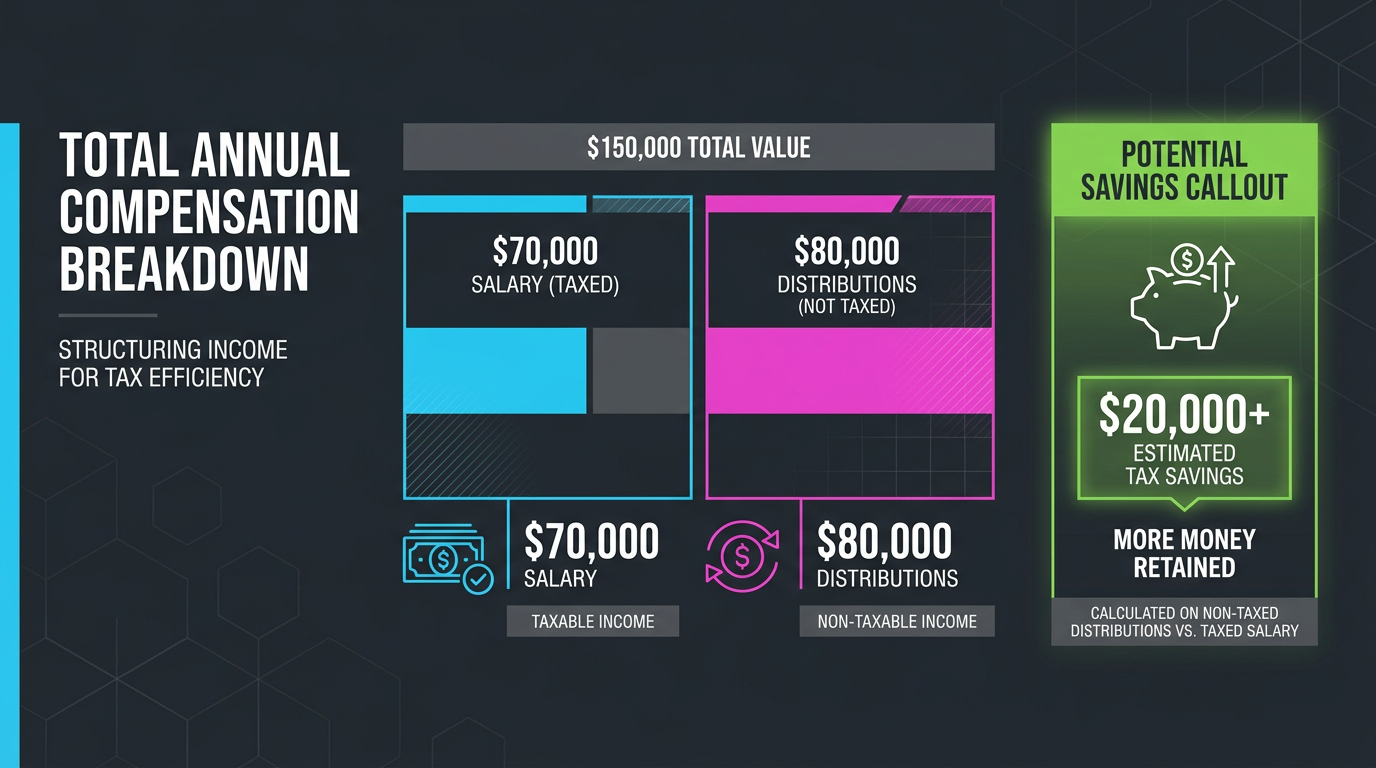
Say your business earns $150,000 in net profit. You pay yourself a $70,000 reasonable salary. The remaining $80,000 is taken as distributions.
Because payroll taxes apply to the salary but not the distributions, that structure can reduce payroll-tax exposure significantly. In this example, the potential savings exceed $11,000 per year.
Want to see what your specific numbers look like? The S Corp income threshold guide breaks it down by profit level.
Beyond Payroll Tax: More Deductions in Your Corner
Payroll-tax savings are often the headline benefit, but they're not the only advantage.
S Corp owners may also be able to deduct health insurance premiums, maximize retirement contributions through a Solo 401(k) or SEP IRA, claim home office expenses, deduct qualifying vehicle costs, and potentially benefit from the Qualified Business Income (QBI) deduction, which can reduce taxable income even further.
Setting your reasonable salary correctly is what keeps those savings compliant and sustainable over the long term.
Curious what the numbers look like for your business? An S Corp tax calculator can help estimate your potential savings before you file.
Common Form 2553 Mistakes and How to Avoid Them
A handful of Form 2553 mistakes trip up even the most organized solopreneurs. Spot them now, and your S Corp election stays on track, with your tax savings intact.
-
Filing after the deadline. The IRS requires Form 2553 no later than 2 months, and 15 days after the start of the tax year you want S Corp status to begin. For calendar-year businesses, that's typically March 15. For newly formed businesses, the same 2-months-and-15-days rule applies from the date the business is formed or begins operations. Miss the deadline, and you'll likely need to pursue late election relief to get back on track.
-
Entering the wrong effective date. Item E on Form 2553 determines when your S Corp election takes effect. Enter the wrong date,e and your election could apply to a different tax year than intended.
-
Missing shareholder signatures. Every shareholder must sign and date the consent section in Part I. For a solo business, that's usually just you. Missing signatures remain one of the most common reasons Form 2553 elections are rejected.
-
Filing without an EIN or sending the form to the wrong IRS address. Your Employer Identification Number must be listed before you file. Form 2553 must also be sent to the correct IRS service center for your state. The correct filing address varies by location, and mistakes can delay processing.
-
Skipping your state S Corp election. Some states require a separate state-level filing in addition to the federal Form 2553. Missing that step can leave you paying state taxes under different rules while still handling S Corp compliance requirements.
-
Not paying yourself a reasonable salary. Once your election is active, the IRS expects owner-employees to receive reasonable compensation for the work they perform. Setting your salary too low can attract IRS scrutiny and potentially eliminate part of the tax benefit. Follow reasonable salary guidance to establish a defensible amount.
The good news? Every one of these mistakes is avoidable. Lettuce can handle the filing process, effective-date calculations, and ongoing compliance requirements for you.
Form 2553: FAQs
Form 2553 questions have a way of piling up right when you're ready to move. Whether you're about to file or just got your approval notice, this Form 2553 FAQ has the straight answers you need to move forward with confidence.
What documents do I need before filing Form 2553?
You'll need your EIN, business formation documents (Articles of Incorporation or Organization), and shareholder information, including Social Security numbers. Have your operating agreement ready if you have one.
Can I file Form 2553 online?
The IRS does not offer online filing for Form 2553. You must mail or fax the completed form to the correct IRS service center based on your state. Keep a copy of your submission and note the date you sent it. Lettuce handles this for you, so you never have to track down a fax number or mailing address.
How long does it take the IRS to approve Form 2553?
Per the IRS instructions, processing takes about 60 days from the date the IRS receives your form. You'll receive a CP261 notice confirming your S Corp election. If you don't hear back within that window, contact the IRS directly to confirm receipt.
What if I made a mistake on my Form 2553?
For minor errors, like a misspelled name, a letter to the IRS is all you need. For bigger issues, like a wrong effective date, you'll need to refile with a corrected form and a brief explanation letter. The IRS also offers late election relief if a timing mistake affected your election.
Do I need to file a state S Corp election, too?
Most states automatically recognize your federal S Corp election. Some, including New York and New Jersey, require a separate state-level filing. Lettuce checks this for you during setup, so you're covered at the state level without having to research it yourself.
What is a reasonable salary for S Corp owners?
The IRS requires S Corp owners to pay themselves a salary that reflects what someone in a similar role would earn in your industry. Factors include your hours worked, business revenue, and the going rate for your services. Lettuce calculates this automatically based on IRS guidelines, so you always have a defensible number.
Can I file Form 2553 if my business has no income yet?
Yes, and filing early is actually a smart move. Your S Corp status locks in from the date your business was formed, not from when income starts. You just need your EIN in hand before you file.
How does Lettuce automate the S Corp election process?
Lettuce files Form 2553 as part of a setup process that takes about 10 minutes of your time. From there, the platform handles payroll, salary calculation, and ongoing compliance automatically, including year-end tax filings and audit defense.
Your S Corp Savings Are Waiting: Next Steps
One IRS form can unlock meaningful tax savings for years to come. By now, you know how to determine whether you're eligible, when to file, how to complete Form 2553 correctly, and which mistakes to avoid. And if you've already missed the deadline, late-election relief may still provide a path forward.
The reason Form 2553 matters is simple: S Corp status allows you to split income between salary and distributions, reducing the amount subject to self-employment taxes. For many solopreneurs earning $80,000 or more, that can translate into thousands of dollars in annual savings.
You've built a business worth protecting. Make sure your tax strategy reflects that.
Follow the Form 2553 step-by-step guide to file on your own, or let Lettuce handle it. From S Corp formation to payroll and ongoing compliance, Lettuce streamlines the entire process so you can focus on running your business.
Not sure how much you could save? Use the S Corp Tax Calculator to see your personalized savings estimate in minutes. And if the tax savings don't exceed your subscription cost, the Lettuce-Back Guarantee means you pay nothing.