
 Natalia Budyldina
1 min read
.png)
A 1099 error is a data-entry problem with a straightforward fix. The part worth building is a records system where payments are already categorized, W-9s are already collected, and a correction, if you ever need one, takes minutes.
A wrong dollar amount in Box 1 or a contractor's name spelled incorrectly is a data-entry problem, and the IRS correction process treats it as exactly that. Name the specific error, pull the payment records that prove the right answer, and refile. That's the whole job.
Here's the insight most solo business owners miss: IRS attention follows messy books, mismatched filings, and missing forms, not the fact that you run your business as an S Corp. A corrected 1099 backed by organized records is a routine administrative task, not a red flag. The real question isn't whether you can fix the form. It's whether your records are ready to support the fix without a reconstruction project.
Lettuce tracks contractor payments in real time, so your records are always ready when you need them.

Is Lettuce right for you?
See if Lettuce can help you keep more of what you earn with our short quiz.
Take QuizHow to Correct a 1099 Mistake
The mechanics of correcting a 1099 are not complicated, but the order matters, and skipping steps is usually how a small error turns into a bigger one. Here are 7 steps on how to do it right.
1. Verify Which Copy Is Wrong Before You Refile
Before you prepare anything, confirm exactly where the error lives. A 1099 has two distinct destinations: the recipient copy that went to your contractor and the Copy A that went to the IRS. The IRS correction rules treat them as a linked pair: if the IRS received bad information, your corrected filing has to match what that record should have said from the start.
Many manual filers skip this check and rush to reissue, which can create a second mismatch on top of the first. Pull the original form, compare it against your actual payment records, and confirm what was filed, then correct only what the evidence supports.
2. Fix A Wrong Dollar Amount With Your Payment Ledger First
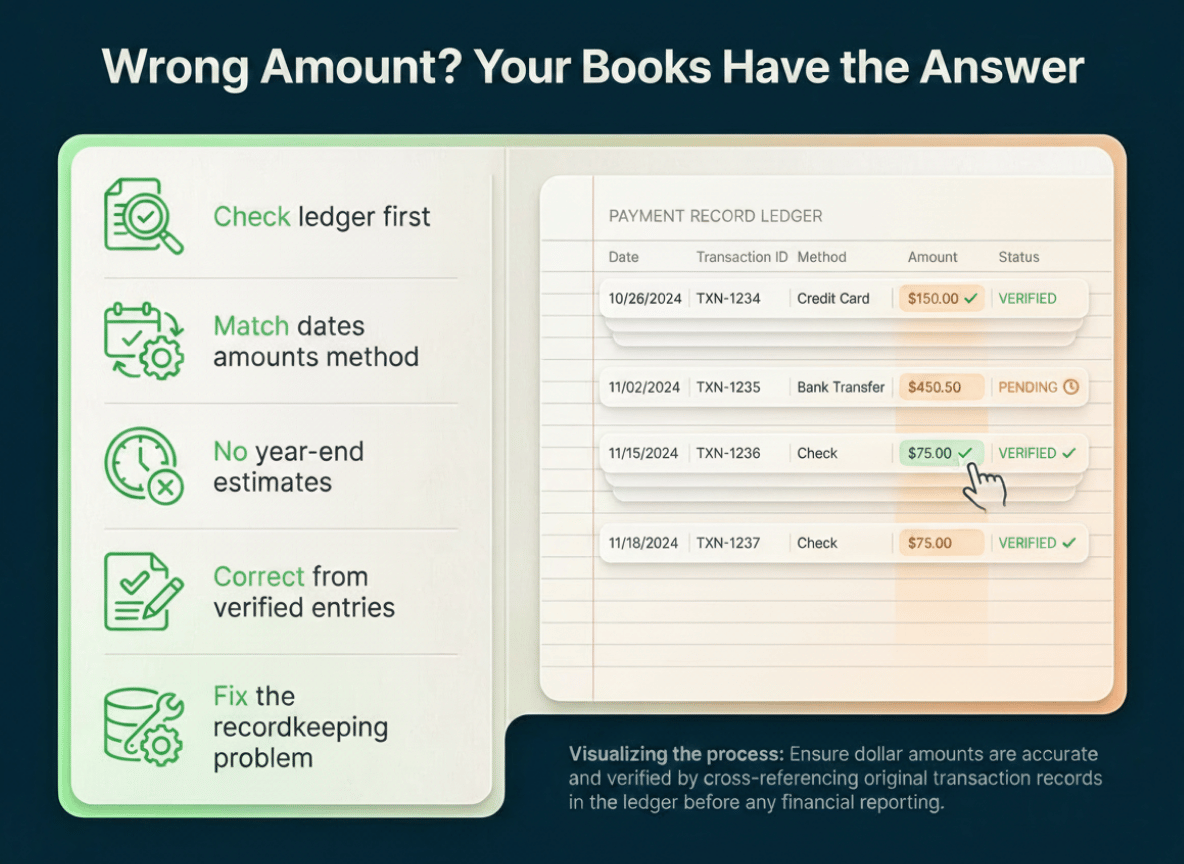
A wrong dollar amount on a 1099 rarely starts with the form itself; it starts in the books. Before you make any corrections, reconcile your actual contractor payments against your ledger. Per IRS guidance, verify payments with the source before estimating or refiling anything.
- Pull the real numbers first. Match every payment to your transaction records, such as dates, amounts, and method, before you fill in a single field on the corrected form.
- Never use a year-end estimate. Memory, email threads, and half-updated spreadsheets are how the original error happened; the correction amount should come from verified entries, not a best guess.
- Let a clean ledger do the heavy lifting. When your books are reconciled, the correction becomes a straightforward data entry task, not a forensic exercise.
- Treat the mismatch as a records signal. A wrong dollar amount is usually a symptom; disorganized contractor payment records are the underlying problem worth solving.
3. Correct A Bad TIN Or Name Before The Mismatch Compounds
An incorrect taxpayer identification number breaks the IRS's ability to match the form to the right contractor. When a name and TIN don't align, the IRS can issue a CP2100 notice and require you to begin backup withholding at 24% on future payments until a verified TIN arrives.
The clean fix starts with the W-9 on file. Pull the contractor's legal name and TIN directly from that document, cross-check it against your contractor records, and use that verified information consistently across your books and the corrected form. The IRS even offers a TIN Matching tool to validate name and TIN combinations before you refile. That small step keeps a clerical error from becoming a compliance chain reaction.
The deeper lesson: collecting a W-9 at onboarding (before the first payment clears) makes this a non-issue. Chasing contractor details in January, when the work is done and inboxes are slow, is where mismatches are born.
4. File The Corrected 1099-NEC The Same Way You Filed The Original
The IRS rule is clear: if you filed the original electronically, file the correction electronically. If you filed on paper, submit a corrected Copy A with a new Form 1096 and do not check the VOID box on the corrected return. Mirroring the original filing path keeps your correction tied to the existing record instead of creating a parallel thread that the IRS has to reconcile.
The mechanics are simple. Pull the original form, fix the specific field that was wrong, check the CORRECTED box at the top of the new Form 1099-NEC, and send updated copies to both the contractor and the IRS.
5. Move Fast Even Though There Is No Trophy For Waiting
Once you spot a 1099 error, the only smart move is to fix it now. IRS penalties escalate the longer a correction waits. More practically, your records, contractor emails, and payment details are all easier to verify today than they will be in three months.
Think of the 1099 filing deadline for corrections less as a single calendar event and more as a discipline: fix mismatches while the trail is warm.
- Correct it immediately. Delays do not reduce the error; they just make the supporting documentation harder to pull together.
- Keep your filing trail current. A promptly submitted correction shows the IRS that a business self-corrects, which is a very different signal than an error left to sit.
- Reframe the audit fear. S Corps are audited far less frequently than sole proprietors; the actual red flag is a known mistake you chose not to resolve.
- Act while memory is fresh. Contractor responses and payment confirmations are easier to gather before everyone has moved on to the next tax year.
6. Rebuild The Form From Contractor Payment Records, Not Guesswork
When you need to correct a 1099, your contractor payment records are what turn the process into a quick lookup instead of a guessing game. The IRS expects you to document the payee's identity, payment dates, totals, and method of payment, so if those details live in one place, the corrected form almost writes itself.
A dedicated business account and card keep that paper trail clean by default. When personal and business payments are mixed, you end up reconstructing what actually crossed the reporting threshold from memory, and that's how small errors compound.
7. Replace Year-End Scrambles With Automated Bookkeeping
Most repeat 1099 mistakes come from manual tracking that can't keep up. The IRS requires accurate aggregation of payee totals across the full year, and when payments live in scattered spreadsheets, that aggregation becomes a January guessing game.
When contractor payments are categorized in real time, you never have to reconstruct whether a payment in July pushed someone past the $600 threshold, since the record is already there. That's what makes automated bookkeeping for contractor payments a compliance tool, not just a convenience.
The smarter long-term fix isn't a better scramble next year. It's a system where every contractor payment is already categorized, every threshold is already tracked, and the correction, if you ever need one, takes minutes, not a morning.
Want your records, federal filings, and deadlines kept in one place? See how Lettuce helps you stay compliant automatically.
FAQs About Correcting A 1099 Mistake
Even a straightforward correction raises a few follow-up questions, and getting these details right the first time keeps your filing trail clean.
What backup documentation for 1099s should I keep before filing a correction?
Hold onto the original 1099 you filed, the contractor's W-9, bank records or payment confirmations that match the reported amount, and any correspondence about the error. Per IRS instructions, your corrected form needs to reflect what actually happened, and your supporting records are what prove it.
Do I need to send both the contractor and the IRS an updated copy?
Yes. A corrected 1099-NEC goes to both the recipient and the IRS. Skipping the contractor copy means they may file with inaccurate income information, which creates a downstream mismatch.
What if the contractor never gave me a correct W-9 or TIN?
Request a new W-9 immediately. If the contractor doesn't respond, backup withholding rules may apply to future payments. See the TIN correction step above for the full breakdown.
Can a 1099 correction draw IRS attention if my books are otherwise clean?
A single corrected form with clean underlying records is normal; the IRS processes corrections regularly. What tends to invite scrutiny is a pattern of mismatches, missing filings, or income that doesn't reconcile across forms, not a one-time fix supported by solid documentation.
Does a 1099 error mean my S Corp is at higher audit risk?
No. S Corps are audited far less frequently than sole proprietors, and a corrected 1099 doesn't change that. IRS attention follows disorganized records and unresolved gaps, not business structure.
Fix The Form Once, Then Fix The System
A 1099 correction is a manageable task. File the right form, update both the contractor and the IRS, and keep your documentation. What IRS attention actually follows is not business structure; it's disorganized records, mismatched income, and filings that were never sent at all. S Corps aren't the problem. Messy books are.
The real upgrade isn't a better correction process but a system where corrections are rarely needed. When contractor payments are categorized as they happen, W-9s are collected at onboarding, and every filing connects in one place, January stops being a reconstruction project.
Lettuce handles that system end-to-end. See how it works or sign up today and build the last structure you'll ever have to think about. And if the tax savings don't outpace your subscription cost, the Lettuce-Back Guarantee has you covered.