

 Alex Zelaya
1 min read

Accounting for real estate agents gets easier when you stop chasing deductions and start building a clean system. This guide walks you through separate banking, year-round tax planning, mileage and expense tracking, and simple automation so you always know what you earned, what you owe, and when an S Corp may make sense.
Accounting for real estate agents gets easier when you stop chasing deductions and start building a clean system. This guide covers separate banking, tax planning, mileage tracking, and automation so you always know what you earned, what you owe, and when an S Corp may make sense.
The IRS classifies licensed real estate agents as statutory nonemployees, meaning no employer withholds taxes, cleans up your books, or tracks your mileage. Every commission check lands as gross income, and what happens next is up to you.
Quick definitions: bookkeeping is recording income and expenses; commingling is mixing personal and business money in the same account; quarterly estimated taxes are the payments self-employed professionals make four times a year; and an S Corp is a tax election that can reduce self-employment tax once income is consistent.
Lettuce is built for solo agents who want all of this running on one platform, without the year-end scramble.

Curious if an S Corp is right for you?
Try the Lettuce Tax Calculator to see how much more you can take home each year.
See your savingsWhy Real Estate Agent Accounting Needs A Different Playbook
Most accounting advice assumes predictable paychecks and employer withholding. Real estate agents work differently: commission checks land when deals close, not on a schedule. The gap between a strong sales month and what you actually owe the IRS is where most agents get caught off guard.
Accounting For Real Estate Agents, Broken Into 10 Habits
Accounting for real estate agents doesn't require a finance background. It requires a system you actually follow every month, built around the way commission income really works. Here are the 10 habits that make up that system, starting with the mindset shift that makes everything else easier.
1. Treat Your Real Estate Work Like a Business From Day One
About 87% of NAR members operate as statutory nonemployees, so the recordkeeping that feels personal is actually the industry standard. Agents who see themselves as business owners, not just salespeople, keep cleaner books, open dedicated accounts earlier, and think about taxes before closing funds rather than after.
2. Open a Dedicated Business Bank Account Before Anything Starts Mixing
A dedicated business account is the first real infrastructure decision you make as a 1099 agent. The SBA recommends opening one as soon as you start accepting or spending business funds. Commingling muddies deductions, makes cash flow harder to read, and weakens liability protection. The SBA recommends that you open a business checking account as soon as you start accepting or spending business funds.
Lettuce treats the business bank account as the center of the system: commission income routes in, taxes are set aside automatically, payroll runs through it, and bookkeeping stays current. See exactly how to open a business bank account.
3. Track Mileage and Vehicle Costs While You Drive, Not at Year-End
Every qualifying mile driven for business can be deducted, and the 2026 standard mileage rate sits at 72.5 cents per mile, meaning 10,000 business miles is worth $7,250 before you've touched a receipt( The IRS announced a mid-year increase effective July 1, 2026, due to higher fuel costs. As a result, the business mileage rate increased from 72.5 cents to 76 cents per mile for miles driven on or after July 1, 2026.) Log trips as they happen (IRS Publication 463 favors contemporaneous records), separate commute miles from business miles, and choose between the standard rate and actual expense method deliberately, since the choice affects later years.
4. Plan for Quarterly Estimated Taxes Before the IRS Plans for You
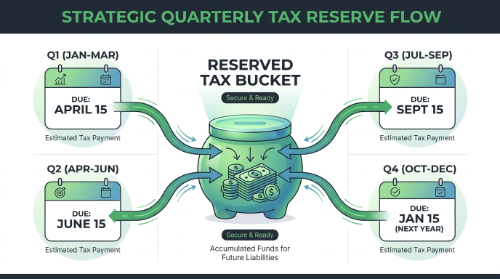
Estimated taxes are due April 15, June 15, September 15, and January 15, and underpaying even one period can trigger a penalty regardless of your final return. Set aside 25% to 30% of each commission as it lands, keep that reserve separate from operating cash, and revisit your estimated payment each period since lumpy income can push liability higher than expected. If you're running payroll through an S Corp, monthly withholding replaces the quarterly cycle, though distributions may still need attention (S Corp quarterly taxes have the mechanics).
5. Learn Which Real Estate Expenses Usually Count as Deductions
MLS dues, association fees, marketing, staging, signage, and business-use phone or internet are typically deductible if ordinary and necessary. A home office may qualify, too, using either the simplified method ($5/sq ft, up to 300 sq ft) or actual expenses under Publication 587. Publication 463 also sets strict standards for vehicle use, meals, and client gifts, including a $25-per-recipient cap.
6. Time Commission Income Carefully When a Closing Lands Near Year-End
Under the IRS constructive receipt rule, a commission is taxable in the year it becomes available to you, even if the wire lands on December 30th. That one deposit can shift your tax bracket and self-employment tax owed. You can't delay a payment you could have received to dodge taxes (Publication 334), but you can talk to a tax professional before a late closing settles, so you can adjust estimated payments or revisit your team leader tax structure in time.
7. Look at an S Corp Election Once Income Becomes Consistent
An S Corp is worth exploring once net income is consistently high enough to justify the payroll and compliance it adds, typically starting around $80,000 to $100,000 for solo agents, though state tax treatment and income predictability matter too. The IRS requires shareholder-employees to pay themselves a reasonable salary before taking distributions, so get banking and bookkeeping clean first, then evaluate the math.
8. Stop Running a Commission Business on Spreadsheets Alone
Spreadsheets crack under a full year of lumpy deposits, broker splits, referral fees, and recurring costs. Dedicated bookkeeping software keeps categories consistent, surfaces real-time profit, and cuts year-end cleanup. Lettuce combines AI-powered transaction categorization with automated income separation, so bookkeeping runs in the background instead of becoming a quarterly project.
9. Talk to a Tax Professional Before Tax Season, Not During Cleanup
A November conversation still gives you room to adjust quarterly payments, review year-end commission timing, and weigh an S Corp election; by April, most choices are already made for you. The IRS also allows an annualization option for uneven income, and reasonable compensation for S Corp owner-employees is assessed on substance, so getting that number right before year-end matters. This year-end checklist is a solid place to start.
10. Build an Accounting System You Will Actually Follow Every Month
A simple monthly rhythm beats a complex system you abandon: one business account for commission income, automatic tax set-asides, and a consistent place to log mileage and receipts. The SBA recommends starting with that dedicated account and business card, because separating business and personal finances makes every workflow downstream easier to maintain.
FAQ About Accounting For Real Estate Agents
Real estate agent accounting questions tend to cluster around the same handful of decisions: banking, taxes, mileage, deductions, and structure. The answers below cut straight to what actually matters for a 1099 agent running a business-of-one.
Do I need a separate business bank account if I am a sole proprietor real estate agent?
Legally, no. Practically, yes. Commingling personal and business funds makes expense tracking unreliable and deductions harder to support. A dedicated account gives you cleaner books from the start, which pays off every month, not just at tax time.
How do quarterly estimated taxes work for a 1099 real estate agent?
The IRS treats licensed real estate agents as self-employed, so no employer withholds taxes for you. You pay estimated taxes four times a year using Form 1040-ES. A practical starting point is setting aside 25% to 30% of each commission. Lettuce's guide to estimated quarterly payments walks through the deadlines and math in plain terms.
Should I use the standard mileage rate or actual vehicle expenses?
It depends on your situation. The standard mileage rate is simpler and works well for high-mileage years. Actual expenses can produce a larger deduction if you drive a more expensive vehicle with high operating costs. IRS Publication 463 covers both methods and what records you need to support either one.
What expenses can real estate agents usually deduct if eligible?
Common deductions include MLS dues, association fees, marketing and advertising costs, E\&O insurance, staging, signage, a business-use phone or internet line, and a qualifying home office. Eligibility depends on whether each expense is ordinary and necessary for your business. Lettuce's breakdown of real estate agent tax deductions covers the full list with context.
When should an independent real estate agent start looking at an S Corp?
The conversation tends to make sense once net income is consistently in the $80,000 to $100,000 range, though your state rules and income pattern matter too. Below that threshold, the added payroll and compliance costs can outweigh the self-employment tax savings. Get clean books and separate banking in place first, then explore whether the structure fits. Lettuce can help you run those numbers.
Get The Basics Right First, Then Look For Bigger Savings
The agents who feel most in control aren't chasing one more deduction. They're running a clean business account, keeping books current, and building tax habits that make every commission decision easier.
Once that system is in place, it's worth seeing whether an S Corp makes sense for your income level, and with the Lettuce-Back Guarantee, there's little risk in finding out. See what that structure could look like at Lettuce.
