 Natalia Budyldina
1 min read

Income tax by state isn't one-size-fits-all, but for solopreneurs, the real challenge isn't your state's category. Whether you're in a no-tax, flat-tax, or progressive state, quarterly payments and the 15.3% self-employment tax still apply. Lettuce automates it all through payroll, so compliance happens without you lifting a finger.
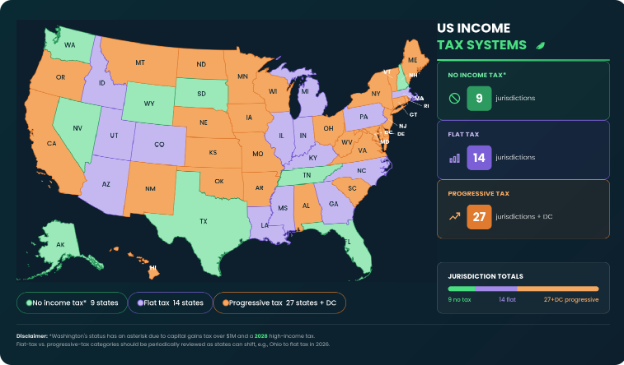
Most solopreneurs assume that income tax by state follows one universal rule. It doesn't. The Tax Foundation identifies three distinct state systems: no income tax, flat tax, and progressive brackets. Which category your state falls into shapes how you handle quarterly estimated taxes throughout the year.
Forget memorizing rates or brackets. Knowing your state's category is what actually matters for your planning.
Lettuce automates federal and state tax payments every month through payroll. You stay current no matter where you operate. Take the guesswork out of state taxes with Lettuce.
Curious if an S Corp is right for you?
Try the Lettuce Tax Calculator to see how much more you can take home each year.
See your savingsNo-Income-Tax States: Simpler, But Not Tax-Free
For solopreneurs, no-income-tax states like Texas and Florida can look like an easy win on paper. According to the Tax Foundation, nine states fall into this category: Alaska, Florida, Nevada, New Hampshire, South Dakota, Tennessee, Texas, Washington, and Wyoming. The catch? Most of these states offset the gap with higher sales taxes, property taxes, or entity-level fees, which are taxes your business owes directly. Before locking in your state strategy, check the S Corp fees by state to see your real tax picture.
Washington is the clearest example of why the label doesn't tell the whole story. The state levies a capital gains tax of 7% on gains above $270,000 (2025 figure, updated annually), which can affect solopreneurs who sell business assets. Texas tells a similar story: no personal income tax, but S Corp owners still face a franchise tax at the entity level. The Texas comparison breaks down exactly what that means for solo business owners.
Flat-Tax States: One Rate, Less Math
Fourteen states use a flat income tax, and for flat tax states for self-employed professionals, that consistency removes the guesswork. Per the Tax Foundation, everyone pays the same percentage, whether earning $80,000 or $250,000. Think Colorado, Arizona, and Georgia. Colorado applies a flat 4.40% to all taxable income, no matter how much your business grows. No bracket jumps, no surprises.
That simplicity pays off at tax time. Your quarterly obligation stays the same, no matter how much income rises. You don't need to memorize brackets or phase-in schedules. Just confirm your state falls into this category. Then run your numbers through the Tax Calculator to see exactly where you stand.
Progressive-Tax States: Brackets That Rise With Your Income
Progressive state income tax brackets cover the most ground in the U.S., and there's a good chance your state is one of them. According to the Tax Foundation, 27states plus DC use graduated rates, meaning your rate increases as your income rises. Think of it like the federal system you already know. California's top rate hits 13.3%, while Hawaii uses 12 separate brackets. Earn more, pay a higher rate. That's the rule across the board.
Good news: you don't need to memorize any of it. A bigger income means a bigger slice goes to the state. That's why how much to set aside for taxes needs to reflect your bracket, not just your gross income. The same goes for your quarterly estimated payments, especially when income spikes mid-year. Most solopreneurs are already in this system. Knowing that is half the battle.
Why Your State's Category Matters Less Than You Think
Your state's tax category tells you the rate. It doesn't tell you what actually causes tax problems for solopreneurs, and that gap is where most people get tripped up.
When it comes to state income tax for solopreneurs, one rule applies everywhere: no employer is withholding taxes on your behalf. The IRS requires estimated payments four times a year once you expect to owe $1,000 or more, and most states mirror that same schedule.
- Quarterly estimated taxes are required whether you live in a no-tax, flat-tax, or progressive-tax state.
- Missing quarterly tax deadlines or underpaying triggers penalties that compound with each quarter.
- Per the Tax Foundation, state rates range from 0% to over 13%, but quarterly payment obligations apply across all.
- With Lettuce running payroll monthly, both federal and state payments go out automatically, no tracking required.
The underpayment penalty is entirely avoidable in self-employment. Once quarterly payments are handled automatically, the next question worth asking is why 15.3% follows you no matter which state you're in.
The Bigger Tax Lever: Self-Employment Tax Hits Everyone
Every solopreneur pays a self-employment tax rate of 15.3% on net profits, no matter which state they're in. That breaks down to 12.4% for Social Security (capped at $184,500 for 2026) and 2.9% for Medicare with no cap. For a solopreneur earning $100,000 in profit, that's $15,300 going to federal payroll taxes before state income tax even enters the picture. No state system changes this math.
That 15.3% is exactly what an S Corp election targets. With an S Corp, income splits between a reasonable salary and owner distributions, with SE tax applying only to the salary. For most solopreneurs earning $80K+, that shift saves thousands more than any difference in state income tax rates. The self-employed tax brackets guide shows exactly how the numbers stack up.
How Lettuce Handles It, Whichever State You're In
Whatever state you call home, the compliance process is the same: calculate what you owe, set it aside, and pay on time. The IRS confirms that payroll withholding can satisfy your estimated tax obligations, which is exactly how Lettuce is built.
Automated estimated tax payments through Lettuce's monthly payroll mean you never have to calculate, schedule, or send a payment yourself. Federal and state obligations are handled together.
- The Lettuce payroll system runs on the 10th of every month, automatically withholding federal and state taxes.
- The real-time dashboard shows what's been withheld, what's been paid, and what's due next.
- No quarterly deadlines to track, no reminders to set, no penalties to worry about.
- Your Salary & Taxes account (a dedicated Lettuce account) reserves funds automatically, so you're never caught short.
- Running as an S Corp through Lettuce means payroll handles withholding that sole proprietors must calculate manually.
The specifics of your state's system matter far less than having a process that runs without you. If you're wondering how this applies to your situation, the most common questions are answered just ahead.
FAQ: State Income Tax and Quarterly Payments for Solopreneurs
State tax rules vary more than most solopreneurs expect, and the wrong assumptions can cost you at filing time. The answers here focus on what actually affects your bottom line: which states tax income, how quarterly payments work, and what changes when you operate as an S Corp.
Which states have no personal income tax for solopreneurs?
As of 2026, nine states have no broad-based personal income tax: Alaska, Florida, Nevada, New Hampshire, South Dakota, Tennessee, Texas, Washington, and Wyoming. The Tax Foundation's 2026 breakdown is the best place to verify your current status, since rules do change. Checking it annually takes 30 seconds and keeps your planning accurate.
How do I know if my state uses a flat, progressive, or no income tax system?
The Tax Foundation's full 2026 state-by-state guide is an annual summary of every state's structure. Your home state's department of revenue website is another reliable source. If you're unsure, searching your state's name alongside "income tax rate" will confirm which category applies and what rate or brackets to expect.
Do I still have to pay quarterly estimated taxes if my state has no income tax?
Yes. Self-employed quarterly estimated taxes are still required at the federal level if you expect to owe $1,000 or more. Lettuce's estimated tax guide walks through how to calculate that. Living in a no-income-tax state removes the state layer, but your federal obligation stays the same. States like New York maintain their own separate estimated payment requirements.
Does an S Corp change how state taxes work for me?
An S Corp doesn't eliminate state income tax, but it does change how your income is structured and taxed. You pay yourself a W-2 salary and take the rest as distributions. Some states charge entity-level fees or minimum taxes separate from income tax.
How does Lettuce keep up with changing state tax laws and categories?
The platform tracks federal and state tax rule changes automatically. If a state adjusts its rate or bracket structure, the system reflects it before your next payroll runs. When payroll runs through Lettuce, withholdings are calculated using current rates for where you operate. You don't need to track legislative changes or update anything yourself.
Your State Is Just the Start, Let Lettuce Handle the Rest
When it comes to income tax by state, your state's tax category is a solid foundation. But quarterly obligations and how you pay yourself as an S Corp owner move the needle more.
State income tax rates shift more often than you'd expect. Always check your state's current rules before filing. The S Corporation Tax Calculator shows your actual numbers by income and state, revealing your savings before you commit.
Backed by the Lettuce-Back Guarantee, see how Lettuce works and keep your payments current, your filings accurate, and your focus on growing your business.
Note: Rates current as of June 30, 2026. Always verify before filing.