
1 min read

AI handed one person the keys to a whole company. It didn't hand them a finance team. Here's the gap, and how to close it.
Something remarkable happened while everyone was arguing about whether AI would take our jobs: it started helping people build their own.
A single person can now do what used to take a founding team: size a market, ship the product, run the marketing, and close the deals. The proof is in the data. Stripe Economics reports that AI-influenced business sign-ups are running roughly four times the share they were a year earlier. This isn't a trend. It's a structural shift in who gets to start a company.
But there's one job AI quietly left on the table. It can build your business. It can't manage your money. And the more successful you get, the more that gap costs you.

Is Lettuce right for you?
See if Lettuce can help you keep more of what you earn with our short quiz.
Take QuizHow AI became the solopreneur's entire team
For a long time, “solopreneur” carried a quiet asterisk: a nice lifestyle, maybe, but not a real business. The numbers erased the asterisk. If you're newer to the solo path, start here.
By 2023, roughly four million Americans were already earning their primary income as solopreneurs, pulling in over $100,000 a year, up from around two million a decade earlier. And the growth is steepest at the top: more than twice as many solopreneurs earned over $1 million in 2025 as in 2023, and close to three times as many crossed the $5 million and $10 million marks.
What changed? AI filled the capability gaps that used to force you to hire. The reason companies were historically built by teams is that no single person had every skill the job required. Now, AI and AI-powered software cover a startling amount of that surface area. Or, as Sam Altman put it, this is the “revenge of the idea guys”: the person with the vision no longer has to go find the person with the execution.
This is a genuine economic revolution, and if you're in it, you should feel proud. But scaling a business alone changes something most people don't see coming.
What a $200K, $500K, or $1M solo business actually looks like
Here's the part nobody warns you about at the milestone. The moment you cross into serious revenue, your financial complexity starts compounding faster than your income.
It starts at the baseline. When you work for yourself, you owe self-employment tax of 15.3% (12.4% for Social Security, 2.9% for Medicare), and you pay both the employee and employer halves. A W-2 employee splits that bill with their employer. You don't. On $100,000 of net profit, that's roughly $14,129 before a dollar of income tax. (Here's how to bring it down, and where your tax bracket actually lands.)
Then it layers. Multiple income streams. Variable monthly revenue. Deductible expenses scattered across software, travel, equipment, and a home office. Quarterly estimated tax payments that the IRS requires the moment you expect to owe $1,000+, and if you miss one, interest accrues at 7% (as of Q3 2026, a rate that resets every quarter and compounds daily). At $200K or $500K in revenue, a mistimed quarter isn't a rounding error. It's real money.
You have the tools to market, build, and sell. What almost no solopreneur was handed is the financial playbook that big companies take for granted.
The one thing AI can't do for you
Here's the honest pivot, and it's worth being precise about, because it isn't anti-AI.
AI is extraordinary at generative work. It writes, codes, designs, and researches at superhuman speed. But tax management isn't generative. It's predictive, personal, and consequential. Getting it wrong doesn't waste a draft. It costs you money and triggers penalties.
AI can write your pitch deck. It can't tell you what to set aside for your Q3 estimate — or what you'll owe when your biggest client pays late.
A general-purpose AI tool has no line of sight into your actual finances, no awareness of your filing deadlines, no model of your specific tax situation, and no accountability if it's wrong. This is a different problem than the one chatbots solve, which is why AI built for taxes has to work differently. The 15.3% self-employment problem isn't something you can prompt your way out of. Navigating it legally requires the right structure, which brings us to the single most expensive decision most solopreneurs never make.
The $10,000 problem: your business structure
Most solopreneurs operate, by default, as a sole proprietor or single-member LLC. Which means 92.35% of profit runs through that full 15.3% self-employment tax. It's the leakiest bucket there is, and it's exactly why a business-of-one earning over $100,000 is often overpaying by $10,000 or more a year, simply by default.
The fix isn't a loophole. It's an S Corp election, the same structure Fortune 500 companies and law firms use. An S Corp lets you split your income into two buckets: a reasonable salary (which pays self-employment tax) and owner's distributions (which don't). If you're a freelancer wondering whether it applies to you, here's how the math works.
Here's the mechanism in round, illustrative numbers. A solopreneur netting $150,000 as a sole proprietor pays self-employment tax on nearly all of it: roughly $21,194. As an S Corp paying a $70,000 reasonable salary and taking $80,000 in distributions, self-employment tax applies only to the salary, roughly $10,710. That's over $10,000 a year that stays in your pocket, before income tax even enters the picture. (Illustrative only. Your real number depends on your income, state, and a defensible salary. Run yours below.)
Structure is the biggest lever, but it's not the only money on the table. The deductions solopreneurs most often miss:
-
Home office — a proportional share of rent, utilities, and internet for a space used exclusively for work. (The “it triggers an audit” fear is largely a myth.)
-
Self-employed health insurance — up to 100% of premiums for you, your spouse, and dependents, deductible from your income. (Lettuce covers this, too.)
-
Retirement — a SEP-IRA or Solo 401(k) can shelter tens of thousands in pre-tax contributions. The earned-income rules are more nuanced than most people think.
-
Business expenses — software, equipment, professional development, contractor payments, travel. Deductible with clean records. Here are the most overlooked ones.
The S Corp is a structural fix. The deductions are the annual tune-up. At $100K–$500K, doing both right is frequently the difference between keeping your money and quietly handing it back.
Lettuce is the financial layer your stack was missing
You've already built the AI layer for operations: marketing, code, and content. What's missing is the financial layer. That's Lettuce.
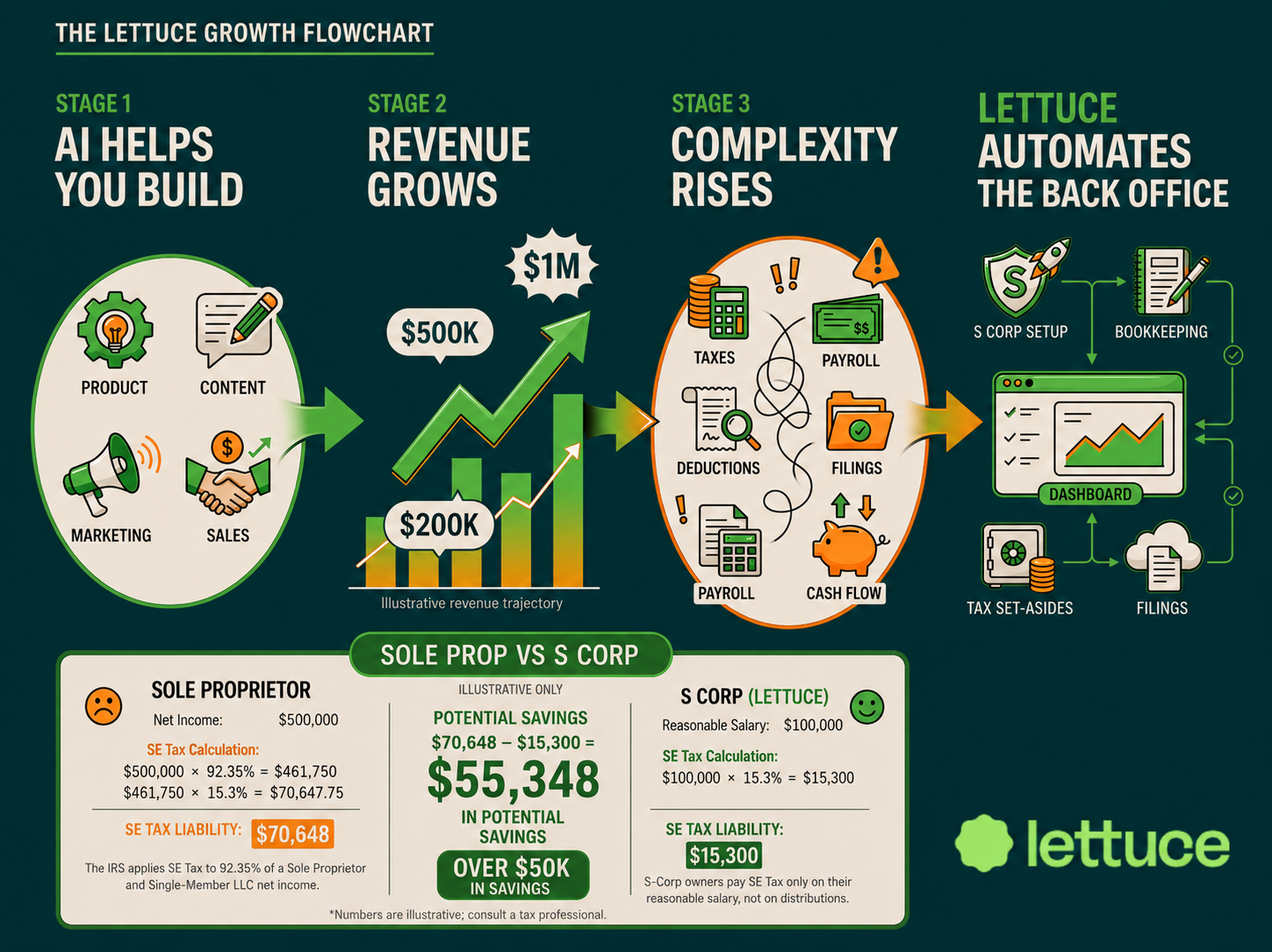
To be clear about what it is: Lettuce is an automated tax and accounting system built specifically for businesses-of-one. Not a human accountant on the other end of a chat. A purpose-built digital product powered by automation and AI, running year-round. It does what a general tool can't:
-
Sets up your S Corp and handles the paperwork
-
Automates bookkeeping by connecting to your business bank account, no manual tracking
-
Runs payroll (required once you're an S Corp)
-
Sets aside and auto-pays your quarterly taxes from each payment that comes in, no more April surprises
-
Prepares your business return (Form 1120S and your K-1)
-
Gives you a real-time dashboard of income, expenses, and what you're saving, plus LettuceHead AI for tax questions, 24/7
The timing matters. Stripe's data shows the newest cohorts of solo businesses are hitting seven figures faster than any cohort before them, which means the financial complexity is arriving faster, too. Lettuce is built for exactly that moment, and it backs its work with the Lettuce Savings Guarantee: meet or exceed your estimated savings, or your money back.
“With Lettuce, I'm keeping more of every dollar I earn. The ROI speaks for itself.” — Brenden Grace, Fractional CTO
Frequently Asked Questions
What's the difference between a sole proprietor and an S Corp for tax purposes?
As a sole proprietor, 92.35% of your net profit is subject to the full 15.3% self-employment tax. As an S Corp, you split your income into a reasonable salary (which is subject to self-employment tax) and owner distributions (which aren't), which is what creates the tax savings.
How do I know if my business is big enough for an S Corp election?
The S Corp structure tends to pay off once net profit is consistently above roughly $60,000–$100,000 a year. Below that, the added payroll and compliance costs can outweigh the tax savings. Running the numbers on a calculator with your actual income and state is the fastest way to check.
Does Lettuce replace a human accountant?
No. Lettuce is an automated tax and accounting system, purpose-built for businesses-of-one, that handles S Corp setup, bookkeeping, payroll, quarterly tax payments, and your business tax return. It's not a human on the other end of a chat; it's software running year-round, backed by the Lettuce Savings Guarantee.
The idea guys won. Now keep what you built.
AI didn't just help solopreneurs. It changed what one person can build. That's worth celebrating.
But every business that scales needs a financial layer, and a business-of-one is no exception. The question is no longer whether you can build a $500K or $1M company alone. It's whether your financial management is keeping pace with your revenue.
AI built the solopreneur economy. Lettuce helps you keep what you earn in it.
See what your structure is really costing you.
Enter your income, state, and filing status, and the free S Corp Tax Calculator shows your estimated savings in under a minute.
Not sure if Lettuce is right for you? See how it works.
