
 Alex Zelaya
1 min read

Projected income statements turn your pipeline, rates, and expenses into a real-time profit forecast, so you always know where you stand. Platforms like Lettuce keep these numbers current automatically, no spreadsheets required. For S-corp solos, that means sharper salary and distribution decisions, plus bigger tax savings.
Most solopreneurs make pricing and owner pay decisions using back-of-the-envelope math and crossed fingers. You quote a project rate, hope it covers expenses, and wonder if you can afford that owner distribution. Projected income statements flip this script by turning your pipeline, rates, and known expenses into a rolling profit outlook you can act on weekly.
You'll learn what to include in your forecast, how AI-powered bookkeeping keeps it current without manual updates, and a 59-minute framework to build your first financial outlook.
Plus, how platforms like Lettuce convert your projections into automated, reasonable salary calculations, monthly tax withholdings, and owner distributions through their S-corp calculator. Stop guessing and start steering your solo business with confidence using Lettuce.

Is Lettuce right for you?
See if Lettuce can help you keep more of what you earn with our short quiz.
Take QuizWhy Projected Income Statements Beat Back‑of‑the‑Envelope Math
Stop wondering if you can afford that new contractor or whether to raise your rates. The benefits of projected income statements become clear when you see how they transform scattered pipeline data into actionable insights that guide every business decision you make.
Your Financial Command Center, Not Corporate Homework
A projected income statement is simply a forward-looking profit and loss statement that forecasts your revenue, expenses, and profit by week or month. Think of it as your financial command center rather than an accounting exercise. Instead of reacting to last month's numbers, you steer based on what's coming.
When a client asks for a proposal discount, you know exactly how it affects your bottom line. When you're considering a new software subscription, the impact on your projected profit is clear before you commit.
Solo-Specific Numbers That Actually Matter
Corporate projections track departments and overhead allocations. Your projections track what matters to a business-of-one: signed contracts, likely wins, utilization rates, and owner pay. Connect your proposals and retainers directly to near-term profit projections.
If you're billing $150 per hour and targeting 25 billable hours weekly, your revenue projection shows $3,750 per week. Factor in your known expenses, and you see exactly what's left for owner distributions and tax set-asides. No corporate fluff, just the numbers that drive your decisions.
For S-Corp Solopreneurs, Projections Become Even More Strategic
When you operate as an S-Corp, projections become even more strategic because they inform your reasonable salary calculation and tax strategy. Lettuce uses your projected income to calculate monthly payroll withholdings automatically, so you're never scrambling to cover quarterly taxes.
Your projections also guide the timing of owner distributions: take them when cash flow is strong, hold back when a lean month is coming. This real-time approach replaces guesswork with projection-powered decisions that keep you compliant and profitable.
From Data to Decisions: Real‑Time Forecasts With AI‑Powered Bookkeeping
The best projected income statements update themselves. When your bookkeeping runs on autopilot, your forecasts stay live without manual data entry or spreadsheet gymnastics.
Smart bookkeeping platforms transform how solopreneurs build and maintain financial projections:
-
Connect bank feeds once — transactions import and categorize automatically, keeping expense baselines up-to-date
-
See 75 days ahead — the sweet spot for solos to align signed contracts and pipeline with known costs without enterprise complexity
-
Track cash flow in real-time — rolling forecasts show exactly when money hits your account
-
Split income automatically — platforms like Lettuce allocate funds for salary, taxes, and owner distributions as revenue arrives
-
Eliminate spreadsheet drift — automated categorization maintains 99%+ accuracy without manual updates
Your projected income statement becomes a live dashboard instead of a monthly homework assignment. When your bookkeeping stays current, your business decisions stay sharp.
Build Your First Forecast in 59 Minutes: A Simple Solo Framework
Learning how to create a projected income statement doesn't require an MBA or complex software. The SBA recommends lean business plans that take about an hour to complete, focusing on monthly projections for year one.
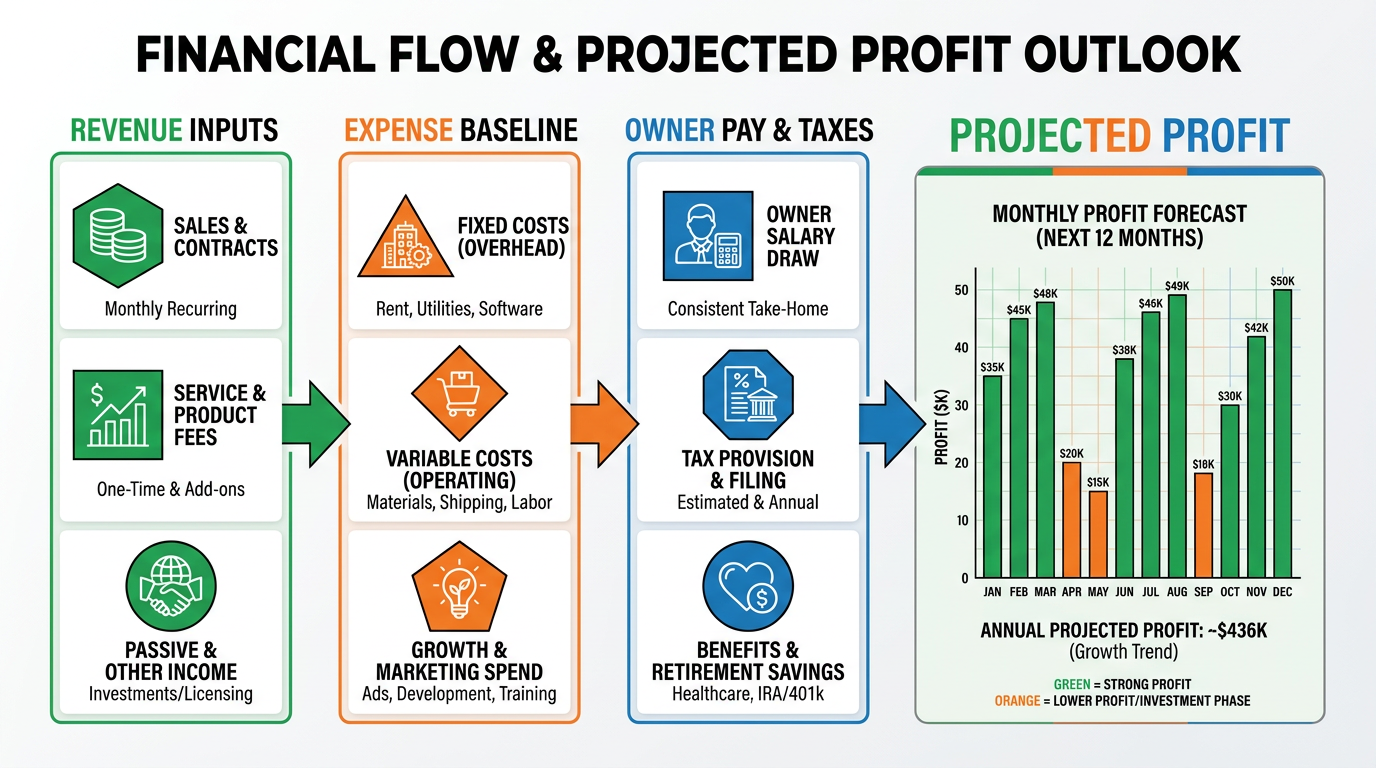
Start with these core components to create a rolling forecast that guides your business decisions:
-
Map signed contracts and pipeline: List confirmed work with delivery dates, plus likely wins with realistic close probabilities.
-
Lock in your expense baseline: Capture fixed costs monthly, then add variable spend like ads, contractors, and planned tool investments.
-
Calculate owner pay and tax impact: Choose your reasonable salary based on IRS guidelines, then model monthly payroll taxes and withholdings.
-
Model rate increases of 10-20%: Quantify the profit impact of pricing changes before you quote your next project.
-
Track cash timing, not just revenue: Account for payment terms, retainer schedules, and seasonal client patterns in your monthly flow.
With organized expenses and clear revenue assumptions, your forecast becomes a decision-making tool that stays current through AI-powered bookkeeping. No more guessing about pricing changes or owner distributions.
Frequently Asked Questions (FAQs): Projected Income Statements for Solo Business Owners
You've built the framework, now here are the implementation details that turn real-time projected income statements for solo business owners into your business control panel.
How do projected income statements help with tax planning and maximizing deductions?
Projected income statements let you model deduction timing and impact before you spend. Plan home office expenses ($1,500 max annually), vehicle mileage at $0.70 per mile, and retirement contributions to see exactly how they affect your bottom line and tax liability.
Can automated financial dashboards replace spreadsheets for tracking projected income and expenses?
Yes, when they connect to live bank feeds and categorize transactions automatically. Lettuce's dashboard shows real-time profit projections and separates what's set aside for S-Corp payroll versus what you can distribute. Your numbers stay current automatically, so you focus on decisions, not data entry.
What's the best way to handle variable income without overcomplicating the model?
Give each prospect a close rate (90% for verbal commitments, 50% for submitted proposals) and build three versions of your forecast: conservative, likely, and optimistic. Focus on the 90-day rolling view to balance accuracy with actionable planning.
How do S-Corp elections change projected income statement planning?
S-Corps require reasonable salary planning, which affects your projections significantly. You'll model monthly payroll, employment taxes, and owner distributions separately. Lettuce automates this split, calculating your salary per IRS guidelines.
When should I update my projected income statements?
Update weekly for pipeline changes and monthly for actual results. Real-time bookkeeping keeps your baseline current automatically. Major shifts like landing new retainers, raising rates, or changing tax strategies warrant immediate model updates to maintain accuracy.
Turn Projections Into Paychecks: Put Your Forecast on Autopilot
A projected income statement transforms your solo business from reactive to strategic. Instead of wondering whether you can afford that new contractor or when to pay yourself, you have a rolling forecast that connects pipeline to profit. Your numbers become a control panel for pricing decisions, owner pay timing, and tax planning. But projections only matter when they drive action.
The real power comes when your forecast drives streamlined operations. With S-Corp payroll running monthly, your projected income flows into reasonable salary calculations and tax withholdings. The IRS requires S Corp owners who work in their business to receive wages. But systematic withholding through payroll eliminates quarterly estimated payments and year-end surprises.
Most solopreneurs who switch to AI-powered bookkeeping save $8,000+ in taxes annually and save 20+ hours monthly that used to go toward manual financial tracking. Your forecast becomes the foundation for hands-off salary, tax withholdings, and owner distributions based on live data.
Ready to put your forecast on autopilot? Lettuce handles the entire financial back-office so you can focus on what drives those projected numbers up.
