

 Alex Zelaya
1 min read
%20(1).png)
Real estate agent independent contractors face their biggest tax gap when they treat commissions like a paycheck. This guide shows you how to handle 1099 income like business revenue, combine deductions with an S Corp strategy, and set aside taxes automatically so uneven commissions turn into steady, compliant payments.
Yes, the IRS treats licensed real estate agents as statutory nonemployees, meaning you're self-employed for all federal tax purposes. That means a 15.3% self-employment tax on net income, quarterly payments with no employer withholding, and deductions you have to track yourself. This guide covers how 1099 taxes work, staying current on quarterly payments with uneven commissions, which deductions matter most, the 20% QBI deduction, and when an S Corp starts to pay off.
If you'd rather skip the guesswork and automate the whole system, Lettuce is built specifically for commission-based agents who want their tax strategy running in the background while they focus on closing deals.

Is Lettuce right for you?
See if Lettuce can help you keep more of what you earn with our short quiz.
Take QuizAre Real Estate Agents Independent Contractors?
The IRS classifies licensed real estate agents as statutory nonemployees when two conditions are met: pay is based on sales rather than hours worked, and a written contract confirms you're not an employee. This triggers self-employed status for all federal tax purposes, the 15.3% self-employment tax, your own estimated payments, and no employer withholding.
What Being a 1099 Agent Means for Your Taxes
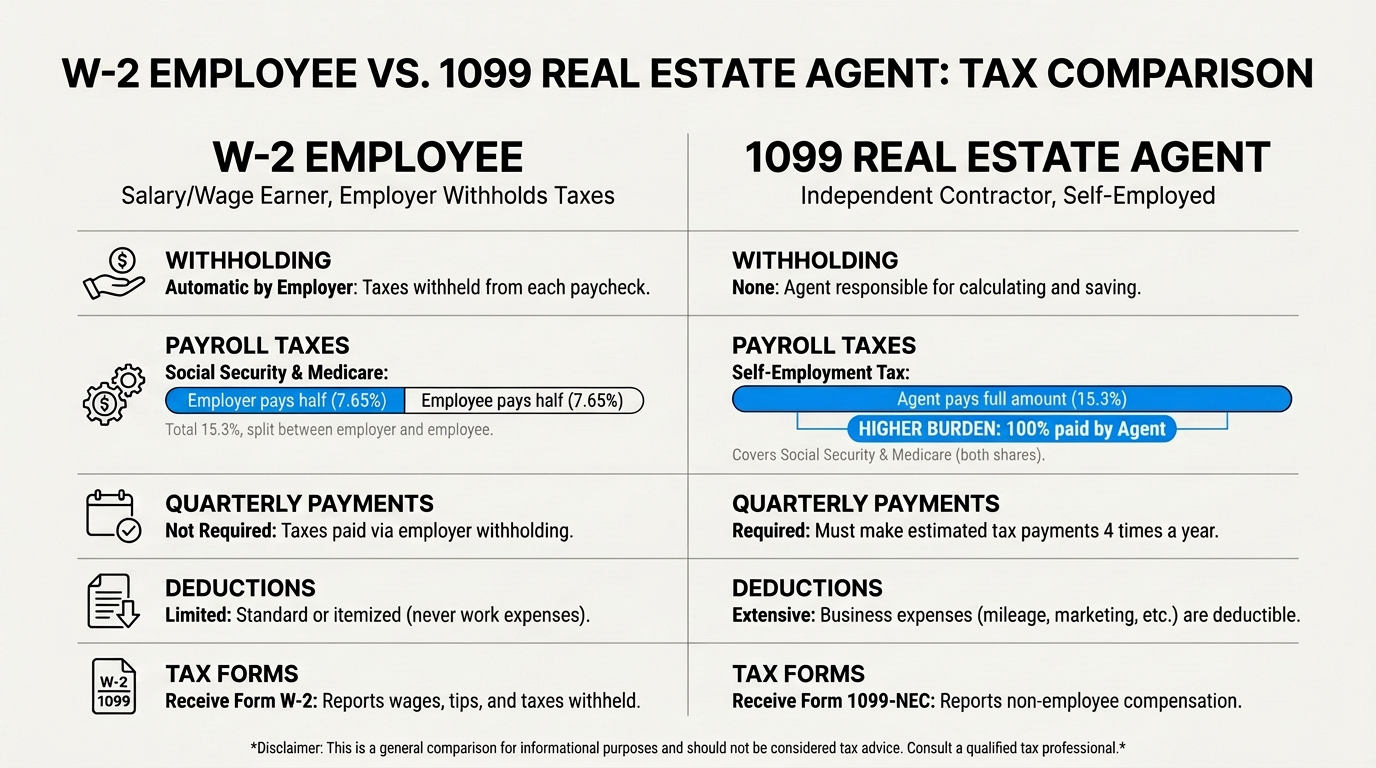
When a commission check lands in your account, there's no employer quietly handling Social Security, Medicare, or federal income tax on your behalf. As a 1099 agent, the IRS treats your commissions as business revenue, which means you owe self-employment tax at 15.3% on net income, and you're responsible for paying it on your own schedule. That's a fundamentally different tax situation than a salaried employee faces, and the gap matters more than most agents realize until April.
To make that concrete: take an agent with $85,000 in gross commissions and $12,000 in legitimate business expenses like MLS dues, E\&O insurance, and marketing spend. Net income comes to $73,000. The IRS calculates self-employment tax on 92.35% of that figure, so $73,000 × 0.9235 \= $67,416.
Apply the 15.3% rate and you're looking at roughly $10,315 in self-employment tax alone, before a single dollar of federal income tax is counted. A W-2 employee earning the same $73,000 would see only 7.65% withheld from their check; their employer covers the other half. That employer share doesn't disappear for 1099 agents — it just shifts entirely onto you.
The table below shows exactly where those differences show up across five tax issues that catch new agents off guard.
| Tax Issue | W-2 Employee | 1099 Agent |
|---|---|---|
| Who withholds taxes | Employer withholds federal income tax, Social Security, and Medicare from every paycheck | No withholding; agent pays directly through quarterly estimated payments |
| Social Security & Medicare burden | Employee pays 7.65%; employer pays the other 7.65% | Agent pays the full 15.3% on net self-employment income |
| Quarterly payments | Generally not required; withholding keeps the account current | Required four times per year to avoid underpayment penalties |
| Deduction handling | Limited deductions; standard or itemized on Schedule A | Business expenses deducted on Schedule C, which directly reduces net self-employment income and can take standard or itemized deductions. |
| Tax forms received | W-2 from employer | 1099-NEC from broker or clients; files Schedule C and Schedule SE |
Tracking deductions through a dedicated business account and setting aside a portion of every commission check aren't optional good habits for 1099 agents — they're the minimum. Everything else is cleanup.
Big decisions get easier when the numbers are clearer. Use the W-2 vs 1099 vs S Corp Calculator to explore which setup may fit your goals best.
Quarterly Estimated Taxes: Deadlines And How To Calculate
No employer is pulling taxes from your commission checks, which means the IRS expects you to send payments yourself throughout the year. Miss those payments, and you can owe an underpayment penalty even if you pay your full tax bill by April — the penalty is based on what you owed during the year, not just what you owe at filing.
The four deadlines for 2026 are:
-
April 15, 2026 — covers January 1 through March 31
-
June 15, 2026 — covers April 1 through May 31
-
September 15, 2026 — covers June 1 through August 31
-
January 15, 2027 — covers September 1 through December 31
You don't need to forecast your income perfectly to stay compliant. The IRS safe-harbor rule, outlined in Publication 505, says you avoid penalties as long as you pay either 90% of what you owe this year or 100% of what you owed last year (110% if your prior-year adjusted gross income was above $150,000). In plain terms: if you base your payments on last year's tax bill and pay on time, you're covered even if a big commission comes in late.
For a working estimate, a simple three-step method gets most agents close:
-
Estimate your annual net income — start with expected gross commissions, subtract business expenses like brokerage fees, marketing, and mileage, and use that net figure as your base.
-
Apply a combined tax rate — self-employment tax runs 15.3% on net income, and federal income tax sits on top of that; setting aside roughly 25–30% of each commission check is a reasonable starting point for most agents.
-
Divide and adjust — split your estimated annual liability across the four deadlines, then revise the remaining payments as your actual income becomes clearer through the year.
The friction with commission income is that it doesn't arrive in neat, predictable installments. A slow January followed by a strong March can leave you guessing whether you've set aside enough. That's where automating the math matters.
Lettuce calculates and pays your taxes monthly through payroll, so each commission that clears your account is already accounted for: no spreadsheet, no deadline scramble, no end-of-year surprise.
For agents managing uneven income through an S Corp, the same system keeps salary, distributions, and tax payments synchronized without manual intervention.
Tax Deductions For Real Estate Agents
Deductions are real money, but they work differently than most agents expect. A $1,000 write-off doesn't save $1,000 in taxes. It reduces your taxable income by $1,000, which means the actual savings depend on your tax rate, closer to $250 to $370 for most agents in the 25–37% bracket. Track everything carefully, but don't confuse spending money with saving money.
Here are the categories worth staying on top of:
-
Vehicle and mileage. Every client showing, open house, and office run counts. The IRS lets you choose between the standard mileage rate or actual vehicle expenses, but you need a contemporaneous log either way. A note in your phone after each drive is enough; reconstructing a year's worth of trips from memory is not.
-
MLS and board dues. Annual NAR membership, local board fees, and MLS access fees are ordinary business costs and fully deductible.
-
E\&O insurance and licensing. Errors and omissions coverage and state licensing renewal fees are standard operating costs for any licensed agent.
-
Marketing, staging, and photography. Listing ads, social media spend, yard signs, professional photography, and staging costs all qualify as business expenses under the IRS business expense framework.
-
Continuing education and professional development. CE courses required for license renewal are deductible, as are other education costs directly tied to your real estate practice.
-
Home office. If you use a dedicated space exclusively and regularly for business, you may qualify for a home office deduction. The IRS simplified method allows $5 per square foot up to 300 square feet. If you operate as an S Corp, the rules work differently; an accountable plan reimbursement is the cleaner approach. See how that works at Lettuce's home office deductions guide.
-
Desk fees, phone, and software. Brokerage desk fees, the business portion of your phone bill, and tools like your CRM or transaction management software all reduce taxable income.
Deductions belong in your tax strategy. But they trim a bill, they don't reshape it. The move that changes how much self-employment tax you owe in the first place isn't a write-off. It's your business structure.
Do Real Estate Agents Qualify For The 20% QBI Deduction?
Most real estate agents operating as independent contractors can qualify for the 20% qualified business income (QBI) deduction, but the final number depends on taxable income, filing status, and phase-out thresholds that change with your earnings. Think of it as a bonus built into the tax code for pass-through business owners: one worth understanding, but not one that replaces a real tax system.
What QBI Actually Is
QBI lets eligible pass-through owners deduct up to 20% of qualified business income from their federal taxable income. If your net income is $100,000 and you qualify in full, you'd calculate income tax on $80,000 instead. The deduction doesn't touch self-employment tax, so it works on the income tax side of your bill only.
Real Estate Agents Are Not Excluded
One detail that surprises many agents: the IRS carved out certain "specified service trades" from full QBI eligibility, but real estate brokerage is not on that list. NAR confirms that real estate professionals were explicitly not classified as a prohibited brokerage service, meaning most independent agents can claim the deduction without the SSTB restrictions that apply to, say, financial advisors or attorneys.
Income Thresholds Still Matter
The deduction starts to phase out once taxable income crosses certain thresholds, and at higher income levels, W-2 wages paid and qualified property become limiting factors. The One Big Beautiful Bill made QBI permanent, so this deduction isn't going away, but your specific benefit depends on where your income lands each year.
QBI Is an Add-On, Not a Strategy
A 20% deduction on pass-through income is real money, but it only moves the income tax needle, not the 15.3% self-employment tax that runs on every dollar of net commission income. Here's the part most agents miss: S Corp distributions count as QBI while salary does not.
So how you pay yourself, the salary-to-distribution split, directly determines the size of the deduction. That's not a quirk of the tax code. It's why the entity structure conversation has to come before the deduction conversation. QBI and write-offs trim the bill; the structure determines how large it was to begin with.
When Should An Agent Form An S Corp?
An S corp for real estate agents starts to make sense once the 15.3% self-employment tax stops feeling like a cost of doing business and starts feeling like a problem worth solving. For most independent real estate agents, that point arrives when commission income is consistently high enough that the tax savings from an S Corp outweigh the added payroll and compliance costs. That crossover tends to happen around $80,000 in net income, and the math gets more compelling the higher commissions climb.
Why the S Corp Structure Changes the Tax Equation
As a sole proprietor, the IRS taxes every dollar of net income for self-employment purposes. An S Corp splits your income into two buckets: a reasonable salary, which is subject to payroll taxes, and owner distributions, which are not. The IRS is clear that shareholder-employees must receive reasonable compensation for services, but income beyond that salary can flow out as distributions, outside the reach of self-employment tax.
What "Reasonable Salary" Actually Means
A reasonable salary is not a number you pick for maximum tax benefit. It reflects what the market would pay someone performing your role, factoring in your income, hours, and responsibilities. The IRS uses multiple factors to evaluate it, and understating wages is one of the most common S Corp audit triggers. A defensible salary sits comfortably in market range — not the lowest number you can justify.
The Before-and-After on $120,000 in Commissions
Here is what the structure change looks like in practice. As a sole proprietor with $120,000 in net income, the self-employment tax runs roughly $16,955 (net earnings × 92.35% × 15.3%). With an S Corp and a reasonable salary of $60,000, payroll taxes apply only to that salary, coming to about $9,180. The remaining $60,000 moves out as a distribution with no self-employment tax attached. That single structural shift saves roughly $7,775 — without changing how you do your job or which clients you work with.
The Right Time to Make the Move
If your commissions are consistently above $80,000 and you are still filing as a sole proprietor, you are likely paying more self-employment tax than the structure requires. See what you would save on your actual commission income at Lettuce's tax calculator, and read the deeper guide on reasonable salary, Form 2553 timing, and S Corp threshold planning before making the call.
Common Tax Mistakes New Agents Make
The number one mistake new agents make is acting like taxes are someone else's job. When a W-2 employee gets paid, taxes are already withheld. When you close a deal and collect a commission, that money arrives with zero withholding. The IRS expects self-employed individuals to pay taxes throughout the year, generally quarterly, and if you wait until April to settle up, you may already owe penalties on top of the balance due.
A few habits compound that core mistake into a much bigger cleanup project:
-
Skipping quarterly payments. Waiting until April to settle up means you're likely already carrying an underpayment penalty on top of the balance due. The IRS expects payments as income comes in, not one lump sum at filing.
-
Commingling personal and business money. Running commissions through your personal checking account makes it genuinely hard to reconstruct actual business income and expenses at filing time. The IRS recommends keeping business and personal accounts separate, and it's the single easiest step to take before your next commission hits.
-
Skipping the mileage log. You can deduct business miles driven, but only if you can document them. A missing or reconstructed log is one of the most common reasons agents leave vehicle deductions on the table, or worse, face questions on a return they can't support.
-
Ignoring state tax obligations. Federal estimated payments get most of the attention, but most states have their own quarterly requirements. Missing those carries its own penalties, separate from what the IRS assesses.
-
Treating every dollar of spending as a tax win. Deductions lower taxable income, not your tax bill dollar-for-dollar. Track them carefully, but spending more to "write it off" is not a strategy. The real difference-maker is how your income is taxed at the entity level.
If any of this sounds familiar, the cleanup process is manageable, but it's far easier to build clean habits from the start. A dedicated business account, a mileage tracking app running in the background, and an automated tax set-aside so each commission is already partially spoken for before you spend it — these three things eliminate most of what fills tax forums with regret posts every March.
The goal isn't just to avoid penalties. It's to run commission income like the business revenue it actually is, so that when tax time comes, you're confirming a number you already know rather than discovering one you don't.
FAQ
The questions below cut straight to what real estate agents working as independent contractors ask most. Each answer points you toward the next right step.
Do real estate agents file taxes as self-employed?
Yes. The IRS classifies most licensed agents as statutory nonemployees, which means you file as self-employed. You report commission income on Schedule C, owe self-employment tax on net earnings, and handle your own tax payments rather than relying on payroll withholding from a broker.
What can real estate agents write off?
Agents can deduct ordinary and necessary business expenses: mileage or actual vehicle costs, MLS and board dues, E\&O insurance, licensing and continuing education, marketing, staging, photography, client gifts, desk fees, and business phone and software. A detailed breakdown can help you track every category without missing anything.
Will the IRS consider a salesperson an independent contractor?
Generally, yes, if two conditions are met: pay is tied to sales output rather than hours worked, and a written contract states the person is not an employee. When both apply, the IRS treats the worker as a statutory nonemployee regardless of how the brokerage structures the relationship. Team leaders have additional considerations around 1099 issuance and worker classification.
Does forming an S Corp change how commissions are taxed?
It does not change your income tax rate, but it can reduce self-employment tax. As an S Corp owner, only your reasonable salary is subject to payroll tax. Distributions above that salary are not, which is where the savings come in on higher commission income.
Conclusion
The biggest tax gap for most independent agents isn't a missing receipt — it's treating commission income like a paycheck. Your commissions are business revenue — and they need their own payment system, deduction tracking, and entity strategy to stay compliant and keep more of what you earn.
Pairing smart deduction habits with an S Corp structure is where the real savings compound. Once your income supports it, splitting earnings between a reasonable salary and distributions means self-employment tax stops hitting every dollar you make. Back that up with automated tax set-asides and consistent bookkeeping, and irregular commission cycles stop feeling like a quarterly scramble.
See how the math works for your commission income at Lettuce, and if the savings don't outweigh the cost of the platform, the Lettuce-Back Guarantee means you pay nothing.
